World leaders gathered in New York City this week for the 81st meeting of the UN General Assembly at a time of increasing fragility for international humanitarian law. Latin American issues were front and center at the proceedings given the role that recent U.S. interventions in Latin America have played in highlighting contradictions in the rules-based international order and the active role played by the region’s right-wing governments in trampling over human rights. The proceedings provided a space for new leaders from the region to deliver speeches, and provided a snapshot of the material consequences of Latin America’s right-wing turn.
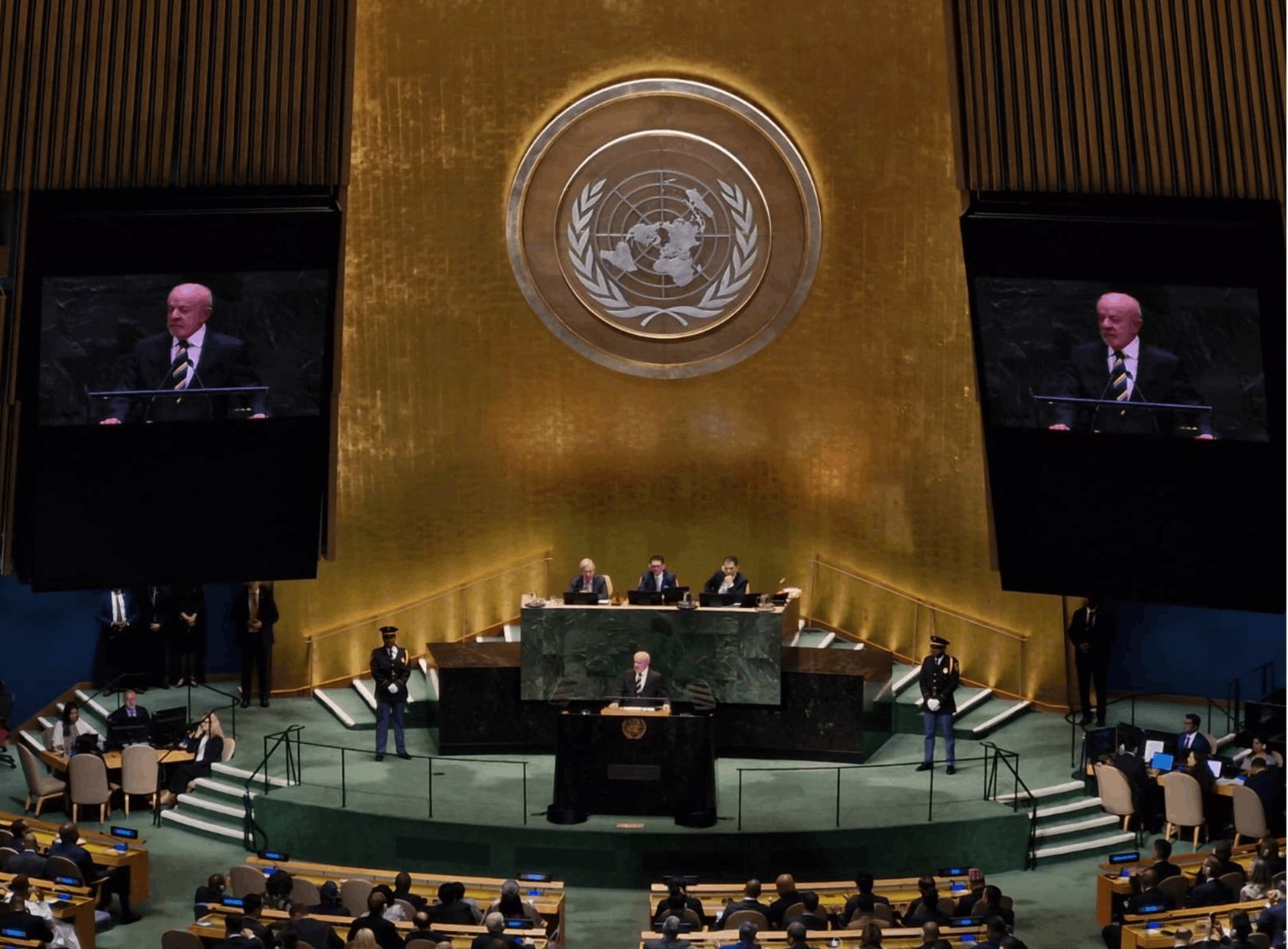
As is customary, Brazil was the first country to address the plenary. President Luiz Inácio “Lula” da Silva is currently locked in a tight presidential race with far-right senator Flávio Bolsonaro. Lula used his time at the podium to warn against foreign interference, particularly addressing the potential role for U.S. interference in the upcoming October elections. He called for the strengthening of international diplomacy, acknowledged the severity of the region’s security crisis while vowing not to outsource Brazil’s defense responsibilities, and defiantly claimed that Brazil “does not fit in anyone’s backyard.”
Trump took to the podium directly after Lula. In his remarks, he painted a starkly different vision of international order in which “might makes right” and “to the victor belongs the spoils,” the latter a phrase he used to describe the recent U.S.-Venezuela oil deal. Trump touted his approach to organized crime in the region, arguing that “the cartels are the ISIS of the Western Hemisphere” and they should be “killed”; portrayed Cuba as a threat to the region’s safety that will soon “fall”; and spoke glowingly of the January operation that led to the kidnapping of Venezuelan leader Nicolás Maduro.
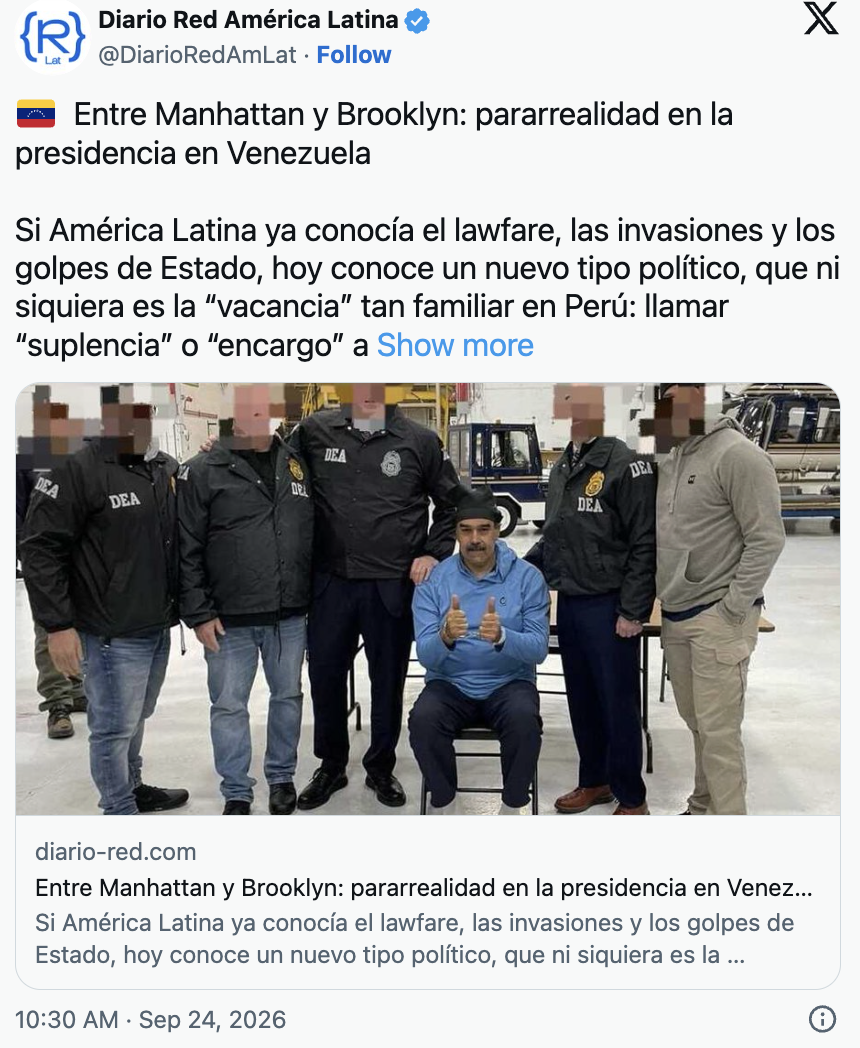
While the speeches of leaders like Chilean President José Antonio Kast and Peru’s Keiko Fujimori attested to the success of the Trump administration’s pivot to bolstering right-wing forces across the region, no leader embodied the success of the “Donroe Doctrine” more than Venezuelan Interim President Delcy Rodríguez. Her appearance in New York City was remarkable: her Tuesday meeting with Trump took place less than 10 miles from the prison where Maduro is being held. Rodríguez’ visit as the head of state was the first by a sitting leader of her country since 2018; and in her speech, she praised the Trump administration for strengthening ties with her country. While the press focused on her declaration that free elections would come soon, the fact that she did not once mention Maduro was stunning. Her transformation is even more startling given that she delivered a fiery address against sanctions and U.S. intervention at the General Assembly in 2019.
Other Latin American leaders took advantage of their time at the podium to speak on their countries’ most pressing issues. Argentina’s far-right President Javier Milei made his case for his country’s claim to the Islas Malvinas, railing against the “parasites” in the UN and threatening to take “matters into our own hands” in their dispute with the United Kingdom. A slew of far-right leaders from the region also used their speeches to call for more tough measures on criminal organizations, a call that was also made in a separate meeting of the Shield of the Americas (read below). Dominican President Luis Abinader used his speech to call for more action against gangs in neighboring Haiti; Ecuador’s President Daniel Noboa spoke of the need to restore security; Paraguayan leader Santiago Peña spoke of "transnational crime” that “knows no borders;” and, Peru’s Keiko Fujimori spoke of an ongoing “war” with an “enemy that hides amongst our people.
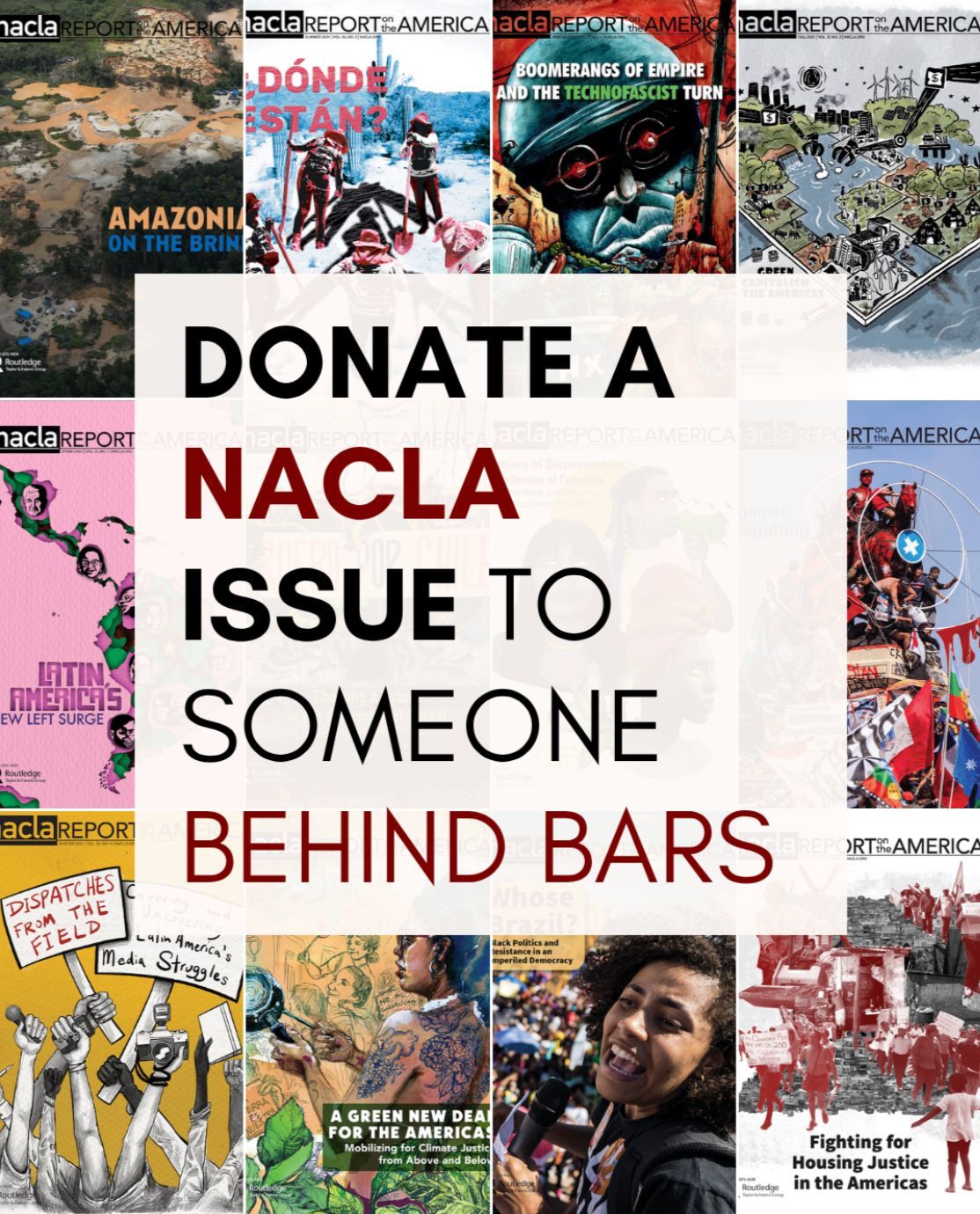
DONATE AN ISSUE OF THE NACLA REPORT TO SOMEONE BEHIND BARS
Help us donate 30 more NACLA Report issues to NYC Books Through Bars, a volunteer-run group that sends donated books to incarcerated people across the country.
NYC Books Through Bars has a standing call for Latin American and Indigenous histories, which NACLA is happy to provide. For $15, you can donate an issue of the NACLA Report to someone who has been deprived of liberty in the ever-growing U.S. prison and detention system.
Want to donate your own books or NACLA issues to a local chapter? Look up a Books-Behind-Bars organization near you!
NACLA joins progressive publications from across Latin America in Mexico City to reflect on the rise of the far right, a changing media landscape, and the possibilities of critical left journalism.
The archipelago’s current water crisis, the product of a colonial system of debt, austerity, and extraction, cannot be solved by community organizing alone ...
La llegada a Honduras del expresidente y narcotraficante Juan Orlando Hernández ha puesto a prueba las instituciones del país
IMAGE OF THE WEEK
Brazilian President Luiz Inácio "Lula" da Silva delivers the opening address for the 81st session of the United Nations General Assembly in New York City. (Lara Loaiza)
AROUND THE REGION
“SHIELD OF THE AMERICAS” MEETING—The Trump administration’s allied governments joined the president and his key staff in New York City for a meeting of the “Shield of Americas” group on Tuesday. During his remarks, he asked allied nations to formally classify the region's key criminal organizations as terrorists. Trump also pushed for stronger sanctions against criminal groups. In a joint statement, U.S. allies across the region indicated that they would soon deepen sanctions and label 25 criminal organizations as “terrorist organizations," though this remains for now a largely symbolic promise due to legal constraints in each country. Insecurity has long been a concern in Latin America. However, the “Shield of the America’s” approach has trampled over the human rights of civilians across the region. Just this week, the UN Special Rapporteur monitoring human rights in the context of counterterrorism released a report detailing how U.S. drone strikes on boats could constitute crimes against humanity. These policies have also largely failed operationally: the amount of drugs entering the United States has not meaningfully declined and right-wing crackdowns have not brought a sustained, meaningful drop in crime in many countries.
U.S. WEAPONS TO GUATEMALA—Guatemala received a shipment of weapons and military equipment from the United States on Monday, the first of a series of commercial exchanges that is set to total $5 million. Weapons sales to the country had been formally frozen since the administration of President Jimmy Carter restricted arms sales in 1977 due to the Guatemalan military’s record of human rights abuses during the country's civil war. The ban was lifted in March, after months of deepening security ties between the two countries. President Bernardo Arévalo was quick to differentiate the country’s current military forces from their predecessors. However, this was not the first delivery of military equipment since 1977. Military parts continued to flow to the country’s armed forces after Ronald Reagan partially lifted the ban in 1983 and provided U.S. training and spare parts to the Guatemalan government despite having information about the ongoing genocide of Mayan communities.
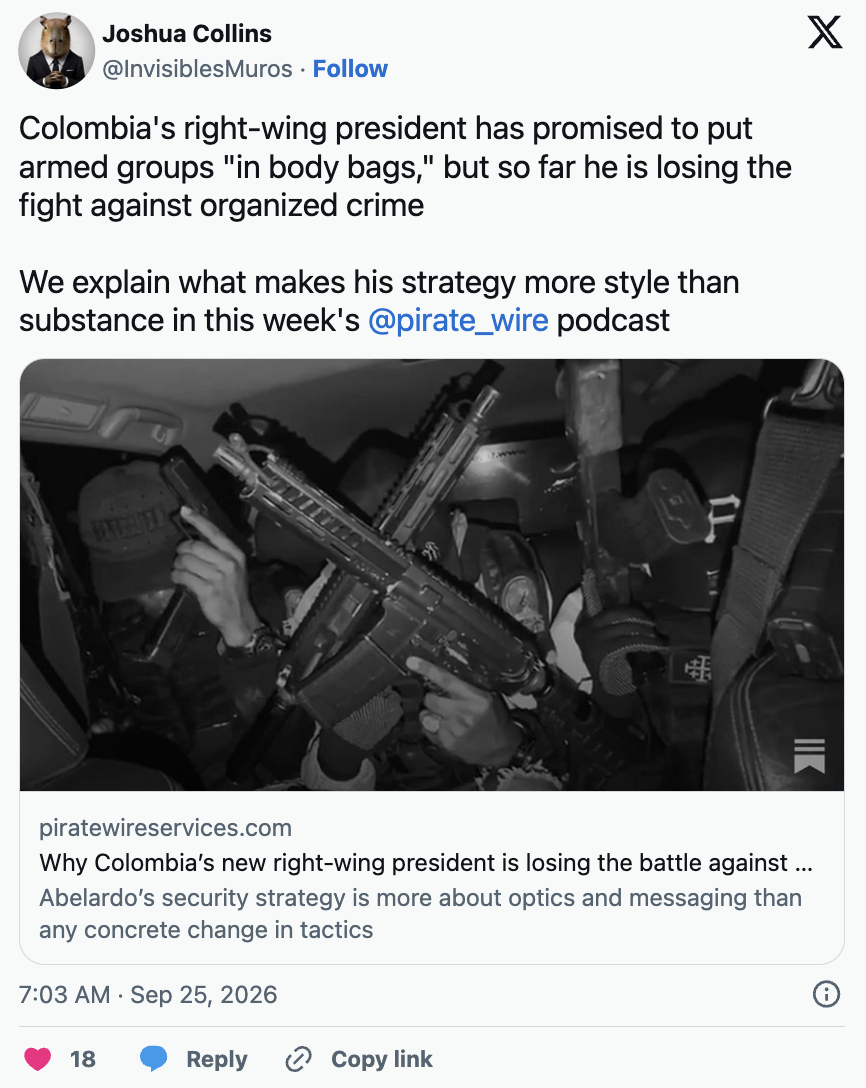
ABELARDO WITH A GUN—Colombia’s far-right president, Abelardo de la Espriella added a new feature to his mano dura propaganda videos. Early Wednesday morning, De la Espriella published a video of his visit to the city of Santa Marta, the site of a recent paramilitary armed strike, in which he is visibly armed with a pistol. The stunt came mere weeks after the president lifted restrictions on the carrying of firearms in public, prompting immediate backlash. His administration’s response to the city’s crisis, which began on Tuesday after a criminal organization shut down parts of the city and the surrounding region in response to a security operation that killed a high-ranking member on Monday, has been heavily criticized. De la Espriella militarized the city after the ACSN attacked local businesses, set cars on fire, and declared a stop to commercial activity. Troops patrolled the streets, fighter jets flew over the city, and the president himself visited affected neighborhoods. Nevertheless, the day after his visit, many businesses remained shuttered, the city remained largely dormant, and his video set off a debate about what it means for the president to carry a weapon.
MACHADO’S RETURN BLOCKED, AGAIN—Venezuelan opposition leader, María Corina Machado, tried to return to Venezuela three times within the span of 24 hours, only to fail each time. Her attempts to return the country from Panama included plans to arrive by both sea and air and were thwarted by a combination of mechanical failure and backroom diplomatic dealing—Curaçao, Aruba, and Bonaire, the Dutch islands off Venezuela’s coast refused to grant the plane carrying her authorization to land. Since U.S. forces invaded Venezuela and kidnapped President Nicolás Maduro, Machado has been sidelined by a Trump administration that has preferred to normalize relations with interim leader Delcy Rodríguez. Despite initially working to further Machado’s goals, the Trump administration has grown frustrated with her repeated attempts to enter the country, saying that she does not have enough support and arguing that the country is not yet “ready” for elections.