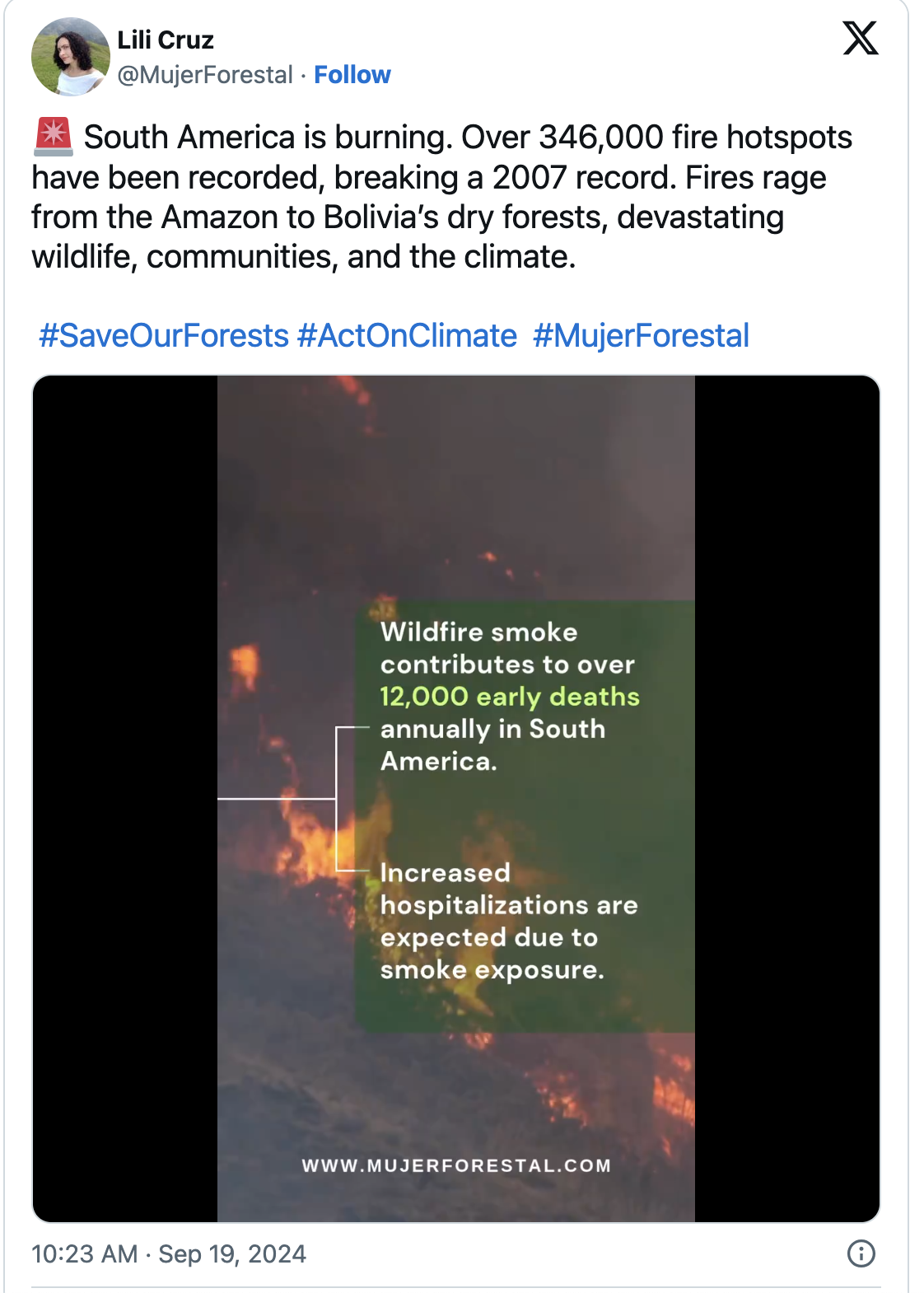
| |  | | Wildfires are burning across South America, fueled by a record-breaking drought caused by the El Niño climate phenomenon, deforestation, and climate change. The burning has been especially damaging in Bolivia, Peru, and Brazil. In Peru, fires have killed at least 15 people since July and burned more than 3,000 hectares (7,400 acres) of natural areas and cultivated land. Peruvian President Dina Boluarte declared a state of emergency in three regions affected by the burning. According to the World Resources Institute, around 61 percent of the wildfires in Peru are burning primary forests, important ecosystems that sequester carbon and maintain biodiversity. The Bolivian government also declared a national emergency due to the burning earlier this month, with the country experiencing the worst fire season in more than 20 years. Data compiled by INPE, Brazil's space research agency, shows that at least 3 million hectares (7.5 million acres) have burned in Bolivia so far this year, with some 70 percent of the burning impacting primary forests. Earlier this week, firefighters battled flames in Brasilia National Park in Brazil in efforts to extinguish a fire that had already burned 2,000 hectares (4,942 acres) of the conservation area. The burning engulfed the capital city Brasilia in smoke, with black plumes visible from several places in the city. Meanwhile, the city of São Paulo recorded the second worst air contamination in the world this week. Reuters reports that worsening drought conditions in the Amazon rainforest are “drastically altering residents’ lives.” According to the National Center for Monitoring and Early Warning of Natural Disasters (Cemaden), the current drought in Brazil is the most intense and widespread since record-keeping began in 1950. The combination of high temperatures and low humidity makes burning impossible to contain. Marina Silva, Brazil’s minister of the environment and climate change, said Sunday that the country is experiencing “climate terrorism,” referring to the fact that the vast majority of burning in the Amazon is human-caused as people clear land for ranching or farming. Since President Luiz Inácio Lula da Silva assumed office last year, deforestation in the Amazon has fallen sharply. But criminal groups that profit from deforestation have retaliated by setting off the blazes in a series of counterattacks. “These are people acting deliberately to create chaos in Brazil, setting fire to forests and people's productive activities,” Silva told media outlets in the city of São Carlos, São Paulo, on Saturday. “It’s like guerrilla warfare,” Brazil’s fire chief Victor Paulo Rodrigues de Souza told The Guardian from the frontlines of the burning in the Amazonian state of Rondônia. Illegal loggers and land grabbers have felled trees across roads and spiked the tires of fire crews to prevent them from extinguishing the fires. “In our first week here we reduced the number of outbreaks to 17 a day. But since yesterday it’s risen from 17 to 59—and today it’s over 80,” Souza said. Carlos Nobre, one of Brazil’s leading climatologists, told The Guardian that environmental criminals see Lula’s administration as “a wartime enemy,” unlike former President Jair Bolonsaro, who actively encouraged deforestation and illegal mining in the Amazon. “It’s war—they want to bring these governments down,” Nobre said. |
| |
|
|
|
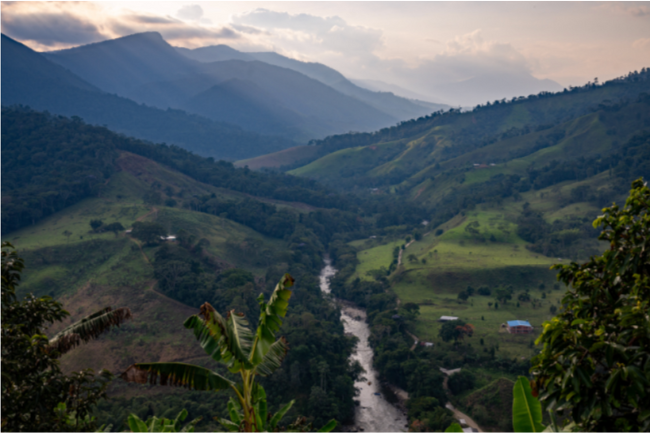
| | | | | | | |  | Rafting on Colombia's Pato River with Caguán Expeditions, formed by former FARC combatants. In June, demobilized FARC members in the Caguán region were forcibly evacuated from their homes by the Estado Mayor Central (EMC), a dissident FARC group. Alejandro Jaramillo writes for NACLA about the battle over the Cagúan region and its revolutionary legacy. Image: Alejandro Jaramillo |
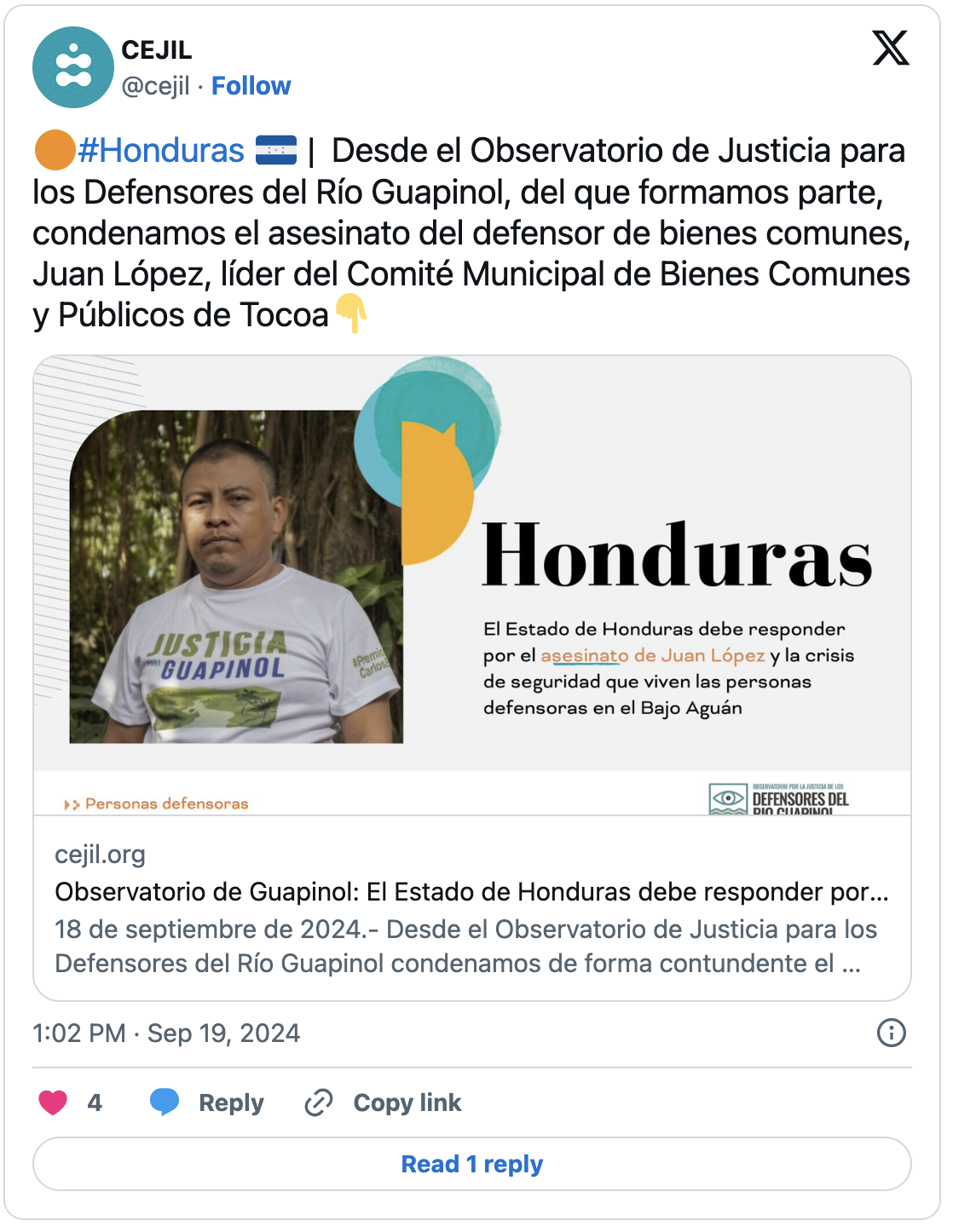
| | | - GUAPINOL WATER PROTECTOR KILLED — Honduran anti-mining activist Juan López was shot and killed on Saturday as he left church in the northeastern town of Tocoa. His killing came days after he demanded the resignation of Tocoa mayor Adán Fúnez, a member of the Libre party, over a newly surfaced 2013 video of Fúnez and politician Carlos Zelaya, President Xiomara Castro’s brother-in-law, discussing bribes with drug traffickers. López was a member of the Libre party and part of the Tocoa Municipal Committee for the Defense of Common and Public Goods, where he spent years combating mining companies. In 2022, he was interviewed in an article for NACLA on land defense in Central America, telling Giada Ferrucci and Pedro Cabezas that “during Covid-19, environmental defenders were jailed, we were locked in our houses, while mining companies kept working and profited from the pandemic.” López received multiple death threats for his activism, and had been granted the same protective measures as Berta Cáceres at the time of her killing. He helped lead the struggle to defend the Guapinol River against an open-pit iron oxide mine, and is one of eight land defenders that have lost their lives defending the Guapinol River. Honduras is one of the most dangerous countries in the world for environmental activists.
- ECUADOR TO ALLOW FOREIGN MILITARY BASES — Ecuador’s President Daniel Noboa announced in a post on X that he will seek changes to the constitution to allow foreign military bases to be established in Ecuador. The country’s constitution has prohibited the presence of foreign military bases since 2008. Noboa says Ecuador needs foreign military assistance to combat transnational gangs that use Ecuador as a transit route for drugs and other illicit activity. The United States government previously operated a military base out of the coastal city of Manta, on Ecuador’s Pacific Coast, but it was closed by former President Rafael Correa in 2009. "We are rebuilding the country that they left on its knees, the country that they turned into a cradle for drug trafficking, that they distributed to the mafias with a false notion of sovereignty," Noboa said in a video recorded from the former Manta military base. Noboa’s predecessor, Guillermo Lasso, signed multimillion-dollar military cooperation agreements with the United States last year, which Noboa ratified in February.
|
|
|
| -
SALVADORAN GOVERNMENT ESPIONAGE — An extensive investigation published by the Guatemalan outlet Prensa Comunitaria outlines plans by the Salvadoran government to spy on journalists, news outlets, and political opponents. The investigation centers on Alejandro Muyshondt, a former national security advisor to President Nayib Bukele who was arrested in August 2023 and accused of working as a “double agent.” In February of this year, Muyshondt died in state custody. In recordings obtained by journalist Hector Silva Avalos, Muyshondt is asked by Ernesto Castro, then-private secretary of the presidency and current president of the Legislative Assembly, to mount a political espionage operation targeting journalists and platforms, including Revista Factum and El Faro, that had revealed cases of corruption within the Bukele government. The recordings also reference corruption in El Salvador’s Prison Bureau and potential plans to extort public figures critical of Bukele. Silva Avalos’s investigation indicates that Muyshondt was subjected to torture, mistreatment, and poor medical care while in detention that potentially led to his death. - PROTESTERS CLASH IN BOLIVIA — Former Bolivian President Evo Morales has initiated a190-kilometer (118-mile) march from the altiplano town of Caracollo to La Paz to denounce the government of his former ally President Luis Arce. Morales has called the mobilization a “March to Save Bolivia,” as Morales and Arce engage in a bitter rivalry over who will lead the governing Movement Toward Socialism (MAS) party in next year’s presidential elections. The pro-Morales demonstrators clashed with counter-protesters blocking their way on Tuesday, injuring 13 people. The march, which is set to arrive in La Paz on Monday, is the sign of a deepening power struggle between Arce and Morales, who together oversaw the country’s commodities boom between 2006 and 2019, when Arce served as economy minister. Arce has accused Morales of trying to orchestrate a coup, and Interior Minister Eduardo Del Castillo has called the demonstration a “death march.” Amid the clashes on Tuesday, calls of “Evo, Bolivia wants you back!” were met with chants by Arce supporters: “Evo, you traitor, your time has passed.”
|
|
|
|
|
|
|
| | | North American Congress on Latin America
53 Washington Sq South, Fl. 4W | New York, New York 10012
(212) 992-6965 | [email protected] |
| |
|
| |
|
|