U.S. Secretary of State Marco Rubio took a three-day trip to Latin America this week, visiting right-wing allies in Colombia, Ecuador, and Peru. The agenda centered around security and the fight against drug trafficking, trade deals, and the Trump administration's effort to counter what they perceive as the growing threat of Chinese investment in the region. Though in large part a “victory lap” as its right-wing allies are spreading across the region, tensions and contradictions lingered under the surface as the heavy-handed maneuvers of the current administration threatened to provoke a backlash.
Rubio began his trip on Tuesday in Colombia, where he met with new far-right leader Abelardo de la Espriella. De la Espriella, a U.S. citizen, is a pro-Trump sycophant who has quickly deepened political, military, and economic ties with the United States. In addition to promising stronger security ties, the two governments reportedly signed agreements dealing with civil nuclear cooperation and the supply of critical minerals, the latter a key goal of the Trump administration. The warm relations marked a stark departure from Colombia-U.S. relations under former President Gustavo Petro, who clashed openly and frequently with Trump over issues like Israel’s genocide in Gaza, the drug trade, and boat strikes in the region. During his speech, Rubio lamented that an “unnatural distance” had grown between the two countries but vowed to usher in a “new stage” of cooperation; this sentiment was echoed by de la Espriella in his remarks.
Rubio then travelled to Ecuador on Wednesday to meet with Daniel Noboa, another key ally. He described Noboa as the Trump administration’s “most involved and aggressive partner” in its regional “antinarcotics” campaign, which has led to attacks on innocent Ecuadorian civilians at land and sea, both defended by Noboa. In the lead-up to the visit, the U.S. carried out more strikes on fishing boats off of Ecuador’s coast, including larger fishing boats that it accused of providing fuel to drug traffickers, a new tactic that lacks evidence and due process. During his remarks, Rubio defended the strikes, claiming that cartels would “eat these countries alive” if left unchecked; while he seemed to gesture at a new era of cooperating with allied countries in a way that aligned with local law, he also promised that the U.S. military retained the right to “still blow up ships.” Hours later, the U.S. carried out another strike that killed three alleged “narcoterrorists,” a designation that the U.S. also announced it would begin to apply to a leading Ecuadorian gang, Los Tiguerones.
Rubio also announced that the Trump administration would soon seek to provide $45 million in additional security funding for Ecuador, new interceptor ships, and a new $10 million initiative dedicated to tackling illegal mining. But, if a key goal was pushing its allies to cut ties with China, the Trump administration secured zero commitments; weeks ago, Noboa took an official state visit to China to deepen commercial ties and Rubio didn’t mention China in his remarks.
The Trump administration’s claim that Chinese involvement in the region constitutes a security threat to the U.S. should not be taken seriously. Even still, “the specter of China” hung most palpably over Rubio’s visit to Peru, his final stop on the tour. During his meeting with President Keiko Fujimori on Thursday, reporters asked Rubio about the growing influence of China, to which he responded that “what happens in the [region] has a direct impact on the United States.” Nevertheless, he did not mention the Chinese-backed port at Chancay, a mega-project that has drawn the ire of the Trump administration. He instead touted new security agreements with the country, though he gave no specific details; Fujimori, for her part, announced that Peru would join the Shield of the Americas. She did stress, however, that trade with China would continue.
Rubio’s visit contained glimpses of tensions that threatened to continue growing. The fact that Rubio sought to ink new trade deals pointed to the straingenerated from his administration’s pointless trade war, which has raised tariffs on goods across the region. In Colombia and Ecuador, Rubio was also grilled by the press about the government’s recent oil deal with Venezuela, a deal whose brazenly neocolonial nature has rankled people across the region. Ivan Cepeda, a Colombian opposition leader and recent presidential candidate, summed up the sentiment well on social media, casting Rubio’s visit as akin to that of a Spanish colonial official and lamenting that the surrendering of sovereign resources was being framed as “economic cooperation” and military intervention as "regional security.”
You still have a few more days to renew your subscription before our brand new issue on the 10th anniversary of the Colombia Peace Agreement goes out to Naclistas!
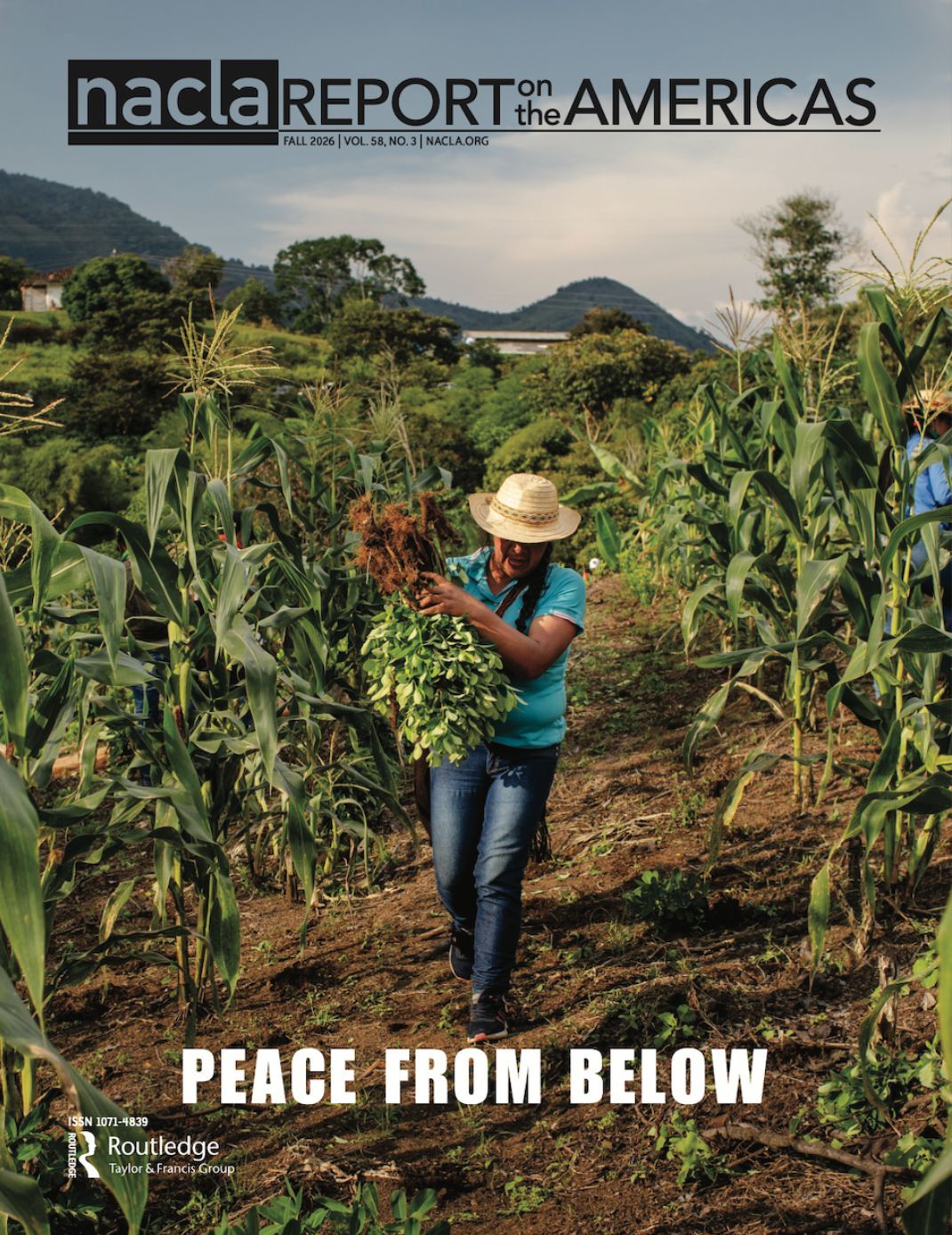
Resubscribe by Monday, September 14, to receive our Fall 2026 issue and to keep getting the NACLA Report in your mailbox every quarter.
November 24, 2026, marks the 10th anniversary of the historic Peace Agreement between the Colombian government and the Revolutionary Armed Forces of Colombia - People’s Army (FARC-EP). The Agreement promised to bring an end to over 50 years armed conflict involving Latin America's oldest guerrilla insurgency. Yet violence persists, and implementation of the 2016 accord has been uneven, incomplete, and fiercely contested.
"Peace From Below" explores the promises, achievements, and shortcomings of Colombia's Peace Agreement a decade after its signing, foregrounding the voices and experiences of those most affected by the armed conflict. As a new far-right administration threatens to roll back the gains of the peace process, this collection centers the analyses, struggles, and proposals of communities and movements working to build peace from below.
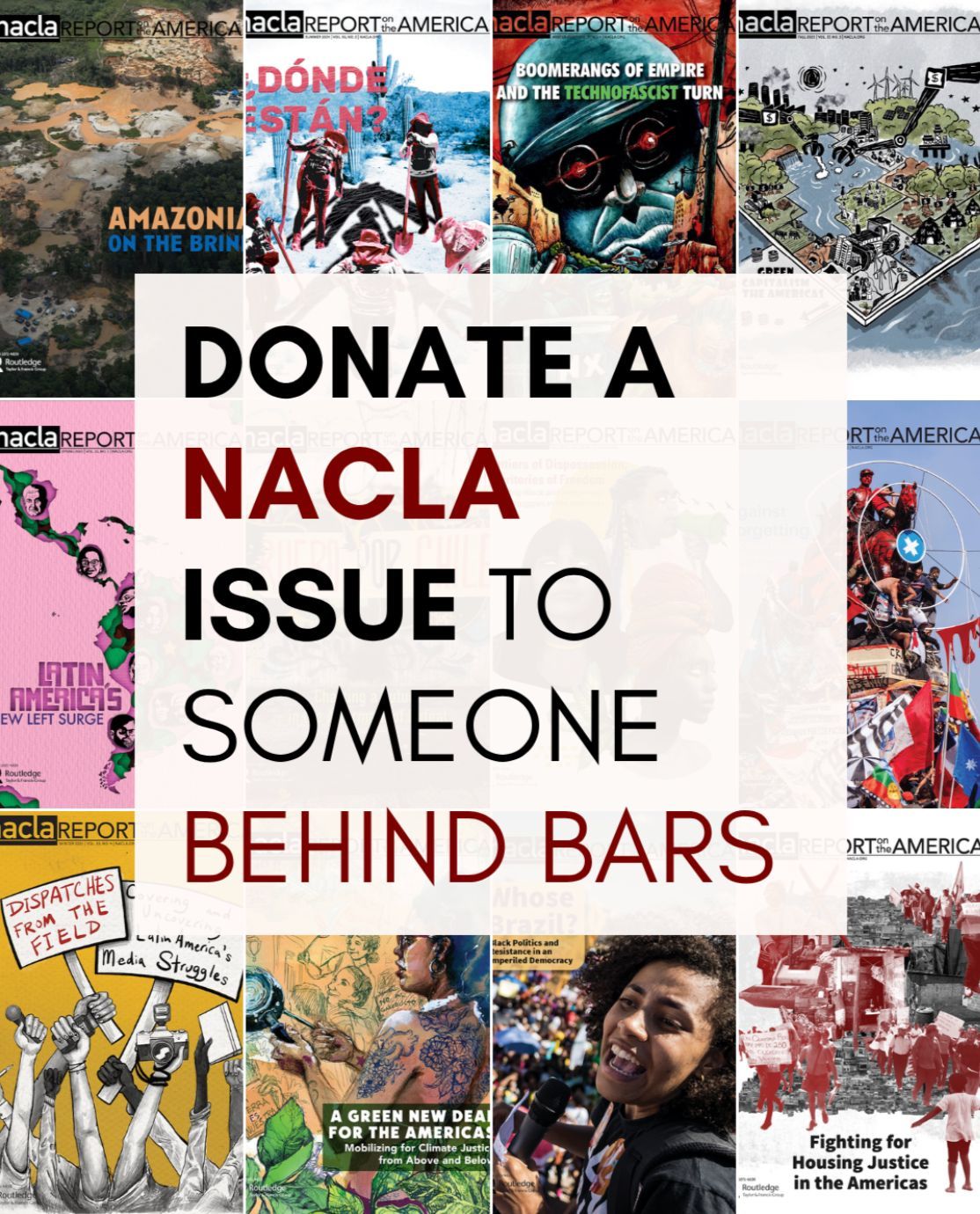
DONATE AN ISSUE OF THE NACLA REPORT TO SOMEONE BEHIND BARS
NACLA is proud to announce a new partnership with NYC Books Through Bars, a volunteer-run group that sends donated books to incarcerated people across the country.
NYC Books Through Bars has a standing call for Latin American and Indigenous histories, which NACLA is happy to provide.
For $15, you can donate an issue of the NACLA Report to someone who has been deprived of liberty in the ever-growing U.S. prison and detention system.
Want to donate your own books or NACLA issues to a local chapter? Look up a Books-Behind-Bars organization near you!
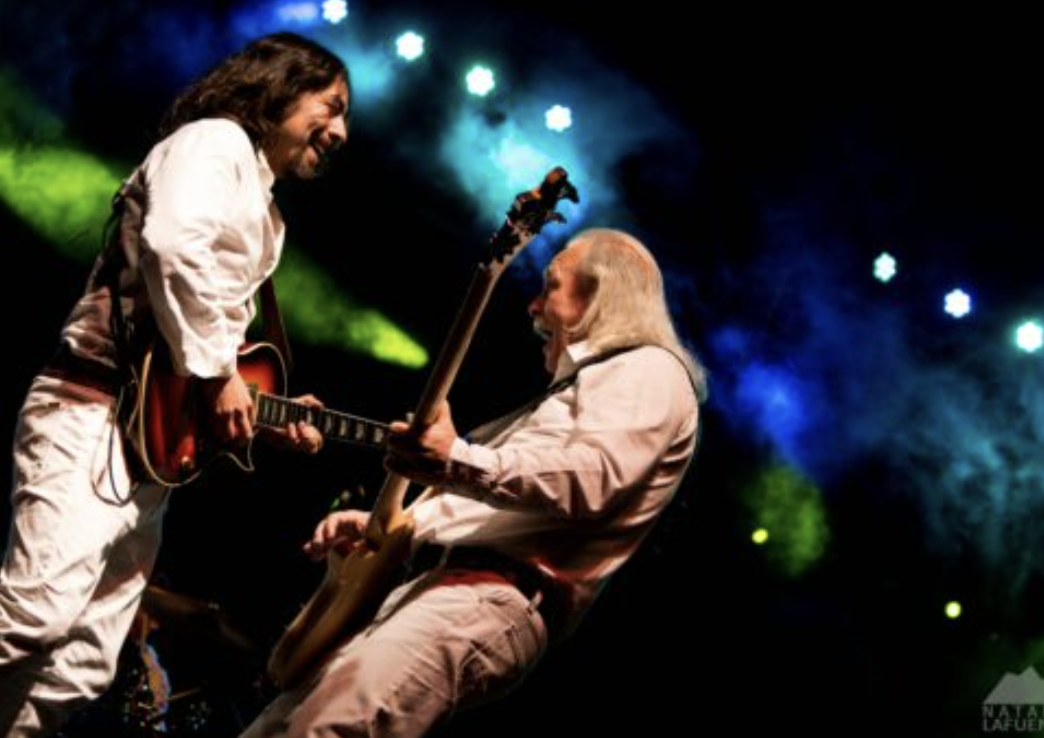
One of Latin America’s most influential bands, Los Jaivas, recently toured Alturas de Macchu Picchu, a relic of the dictatorship era whose relevance today is striking.
A South-African mining company’s lawsuit against the government in an international, pro-corporate court, exposes the insidious nature of investor-state dispute settlement mechanisms.
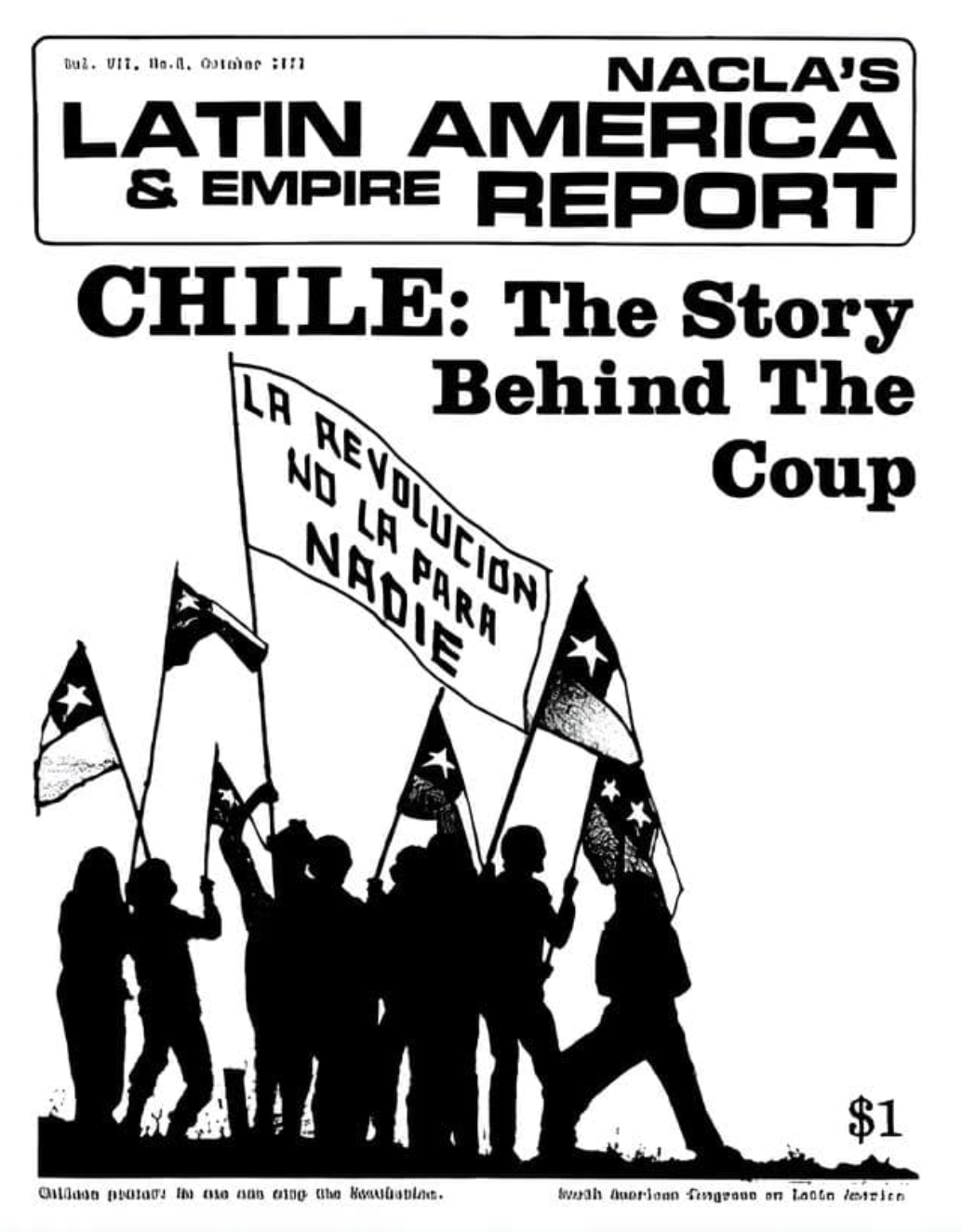
From the NACLA archive: The cover of our October 1973 issue, titled "Chile: The Story Behind the Coup." Read more here.
AROUND THE REGION
SALVADORAN TPS—The Temporary Protected Status (TPS) for more than 200,000 Salvadorans in the United States remains in the balance as a crucial deadline passed without a ruling from the Trump administration. The Department of Homeland Security (DHS) declared that it would make an announcement “at an appropriate time,” specifying that Salvadorans retain TPS protections for now. The lack of certainty caused immense concern in Salvadoran communities across the country, where people have lived for decades on TPS status after its creation in 1990. At the time, Salvadorans were fleeing their country’s brutal civil war en masse; more were granted TPS after deadly earthquakes struck in 2001. Since taking office, the Trump administration has moved to cancel TPS for at least 13 of 17 recipient nations, a policy emboldened by a recent Supreme Court ruling granting the executive the right to remove TPS protections. Many Salvadorans believed that the tight relationship between Salvadoran President Nayib Bukele and Trump would protect TPS status, though Bukele has not made a public push to save TPS and Bukele’s claim that he has solved El Salvador’s problems has led the Trump administration to treat the country as safe, a potential justification for revoking protected status.
BRAZIL’S SUPREME COURT CRISIS—The crisis in Brazil’s Supreme Court has continued to escalate. The conflict first erupted last week after justice Andre Mendonca—a conservative appointed by former President Jair Bolsonaro—unsealed documents alleging that his colleague Alexandre de Moraes had ties to disgraced banker Daniel Vorcaro. De Moraes, who became a household name after leading the coup trial of former President Bolsonaro, faced calls to resign after it was revealed that he had communicated privately with Vorcaro on numerous occasions in the immediate leadup to his arrest. De Moraes then accused Mendonca of violating protocol by meeting with Vorcaro alone; he called for Mendonca to be impeached, a charge that de Moraes himself potentially faces. Mendonca escalated his tactics on Tuesday, removing the head of the country’s federal police and its intelligence from their posts, a decision that was quickly reversed by another justice. Central to the crisis is the “Banco Master” bank fraud scandal, which has touched politicians of all stripes as the country gears up for elections in October, becoming a central issue in yet another tight race for power.
TENSIONS ESCALATE OVER ISLAS MALVINAS—Argentina’s far-right President Javier Milei announced a series of lawsuits and sanctions this week against individuals and legal entities involved in operations around the Malvinas, an archipelago in the South Atlantic that has long been controlled by the United Kingdom. Argentina has long argued that the Islas Malvinas, known in English as the Falkland Islands, belong to them. The status of the Islas returned to the agenda recently when the country’s soccer team lifted nationalist signs after their World Cup victory over England, an action that was punished by FIFA authorities. Milei has recently tried to take advantage of tensions between the United States and UK to get the Trump administration to shift from its historical position of neutrality, a strategy that has shown early signs of promise. This week, Milei announced sanctions against entities operating around the Islas, including an Israeli firm that is leading a nearby oil drilling project. Ironically, members of the Israeli government have come down firmly on the side of Argentina, a close ally, in the dispute; their call for an end to the British “occupation” came after the UK took modest steps to sanction Israel’s illegal occupation of the West Bank.
REPARATIONS FOR SLAVERY?—On Monday, a delegation led by Jamaican Culture Minister Olivia Grange travelled to Buckingham Palace to deliver a petition to King Charles that asked the British monarchy to seriously consider the possibility of providing reparations for the enslavement of its people. Charles, who is formally Jamaica's head of state, was asked by the delegation to use his authority to refer questions about slavery’s legality to the UK’s judicial council, a move that representatives hoped would give the “people of Jamaica” a “fair hearing in the British courts.” The petition is a new tactic for Commonwealth countries seeking reparations, though King Charles did not meet with the delegation and representatives of Prime Minister Andy Burnham said that the UK “will not pay reparations.” According to experts, at least 12.5 million Africans were kidnapped and sold into slavery in the Americas between the 15th and 19th century; upwards of 1 million were forcibly transferred to Jamaica between the 17th and early 19th century. The movement for reparations has been growing; a few weeks ago, a United Nations committee said that countries should be legally obligated to consider reparations and other measures due to the harm caused by the transatlantic slave trade.