| |  | | Colombians across the country participated in a massive paro nacional or national strike this week to show support for President Gustavo Petro’s stalled reforms. The mobilization went forward even as the government appeared to secure a potential victory in its fight for labor reform in the hours before the demonstrations began. Still, in a testament to protesters’ expansive vision, thousands flooded the streets over two days of mass mobilizations to defend Petro’s call for a popular referendum, denounce the country’s entrenched oligarchy, and condemn Colombia’s complicity in Israel’s genocide in Gaza. Evoking the country’s massive 2021 popular uprising, the paro nacional was convened weeks ago by labor unions, trade federations, and allied social movements to back Petro’s reform agenda. It followed a controversial vote by lawmakers to block the government’s attempt to introduce labor reform via a popular referendum—a process that Petro and his allies denounced as fraudulent. The planning of the paro reveals the evolving dynamic between the Petro administration and the progressive social movements that form its base of support. While the initial call to mobilize emerged from the grassroots, the government has actively stoked public outrage to pressure intransigent lawmakers. In recent weeks, Colombians have gathered in local participatory bodies known as cabildos to defend the reforms, heeding Petro’s call to action. The government has even encouraged more radical tactics: a journalist captured a photo of texts between Petro and his interior minister, Armando Benedetti, in which they discuss a “general strike” as the most effective path forward. As the strike gained momentum, Petro instructed the country’s security forces not to intervene in the protests. The government has sought to advance its reform agenda by way of a dual strategy that pairs congressional negotiations with calls for mass mobilization and raising the possibility of a national referendum. That approach appeared to pay off on the eve of the protests when the government’s flagship labor reform package cleared a major hurdle through a key Senate committee vote. While not yet officially law, the committee approved sweeping changes to Colombia's labor code, including significant pay bonuses for work on Sundays and holidays, expanded pay for nighttime shifts, the formalization of a 42-hour work week, stronger contracts for childcare workers, a ban on indefinite short-term contracts, and more formalized contracts for apprentices. Though some of the original proposal’s more radical provisions were stripped in the process, the bill that emerged retains meaningful structural reforms that aim to bolster protections for a workforce increasingly marked by precarity. While Colombia’s social movements took to the streets to support Petro’s reforms, many also made clear that the government was not beyond reproach. Perhaps no issue better illustrated this tension than Colombia’s ongoing complicity in Israel’s genocide in Gaza. The issue came to the forefront this week as the paro nacional coincided with the Global Day of Action Against Glencore. The Swiss mining giant—known around the world for its flagrant human rights abuses and environmental devastation—owns and operates a massive open-pit coal mine in Colombia’s La Guajira region that supplies coal directly to Israel. The obvious connections between violence against Indigenous communities in La Guajira and Israel’s assault on Palestinians in Gaza has galvanized unions, activists, and even Petro himself to center the mine as a vehicle to cut commercial ties with Israel. Even though the president has been a global leader in efforts to hold Israel accountable for its crimes—going so far as to sign a ban on the exportation of Colombian coal to Israel in August of last year— activists on Wednesday demanded more decisive action. In Bogotá, protesters blocked traffic lanes around a government tax agency with a large Palestinian flag reading “Stop the Genocide.” Holding signs that read “Energy Embargo Now!,” they demanded stricter enforcement of the coal export ban. In La Guajira, Indigenous protesters came out in force to protest the violent extraction of resources from their territories, and the use of those resources to kill Palestinians. Waving Palestinian flags and linking their struggle to the genocide, they called on the government to follow through on its promises. While the paro was a show of force that shook Colombian cities and towns across the country, key aspects of the government’s broader structural reform efforts—including those targeting health, education, and political systems—remain stalled. Still, the momentum behind labor reform suggests that the government’s strategy of leveraging mass mobilization to pressure Colombia’s intransigent elites may be bearing fruit. As the promise of another paro in early June makes clear, popular pressure will not let up until these reforms move forward. Yet the stakes are rising. As frustrations mount over the economy, insecurity, and healthcare in the lead-up to next year’s presidential elections, the left is running out of time to deliver on its promises. |
| |
|
|
|
| | | | | | | JOIN US TO CELEBRATE THE NEW ISSUE! |
|
|
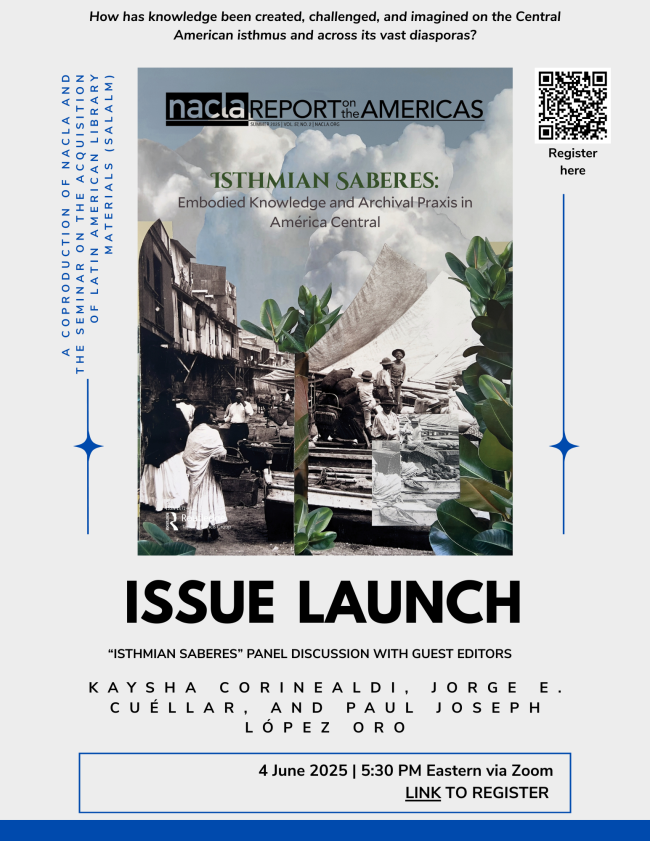
| NACLA and the Seminar on the Acquisition of Latin American Library Materials (SALALM) invite you to celebrate the launch of the Summer 2025 issue of the NACLA Report, Isthmian Saberes: Embodied Knowledge and Archival Praxis in América Central. Guest editors Kaysha Corinealdi, Jorge E. Cuéllar, and Paul Joseph López Oro will discuss the preparation of this issue and the myriad forms by which Central Americans produce the region and its knowledge systems, centering ongoing contestations over memory, history, and self-description in the pursuit of belonging and the articulation of collective futures. If you haven't already, subscribe by June 1st to get your copy in the mail. Please also consider making a donation to help sustain this work. |
| |
|
| APPLY TO BE OUR FALL INTERN! |
| |
|
| NACLA offers a 5-10 hour/week internship opportunity for students who will receive course credit and/or funding from their educational institution for the internship. This opportunity is ideal for undergraduate students with an interest in alternative media, non-profit operation, and left politics and history in Latin America and the Caribbean. Candidates seeking in-person (based in NYC), hybrid, or remote work will be considered. Internship positions are unpaid. NACLA encourages interns to seek applicable funding from their institutions of study to support their work placement. For more details on the internship, read here. To apply, please email [email protected] with a resume and a brief summary of why you are interested in working with NACLA by June 14. |
|
|
| | | | | | | | | 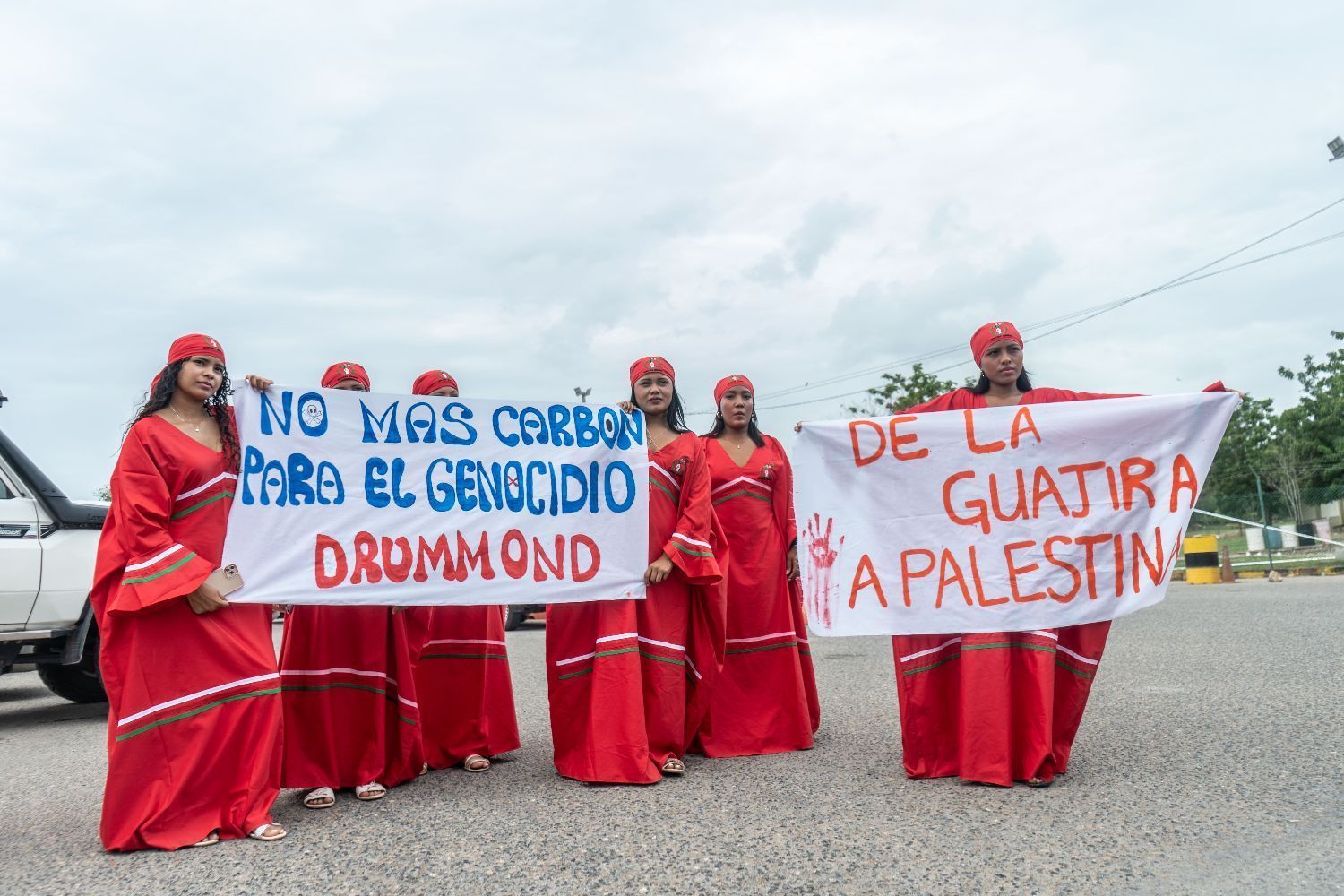 | Protesters in La Guajira on Wednesday hold signs denouncing the export of Colombian coal to Israel. The protest, which was led by the Shinyak Kashikai Indigenous movement, took place at the entrance of the Cerrejón mine, Latin America's largest open pit coal mine. Drawing direct links between violence against Colombia's Indigenous communities and the genocide in Gaza, protesters demanded the government do more to cut ties with Israel. (Lismari Machado) |
|
|
| | | -
MEXICAN JUDICIAL ELECTIONS — Mexicans will head to the polls on Sunday to vote in judicial elections for the first time in the country’s history. The elections are the result of a September 2024 law signed by then-President Andres Manuel Lopez Obrador mandating that all judges and magistrates be elected rather than appointed. The government argued that the reforms were necessary to combat corruption, nepotism, and judicial overreach. While the law’s passage provoked mass protests at the time, the government’s critique resonated with a Mexican public that was deeply distrustful of the judiciary and now supports the reform by a large majority. Still, the reform has raised valid concerns: critics warn it may not end impunity, could expand criminal influence, and risks lowering professional standards. With roughly 5,000 candidates vying for more than 840 positions,the rollout has faced logistical glitches. Nevertheless, Western media reactions have reached apocalyptic proportions, with news anchors asing if Mexico’s democracy is “dying” and think tanks decrying Mexico’s “authoritarian” turn—despite the fact that judicial elections, often along party lines, are common practice in the United States. -
VENEZUELAN ELECTIONS — On Sunday evening, a Venezuelan electoral official announced that the ruling United Socialist Party of Venezuela (PSUV) and its allies had dominated the day’s regional and legislative elections, securing a supermajority in the National Assembly and nearly every governorship. The result was not surprising, given that key opposition figures had called for a boycott. Nevertheless, the election—the first since last July, when President Nicolás Maduro claimed victory despite evidence to the contrary–took place against the backdrop of ongoing persecution of opposition figures and widespread doubts about the reliability and transparency of Venezuela’s electoral institutions. The government reported a turnout of around 40 percent, though the opposition claimed it was far lower. After the vote, Maduro called on Venezuelans to “meet again, dialogue, and have a common project as a country.” The government also noted that it will now have representation in the recently-created state of Guyana Esequiba, a state that falls in the disputed Essequibo region, an oil-rich and sparsely populated territory that the international community recognizes as belonging to neighboring Guyana. Venezuela, which elected a governor to represent the region, has claimed the region since colonial times. |
|
|
| -
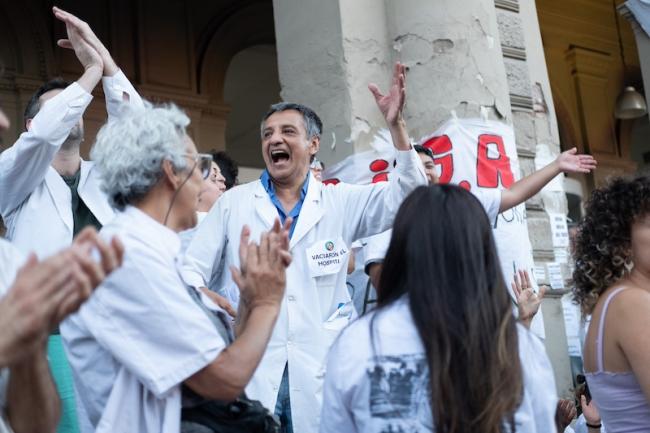
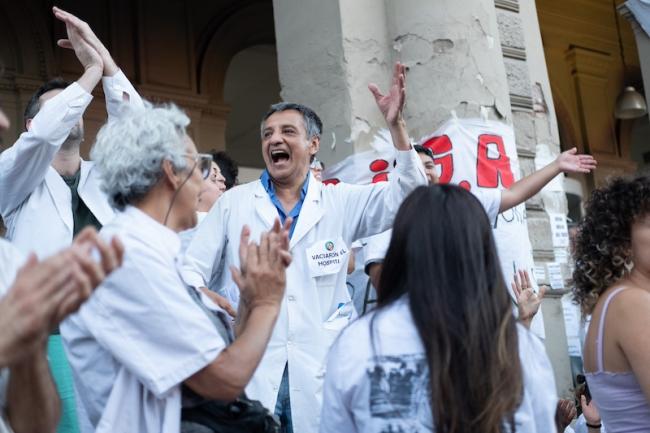
ARGENTINA’S APOCALYPTIC PROTEST — On Wednesday, hundreds of protestors from public universities and institutions took to the streets dressed as characters from Argentina’s hit sci-fi show The Eternaut to protest massive funding cuts. In cities across the country, researchers, students, and staff rallied to denounce Javier Milei’s right-wing government and condemn a program of widespread layoffs and the defunding of scientific research. Invoking an apocalyptic sci-fi show in which toxic snow brings death and destruction, protesters held signs that read “toxic snow is destroying Argentine science.” The reference to The Eternaut added a chilling layer of symbolism: the show is based on a graphic novel by Héctor Germán Oesterheld who, along with most of his family, was eventually disappeared by Argentina's military dictatorship. The choice to don costumes from the show struck a powerful chord at a moment in which Milei continues to openly downplay the violence of military rule. Since coming to power 17 months ago, Milei has implemented a radical agenda that has waged war on truth, memory, feminism, the poor, and the public sector. This week, the government announced that it has so far fired nearly 48,000 public workers. During a visit by U.S. Health Secretary Robert Kennedy, the government also ratified its decision to leave the World Health Organization. -
PANAMA’S CRACKDOWN CONTINUES — On Tuesday, Panama’s government declared a state of emergency in the Bocas del Toro province after the U.S. banana giant Chiquita laid off 5,000 striking workers in the area. The workers, who were fired last Thursday, had been on strike for more than three weeks alongside construction workers, students, teachers, and Indigenous communities in a wave of nationwide protests. What began as opposition to pension reforms has since expanded to include demands for the termination of U.S.-Panama security agreements and the permanent closure of the country’s largest copper mine. Anti-imperialist sentiment has intensified following U.S. Secretary of Defense Pete Hegseth’s April visit to Panama, during which he announced plans to station U.S. troops to the region. The opposition denounced the move as a “camouflaged invasion,” and the burning of American flags has become a common sight at protests. As the uprising has grown, so too has state repression: police raids have violently targeted Indigenous communities, universities, and trade unions. Fearing his arrest, a leading union official even climbed a fence to seek asylum in the Bolivian embassy, where his request is still being considered. |
|
|
|
|
|
|
| | | North American Congress on Latin America
53 Washington Sq South, Fl. 4W | New York, New York 10012
(212) 992-6965 | [email protected] |
| |
|
| |
|
|