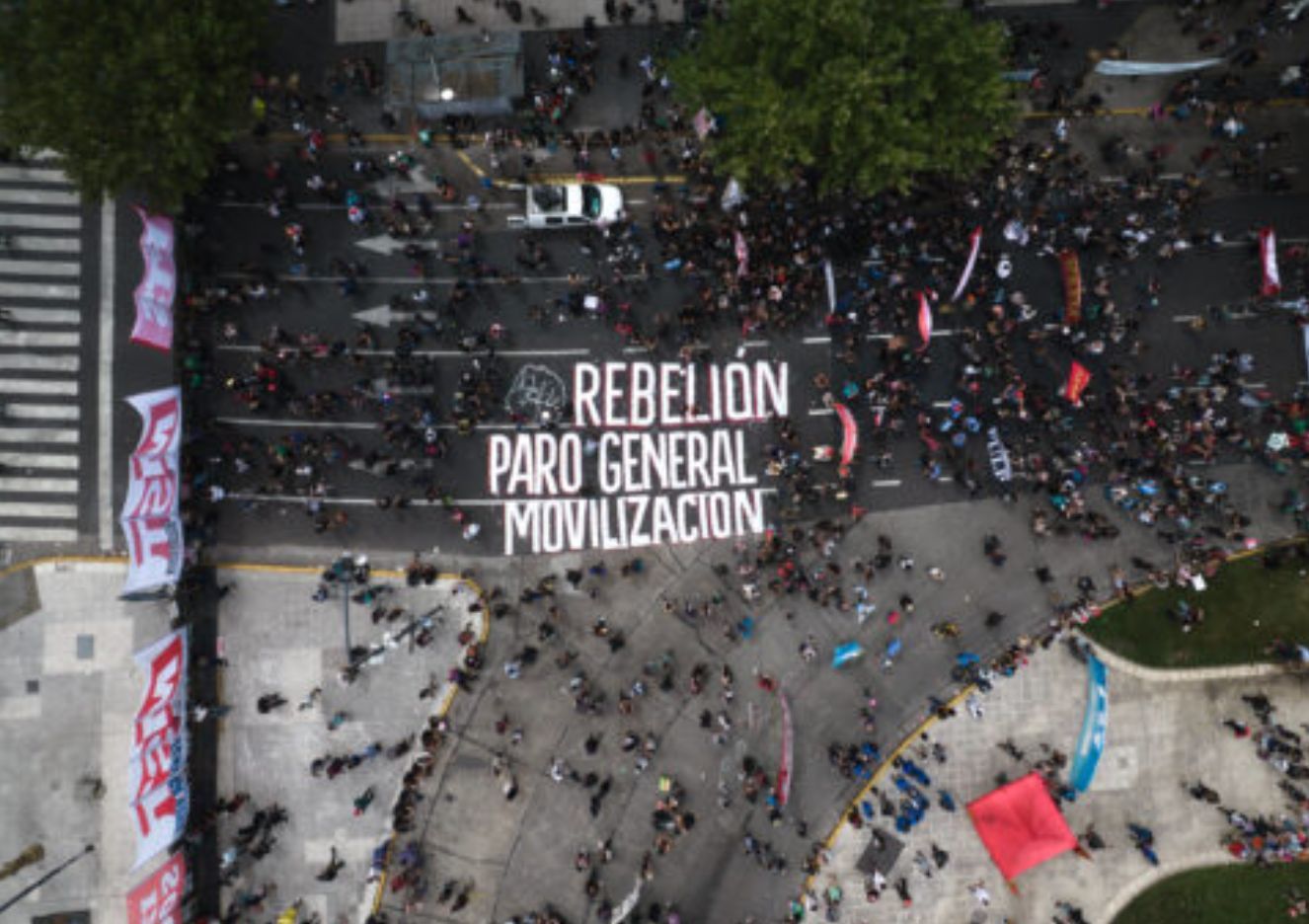
Tuesday marked 50 years since a military coup seized control of Argentina and ushered in a dictatorship so bloody its seven-year rule is often characterized as genocidal. Hundreds of thousands of Argentines marched to honor the upwards of 30,000 victims of state terror, a yearly ritual on the “National Day of Memory for Truth and Justice” that has taken on renewed urgency under far-right rule. The anniversary comes as President Javier Milei continues to downplay the dictatorship's atrocities, cuts funding for ongoing memory work, and foments a political climate of hate that runs counter to Argentina’s groundbreaking advances in memory, truth, and justice.
It is difficult to overstate the violence of the military junta that seized power on March 24, 1976. Claiming to put an end to a spiraling cycle of attacks between left-wing guerrillas and far-right government-backed death squads, the junta—headed for years by Jorge Videla—suspended Congress, banned political parties, cracked down on civil liberties, and imposed sweeping free-market economic policies under the banner of the “national reorganization process.” To eliminate any opposition to its rule, it unleashed a campaign of state terror against the left and civil society writ large that trumped even the excesses of neighboring Southern Cone dictatorships.
Truth commissions estimate that Brazil’s military dictatorship, which ruled for two decades (1964-1985), was responsible for the deaths and disappearances of 434 people, while in Chile under Augusto Pinochet (1973-1990), the dictatorship killed and disappeared around 4,000 people. In just seven years, Argentina’s military forces killed or disappeared a staggering 30,000 people, often in the most heinous ways imaginable. Coordinating repression through the U.S.-backed Operation Condor, the regime operated hundreds of clandestine concentration camps, abducted hundreds of babies from mothers in captivity and gave them away to well-connected families, and threw prisoners alive from aircraft in now notorious “death flights.” Collectively, these acts amounted to a policy of genocide.
If the excessive violence of Argentina’s dictatorship was groundbreaking, so too has been the decades-long struggle to document its crimes, find the disappeared, and hold perpetrators accountable. Early on in the dictatorship, the Mothers and Grandmothers of the Plaza de Mayo, wearing their signature white headscarves, courageously demanded information about their loved ones and made visible the pain of disappearance. Upon the return to democracy, the battle for truth continued: the landmark 1984 Nunca Más report documented hundreds of victims testimonies, eventually used as evidence in the famed 1985 “Trial of the Juntas”—the first major war crimes prosecution since the Nuremberg trials. Although impunity laws and presidential pardons limited accountability, prosecutions resumed in the early 2000s under the left-wing administrations of Néstor Kirchner (2003-2007) and Cristina Fernández (2007-2015). Amnesty laws were annulled, government partnerships with human rights groups expanded, policies of remembrance were instituted, and more than 1,200 people have since been convicted. These ongoing trials, as well as the cutting-edge forensic work of Argentine anthropologists and activists who continue to find the disappeared, have established Argentina as a global model for post-conflict peace and reconciliation.
Under Milei, however, that legacy is under threat. A panel of UN human rights experts recently warned that Argentina risks losing its status as a “global benchmark in transitional justice.” Milei has reduced state support for criminal investigations into crimes against humanity, obstructed access to official archives, pushed revisionist narratives equating left-wing violence with state terror—as he did in a public videoagain on Tuesday—cut funding for memory sites and search efforts, and flirted with pardoning military officers committed of heinous crimes.
At a massive commemoration in the Plaza de Mayo, demonstrators honored the victims while denouncing Milei’s talk of pardons, his ties to the United States, and his radical neoliberal agenda—itself a continuation of dictatorship-era policies. With dictatorship-era laws still on the books and searches for the disappeared ongoing, Tuesday’s marches were not only acts of remembrance to honor the memory of the 30,000 lives stolen, but also part of a continuing struggle to ensure that the slogan “never again” becomes a reality.
(To learn more about ongoing memory battles, read “Feminist Fútbol and Historical Memory in Argentina,” an article written this week by María Mónica Sosa Vásquez).
Since its founding in 1967, NACLA has worked to expose and oppose U.S. intervention in Latin America. In the face of lies and propaganda generated by the U.S. government, and a mainstream media often complicit in legitimizing U.S. actions, NACLA has sought to be a source of reliable information about the facts on the ground.
In this dossier of more than 30 articles, special print issues, and exclusive web series, NACLA's editors have curated a guide that touches on some of the most salient issues in recent Cuban history, including six decades of U.S.-led war, Cuba's role on the global stage, the Obama ‘thaw," the July 11 Protests, the role of the diaspora, and more.
The announcement of a permanent FBI office in Quito is the latest iteration of the U.S. using security cooperation to intervene in the country’s domestic politics.
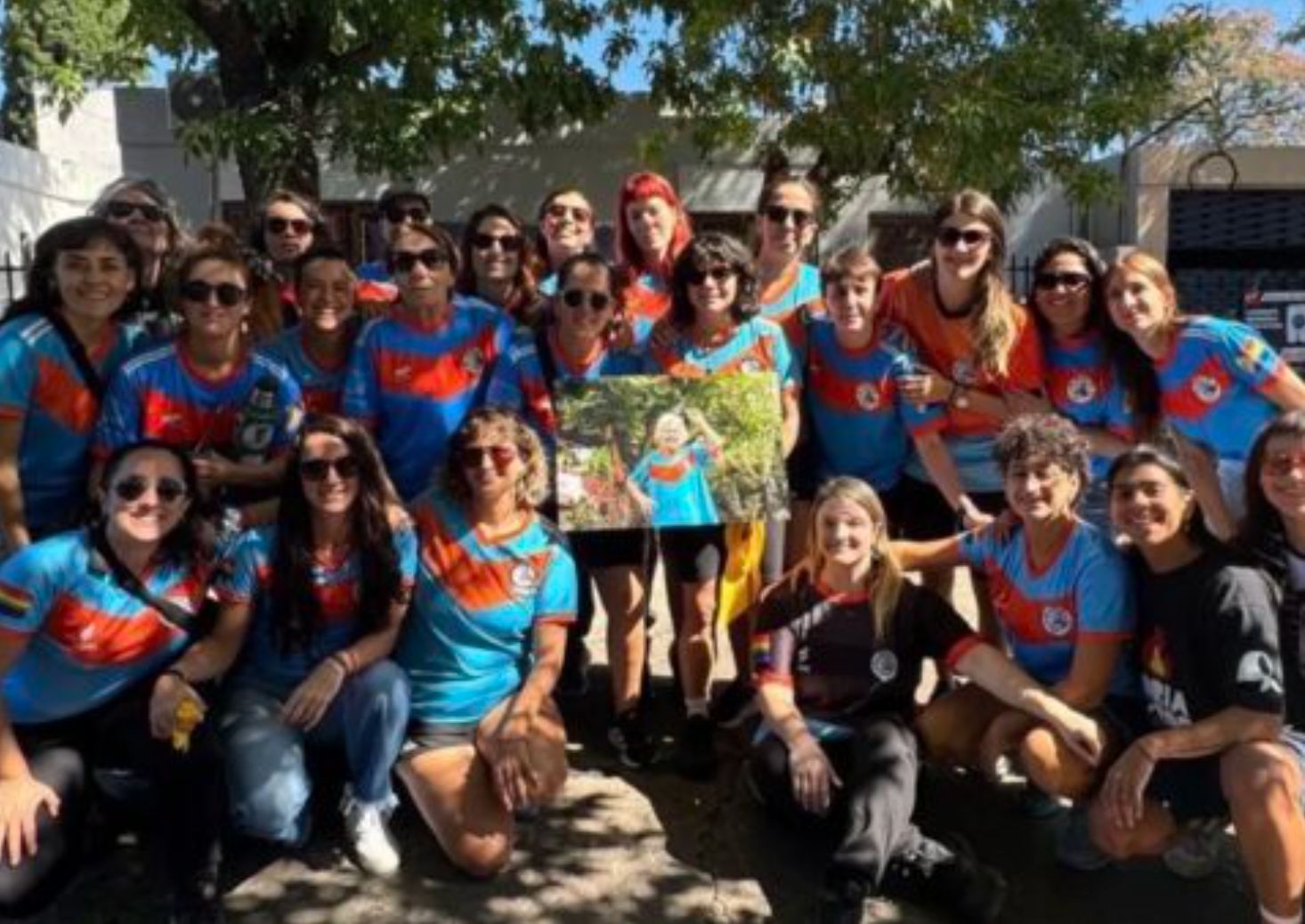
As Argentina marks 50 years since the beginning of its last bloody dictatorship, a feminist fútbol club in Buenos Aires keeps the memory of the disappeared alive as the government
La reciente decisión de la Organización Mundial de la Salud de rechazar la reclasificación de la hoja de coca supone un nuevo fracaso a la hora de comprender la importancia cultural de esta planta.
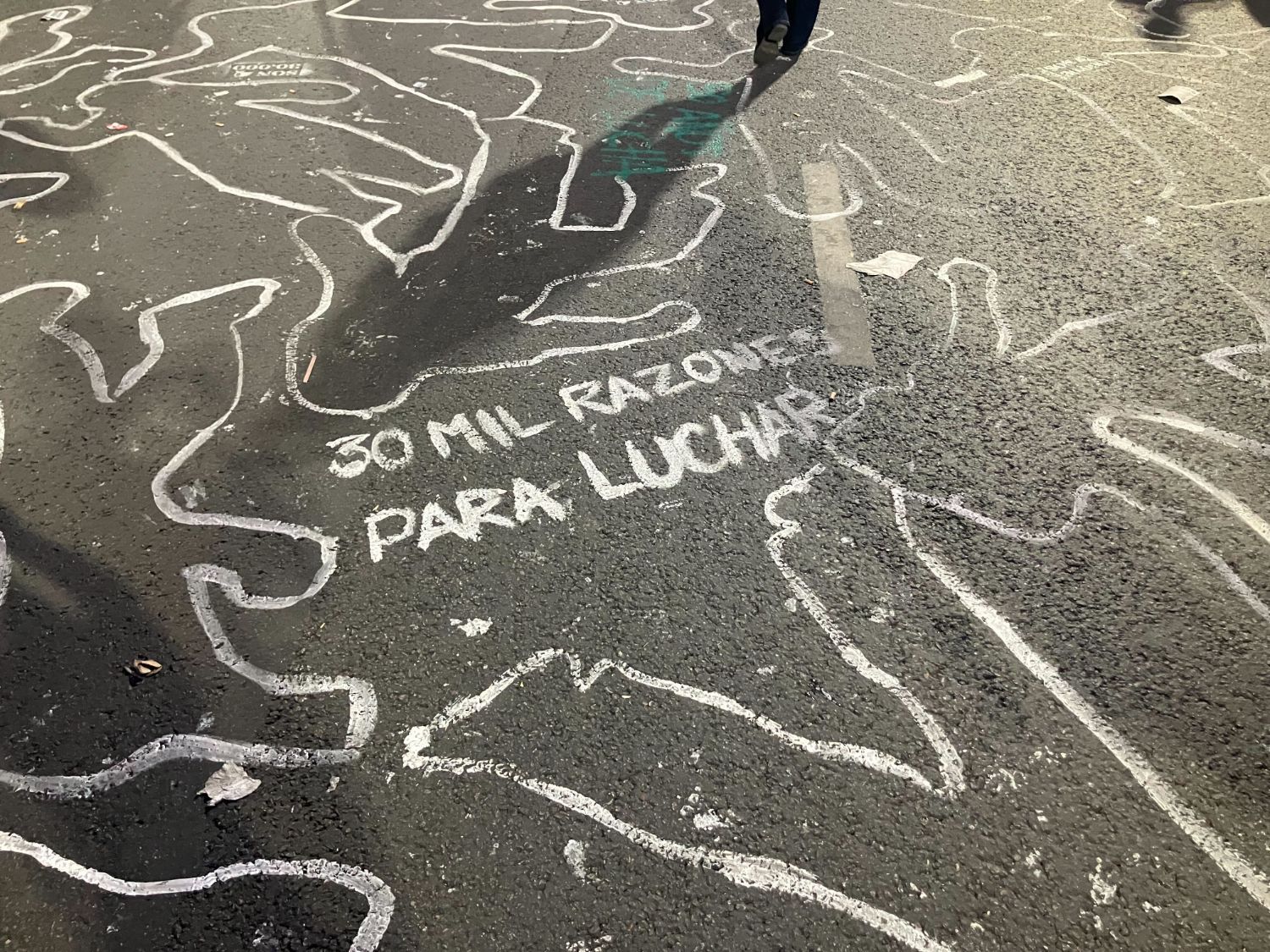
Street art in Buenos Aires honoring the victims of Argentina's military junta. The art reads, "30,000 reasons to fight," a reference to the staggering amount of people disappeared by the dictatorship. To learn more about ongoing memory battles, read “Feminist Fútbol and Historical Memory in Argentina,” an article written this week by María Mónica Sosa Vásquez. (Photo: Gabe Levine-Drizin)
AROUND THE REGION
CUBA BLACKOUT—Cuba’s beleaguered power grid collapsed again on Saturday, plunging the island into darkness for the second time in a week. The blackout occurred as hundreds of activists from the Nuestra América Convoy arrived in the country with solar panels, medicine, and food. Members of the humanitarian convoy, who continued arriving this week, hoped to demonstrate their solidarity in the face of an illegal U.S. blockade that has forced Cuba to go three months without fuel. The strength of the U.S. commitment to enforcing its oil blockade may soon be tested, however, as a Russian tanker ferrying as many as 730,000 barrels of oil—enough to power the island for weeks—appears set to arrive in Cuba. Meanwhile, the Cuban government continued to offer up concessions to the Trump administration to end its siege. It announced that it would consider offering compensation to Americans who had their property nationalized after the 1959 Revolution—as it has already done with a number of other countries—and offer unprecedented opportunities for American investment in exchange for sanctions relief and an end to the blockade.
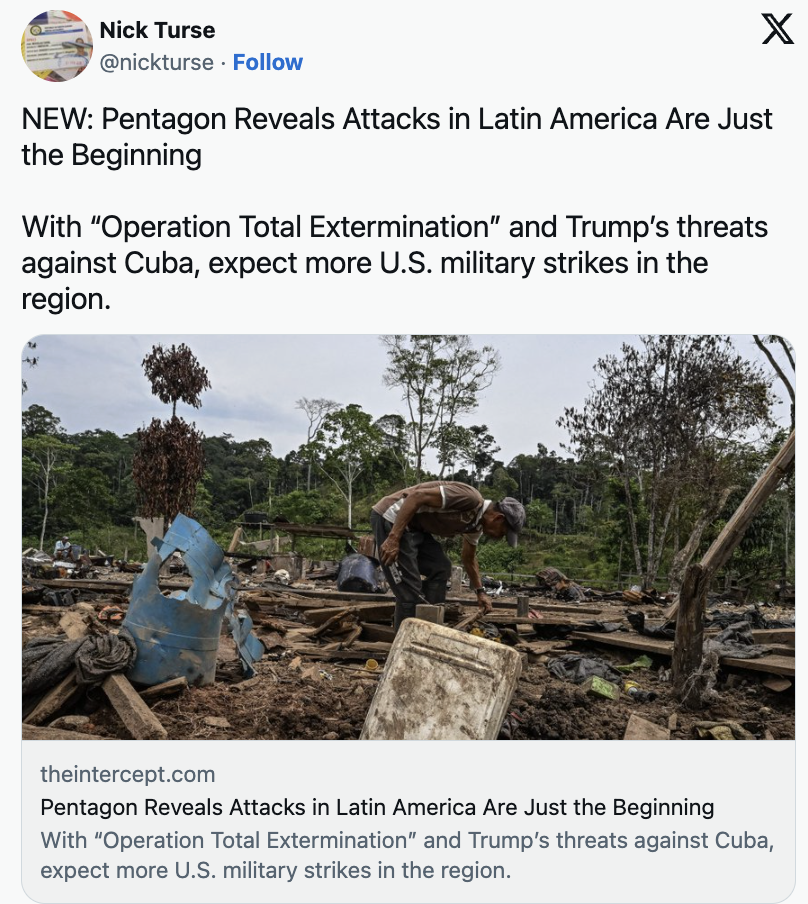
DETAILS ON U.S.-ECUADOR STRIKE—A U.S.-backed Ecuadorian anti-narcotics operation, which included the first public instance of the Trump administration “bombing Narco Terrorists on land,” targeted farmers with no ties to organized crime. According to residents of San Martín, a village along the border with Colombia, the joint mission known as “Operation Total Extermination” did not bomb an armed group “encampment,” but rather the homes of farmers. The March 6 bombing, publicly touted by the Trump administration, was the culmination of a nearly week-long operation in which Ecuadorian troops terrorized local residents. Soldiers allegedly burned the homes of local farmers, dropped more bombs in the area, and abducted four workers who were accused of being guerrilla fighters, subjected to torture, and told they would be killed if they spoke out. The operation was carried out the same week that the Trump administration implored Latin American leaders to rely more heavily upon military force to battle the region’s criminal organizations—and threatened to do so without their approval if collaboration faltered. The mission was heralded as a model of U.S.-backed land strikes against alleged criminal organizations, a tactic that is reportedly set to expand widely in the months ahead.
PETRO UNDER INVESTIGATION—Colombian President Gustavo Petro is reportedly under criminal investigation by U.S. federal prosecutors for his alleged ties to drug traffickers. Two separate investigations in Manhattan and Brooklyn are in their early stages and may not result in criminal charges, though he has reportedly been designated a “priority target.” Even still, news of the investigations have raised fears that the Trump administration may radically escalate its attacks on Colombia’s leader. Though tensions between the two have cooled in recent weeks, Trump previously called Petro an “illegal drug leader,” sanctioned him, revoked his visa, and declared that military action against Petro “sounds good” to him. Federal charges have been increasingly used as a tool by the Trump administration to pursue regime change: U.S. officials cited the indictment of Venezuelan President Nicolás Maduro as justification for his kidnapping and then warned interim leader Delcy Rodríguez that she, too, would be indicted if she fell out of line.
MADURO TRIAL—Nicolás Maduro and Cilia Flores, President and first-lady of Venezuela until their kidnapping and transport to the United States in early January, returned to a Manhattan courtroom on Thursday for the second time to stand trial on multiple charges, including drug trafficking. Up for discussion during the hearing was whether the U.S. was illegally blocking the two from using money from the Venezuelan government to pay their lawyers, an argument aired by the defense to which the judge seemed sympathetic—though he stopped short of dismissing the charges against the two, ruling instead that the case may move forward. Maduro and Flores, who both pleaded not guilty to their separate charges on January 5, have been held at Brooklyn’s notorious Metropolitan Detention Center for more than 80 days, a jail heavily criticized for its inhumane conditions, including a heavy reliance on solitary confinement. As the procedural hearing occurred, supporters and opponents of Maduro rallied outside; in Caracas, hundreds gathered in the morning to demand the return of their president.