Millions of Cubans were left without power on Wednesday after a massive blackout plunged two-thirds of the country—including Havana— into darkness. The blackout highlighted the mounting strain on Cuba’s energy system amid intensifying pressure from the Trump administration. Cuban President Miguel Díaz-Canel announced the prospect of major reforms in a speech this week, though details were sparse and his political future looks increasingly uncertain as Washington escalates its campaign against the island.
Though blackouts are a frequent cause of protest, Cubans have grown grimly accustomed to them. Wednesday’s outage—the second nationwide crisis in three months—was spurred by the shutdown of a thermometric power plant following a boiler leak. Last year, the island was hit by at least five blackouts. While the country’s economic crisis is complex, the collapse of its energy system largely stems from crippling U.S. sanctions that have left the government unable to upgrade its aging infrastructure. In recent months, a tightening U.S. oil blockade has dramatically worsened the situation. Since Trump’s January 29 threat to impose tariffs on any country supplying oil to Cuba, imports have fallen to nearly zero. Because more than 80 percent of the country’s electricity is generated from oil, the shortfall has intensified blackouts while disrupting the medical system and the supply of food and clean water.
Facing mounting pressure, including direct demands for reform from Washington—Díaz-Canel announced a slate of potential changes during a meeting of the Council of Ministers on Monday. He called for the “most urgent and necessary transformations to the economic and social model,” including greater economic autonomy for municipalities and private businesses, foreign investment in the energy sector, and a “resizing of the state apparatus.” Many analysts greeted the proposals with skepticism, arguing that the reforms would have little impact and were meant more as a signal to the Trump administration than a concrete shift in policy. Still, the government moved quickly to implement at least one measure: on Tuesday, Cuba’s Official Gazette published a decree allowing for the creation of public-private partnerships. The new legal framework would permit small and medium-sized businesses to formally operate and partner with the state through entities described as “mixed limited liability companies,” representing a loosening of longstanding restrictions on private property, though questions remain as to how the system will operate.
Even so, the reforms may not be enough to keep Díaz-Canel in power. The Miami Herald reported Wednesday that the Trump administration may be seeking a change in leadership because it sees Díaz-Canel as both too ideological and too weak to guarantee the implementation of reforms. Trump’s recent suggestion that the United States could carry out a “friendly takeover” of Cuba, as well as ongoing negotiations between Secretary of State Marco Rubio and the grandson of Raul Castro, suggest that Díaz-Canel could be sidelined.
Still, the intrigue surrounding these discussions should be treated cautiously. As the deadly U.S. attacks on Venezuela and Iran demonstrate all too well, the Trump administration has often used negotiations as a ploy to cover up impending military moves. While an intervention in Cuba appears unlikely given the concentration of U.S. forces in the Middle East, the attacks on Iran have heightened fears on the island that Cuba could be the next. Senator Lindsey Graham, a Trump ally and supporter of the Iran attack, hinted as much during an interview on Sunday. “Cuba is next,” he said. While bluster is a part of the playbook, the administration’s increasingly aggressive posture indicates these threats must be taken seriously. On Thursday, Trump suggested his administration will turn its attention back to Cuba after operations in Iran, telling reporters that it was “just a question of time.”
Since its founding in 1967, NACLA has worked to expose and oppose U.S. intervention in Latin America. In the face of lies and propaganda generated by the U.S. government, and a mainstream media often complicit in legitimizing U.S. actions, NACLA has sought to be a source of reliable information about the facts on the ground.
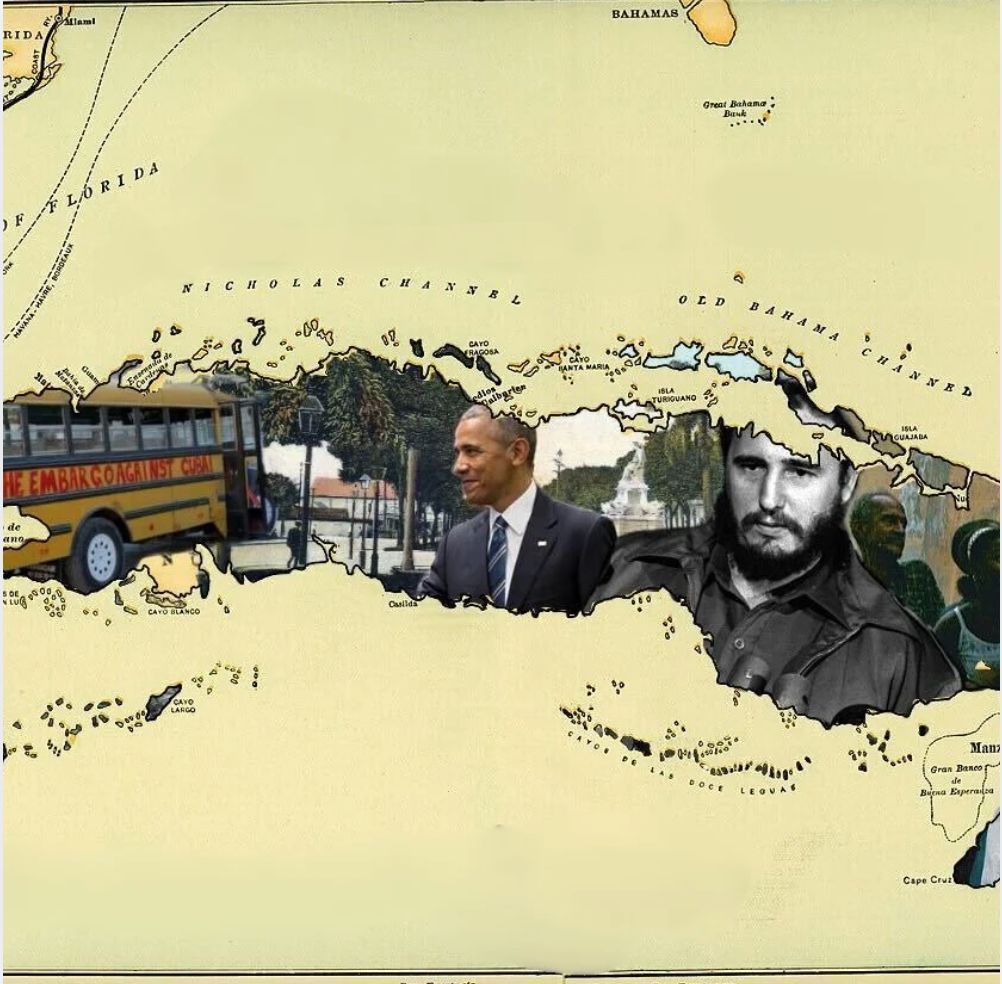
In this dossier of more than 30 articles, special print issues, and exclusive web series, NACLA's editors have curated a guide that touches on some of the most salient issues in recent Cuban history, including six decades of U.S.-led war, Cuba's role on the global stage, the Obama ‘thaw," the July 11 Protests, the role of the diaspora, and more.
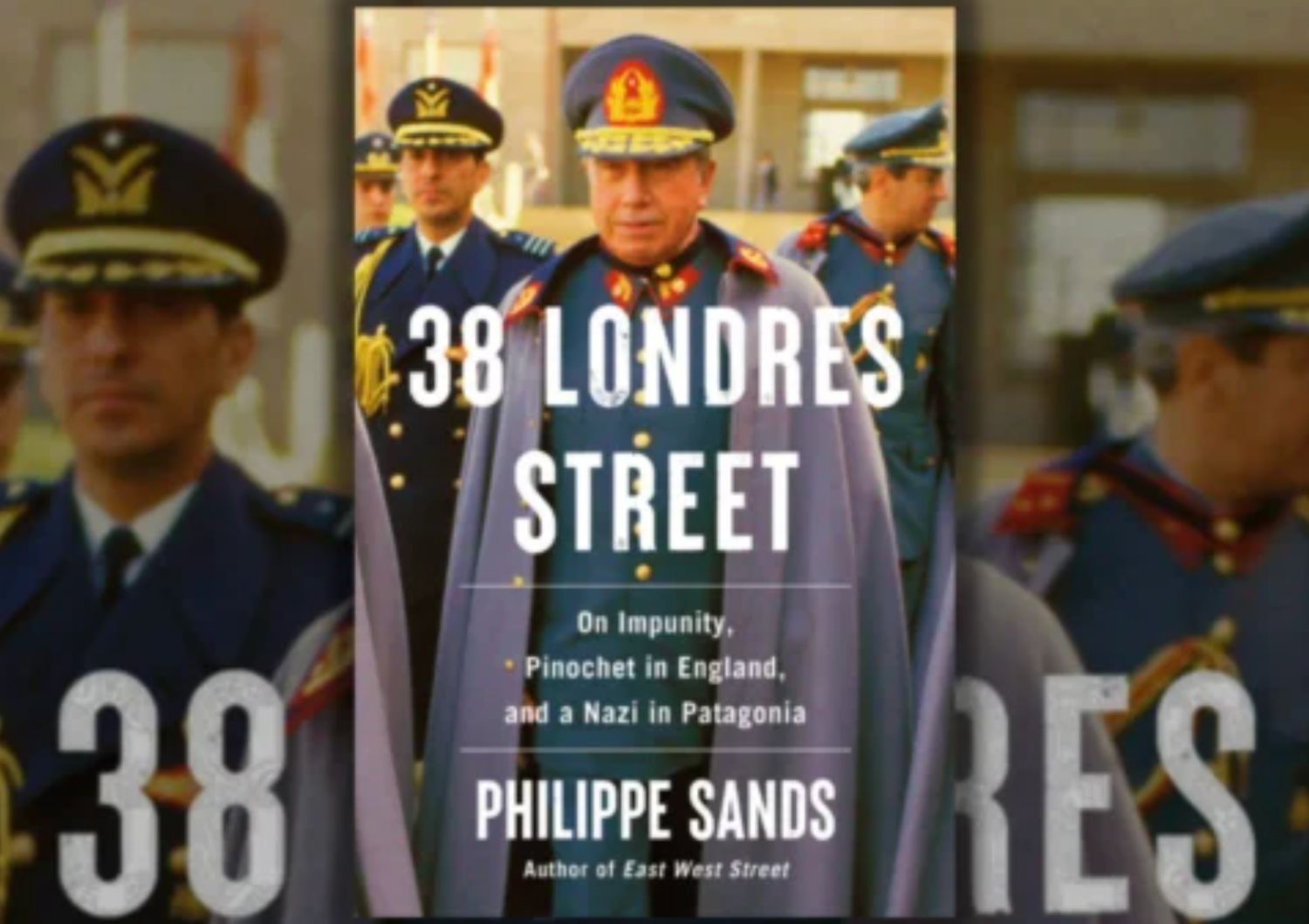
Philipe Sands’ book on the attempts to hold a Nazi leader and Chilean dictator accountable provide lessons for today’s era in which the flouting of international law has become routine.
A wave of violence inside and outside prisons drew attention to President Bernardo Arévalo's fragile political balancing act between the gangs and a corrupt political class.
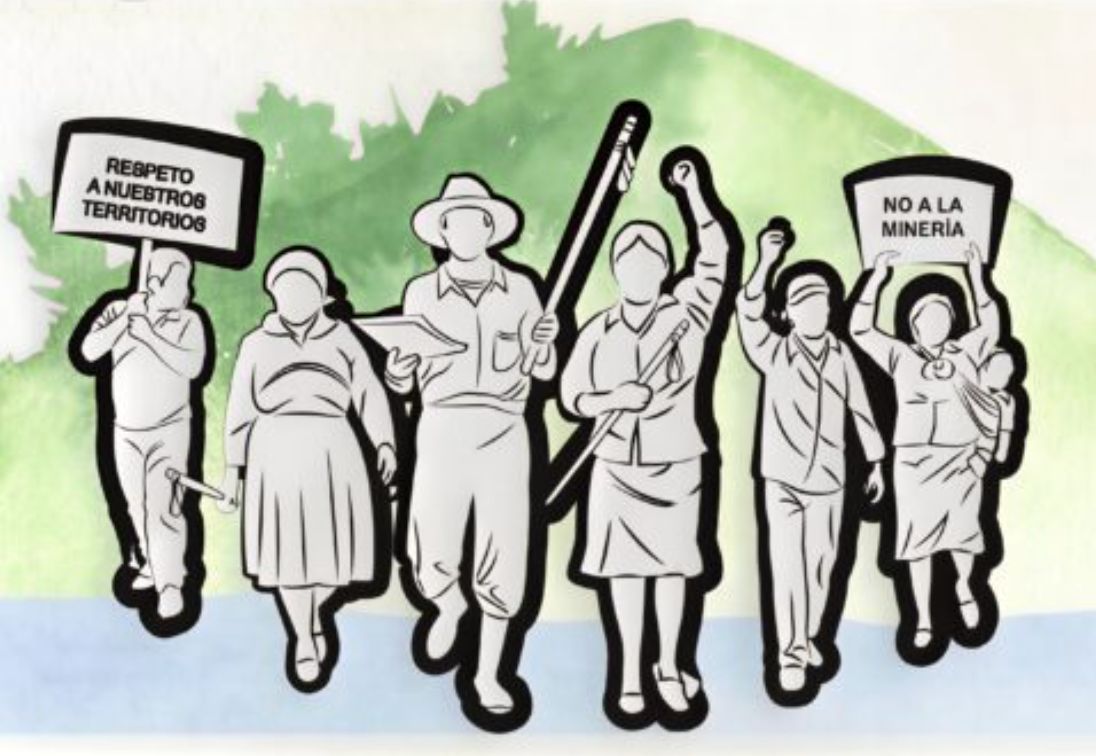
Targeted with death threats, violence, and bogus legal charges, Ch’orti’ people are still fighting to permanently close a mining project that has polluted their lands.
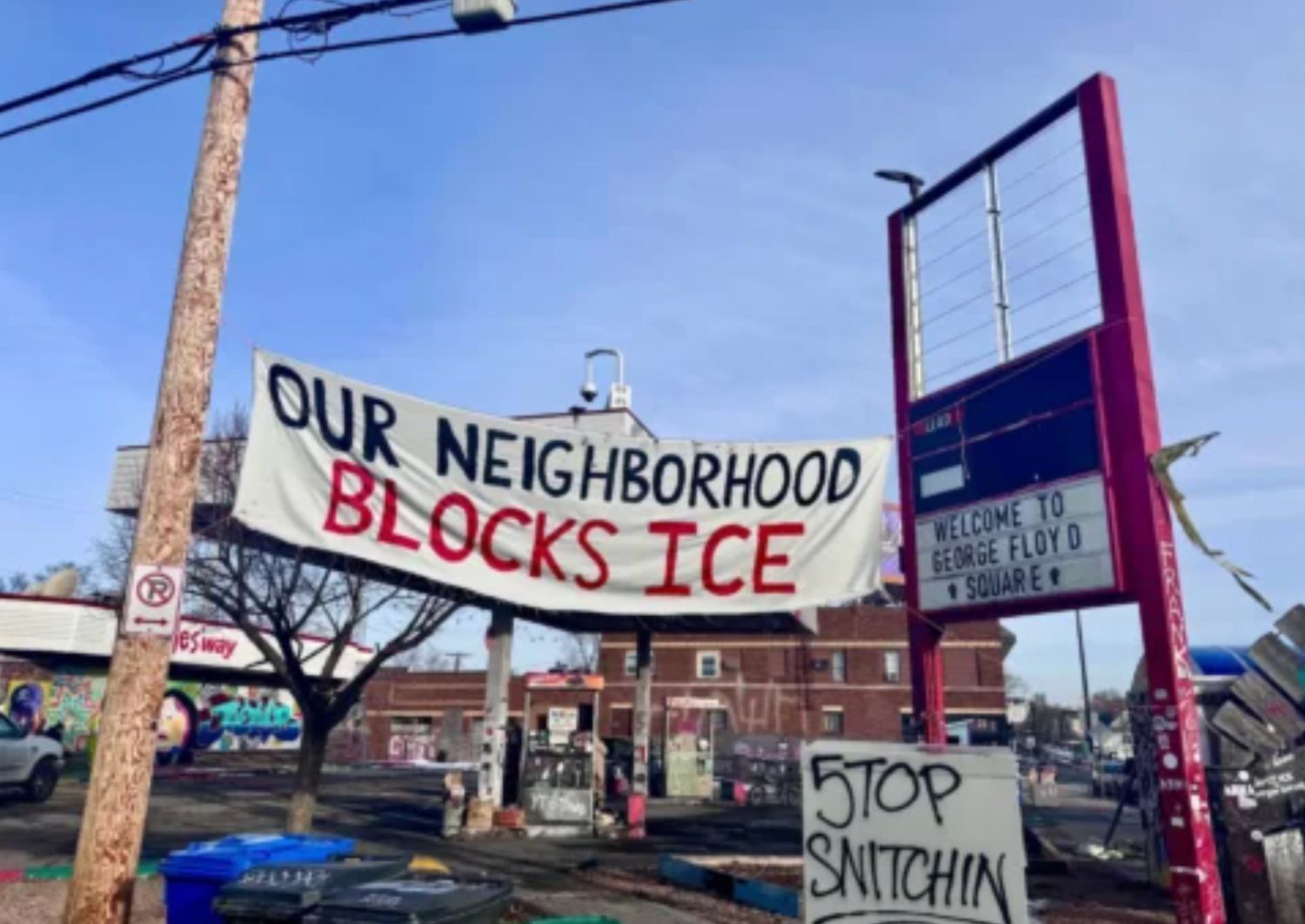
From rapid response networks to labor strikes and tenant organizing, how anti-ICE organizers built a mass movement in the Twin Cities.
IMAGE OF THE WEEK
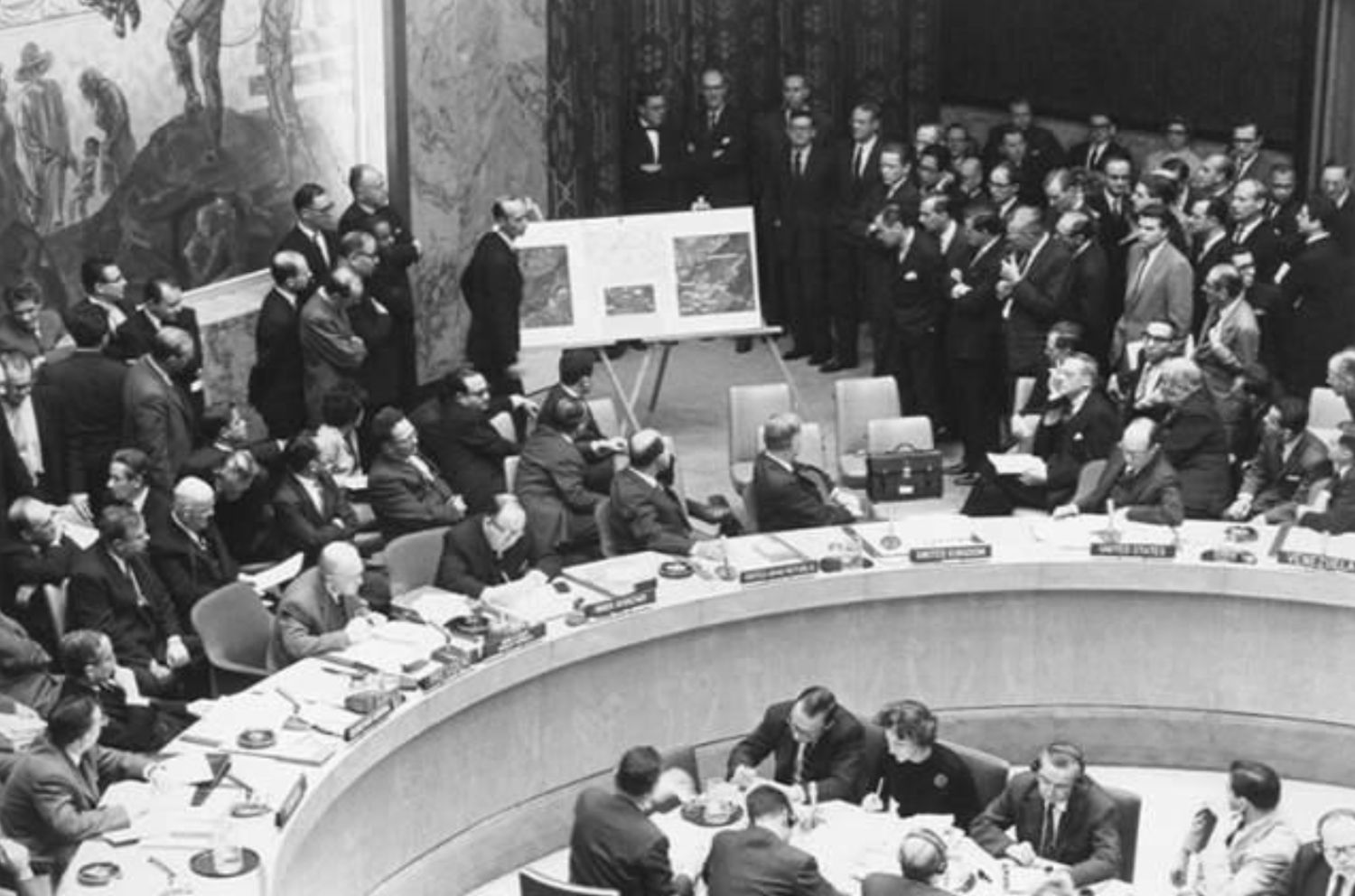
U.S. ambassador to the UN Adlai Stevenson’s famed Cuban Missile Crisis speech at the UN Security Council, October 1962. Read more about the long U.S. war on Cuba in our curated guide, "The Making of Cuba's Crisis." (SIGNALEER / CREATIVE COMMONS)
AROUND THE REGION
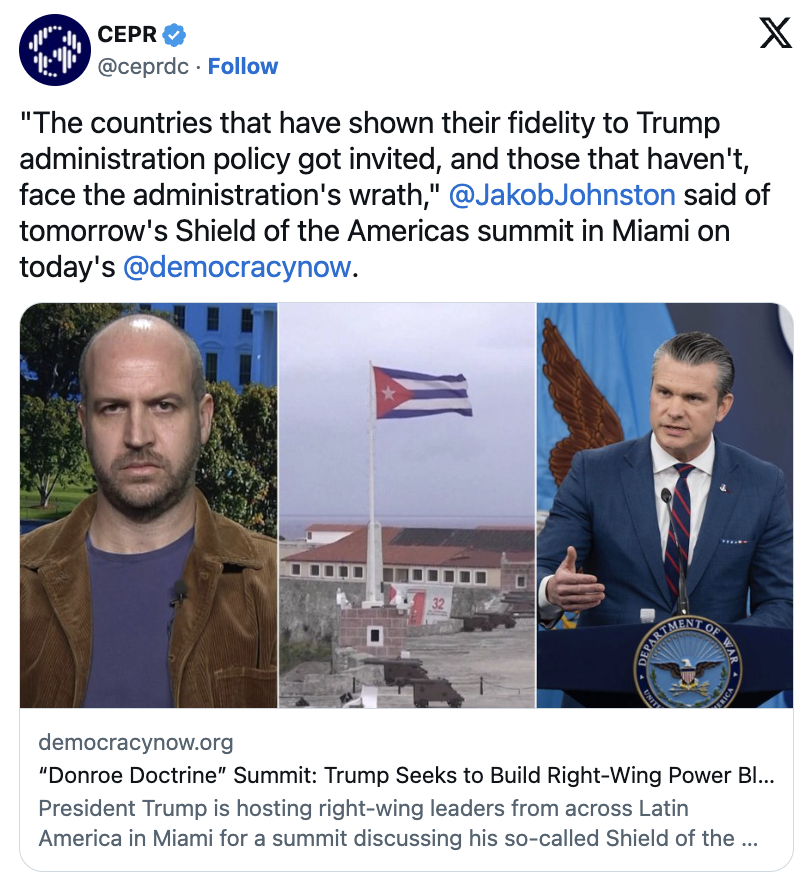
TWO HAWKISH CONFERENCES—Key military officials and political leaders from across Latin America gathered in Florida this week for two conferences focused on regional security. On Thursday, at the inaugural “Americas Counter Cartel Conference,” Secretary of Defense Pete Hegseth and White House Security Adviser Stephen Miller pushed regional leaders to intensify their campaigns against criminal organizations. Likening drug cartels to groups like ISIS, Miller argued that organized crime can “only be defeated with military power” and vowed to continue using “hard power, military power, lethal force, to protect and defend the American homeland.” Hegseth agreed and added that the United States was “prepared to go on the offense alone, if necessary.” Both officials cast the battle against organized crime in civilizational terms, describing the representatives from more than a dozen allied conservative governments as “Christian nations under God” under threat from foreign “incursions.” This message is sure to be repeated on Saturday at the “Shield of the Americas Summit,” a meeting of right-wing Latin American leaders hosted by Trump and dedicated to regional security.
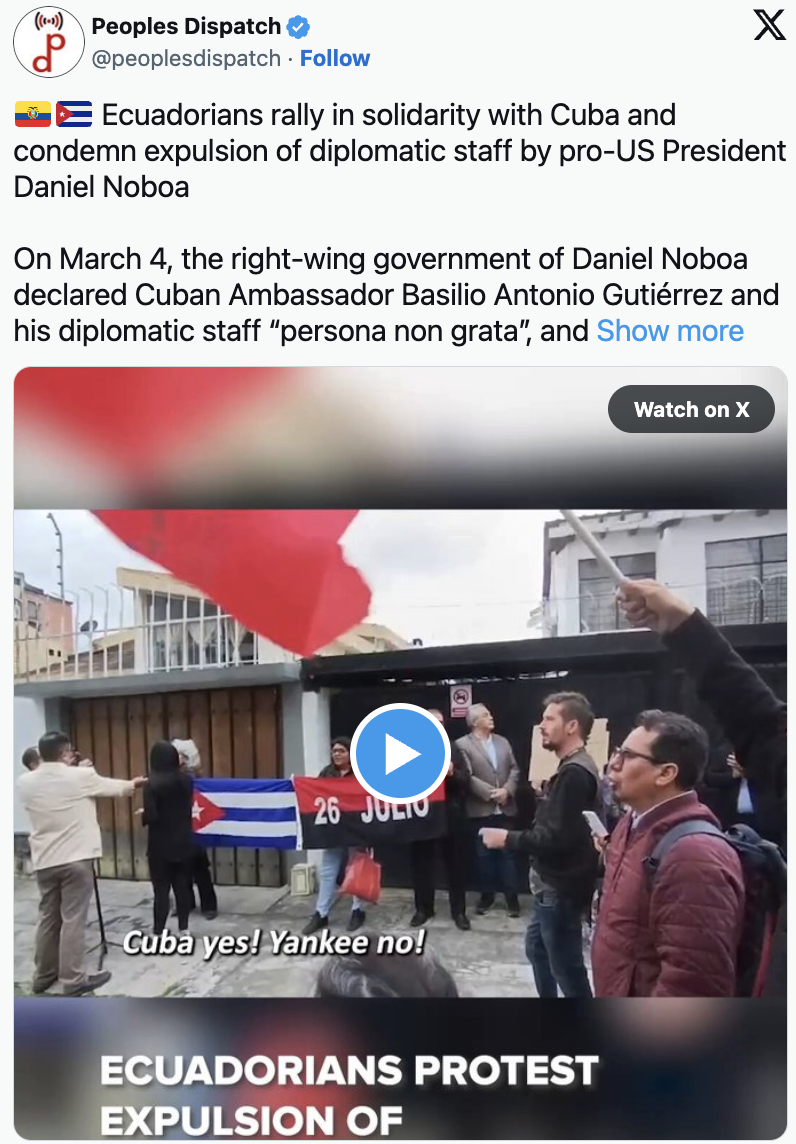
U.S. MILITARY IN ECUADOR?—The U.S. military announced what appears to be a major expansion of its tactics to fight alleged “drug-trafficking” in the region, launching joint military operations with the Ecuadorian military against "designated terrorist organizations.” The nature of the Tuesday announcement, which came via social media, used the language of “narco-terrorists,” and was accompanied by a grainy video of helicopters, was eerily similar to the Trump administration’s media strategy for its ongoing strikes against alleged “drug boats," an illegal campaign that has so far killed more than 150 people. Right-wing President Daniel Noboa, however, has championed the strikes and called for greater U.S. involvement in his disastrous “war on gangs,” even as Ecuadorians have overwhelmingly rejected his calls to establish a U.S. base in the country. Undeterred, Noboa announced a “new phase” in the war against “narcoterrorism” on Monday, the same day he met with high-ranking U.S. military officials. Nevertheless, while the media framed the news as the first-time the Trump administration was striking “cartels” on land, the extent to which these operations are “new” is unclear: if, as experts suspect, U.S. troops are mostly playing an advisory role, it may be best understood as a continuation of long-running U.S. military “assistance.”
PRESSURE ON DELCY—During a Tuesday press briefing in the Oval Office, Trump responded to a question about ongoing operations in Iran by pivoting to what he described as the success of the U.S. invasion of Venezuela. “Venezuela was so incredible because we did the attack, kept the government totally intact…and we have Delcy, who has been very good.” Those public assurances, however, contrasts sharply with recent reporting by Reuters,which alleges that the Trump administration has been quietly building a legal case against interim President Delcy Rodríguez for months. Though no formal charges have yet been filed, federal prosecutors have reportedly already drafted corruption and money laundering charges accusing Rodríguez of laundering money from PDVSA, the country’s state-owned oil company, between 2021 to 2025. According to the reporting, Rodríguez has been informed that she could face prosecution if she does not continue to cooperate with Washington’s demands. In addition to opening up Venezuela’s oil sector to foreign investment, Rodríguez has reportedly been pressured to assist U.S.-led investigations into allies of former president Nicolás Maduro—Washington wants these figures arrested and, in some cases, prepped for extradition.
CASO AYOTZINAPA—A court ordered Mexico’s Armed Forces to hand over documents pertaining to the 2014 disappearance of 43 students from a rural teachers college in Ayotzinapa. The ruling, issued several weeks ago but widely reported this week, mandates the release of 853 pages of information to the public, an encouraging development for the family members of the victims, who have been demanding access to the documents since 2023. The disappearance of the students in the state of Guerrero, largely believed to have been carried out by criminal groups working with local police, has remained in the public consciousness for more than a decade, due to the steadfast activism of the victims’ loved ones. Evidence of what many describe as an institutional “cover-up,” reinforced by the obstacles put in place by successive Mexican governments, has fueled deep public mistrust around the case. Asked about the ruling on Wednesday, President Claudia Sheinbaum said she was not familiar with it but would meet with the victims’ families at the end of the month, something she has done before without satisfactory results. The day before, the federal authorities also announced the arrest of Marco Antonio Mosso Benítez, a man they allege is tied to the crime.