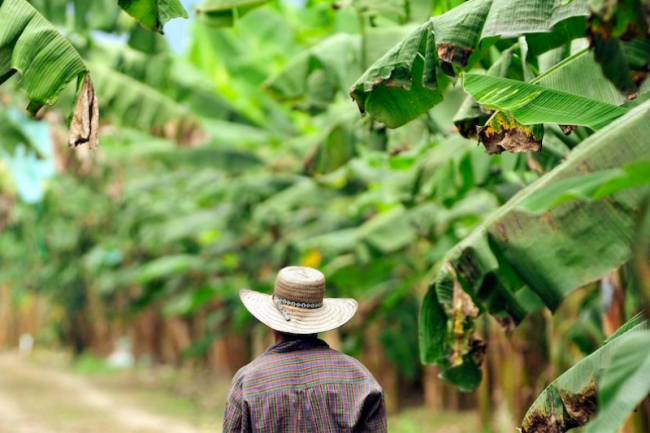
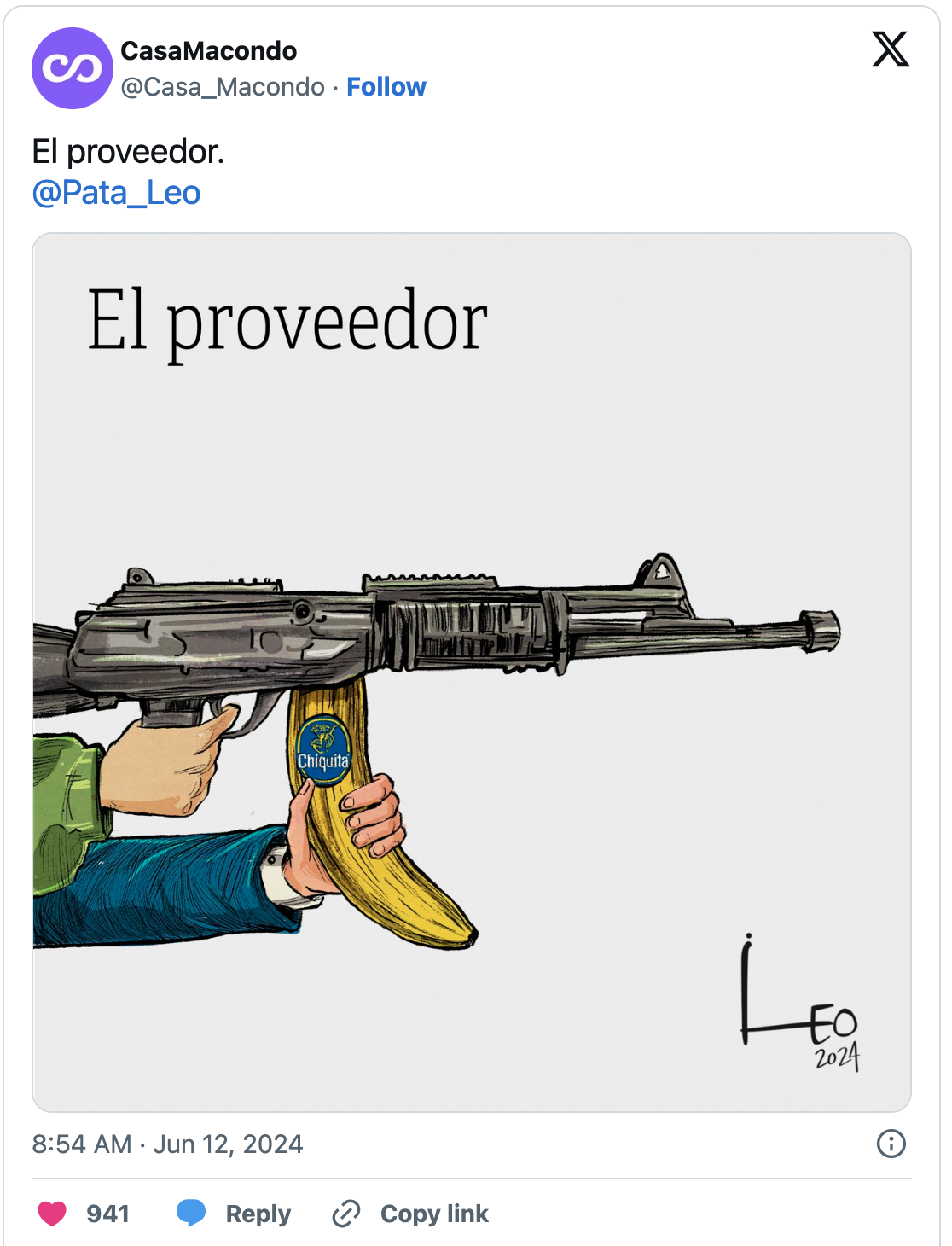
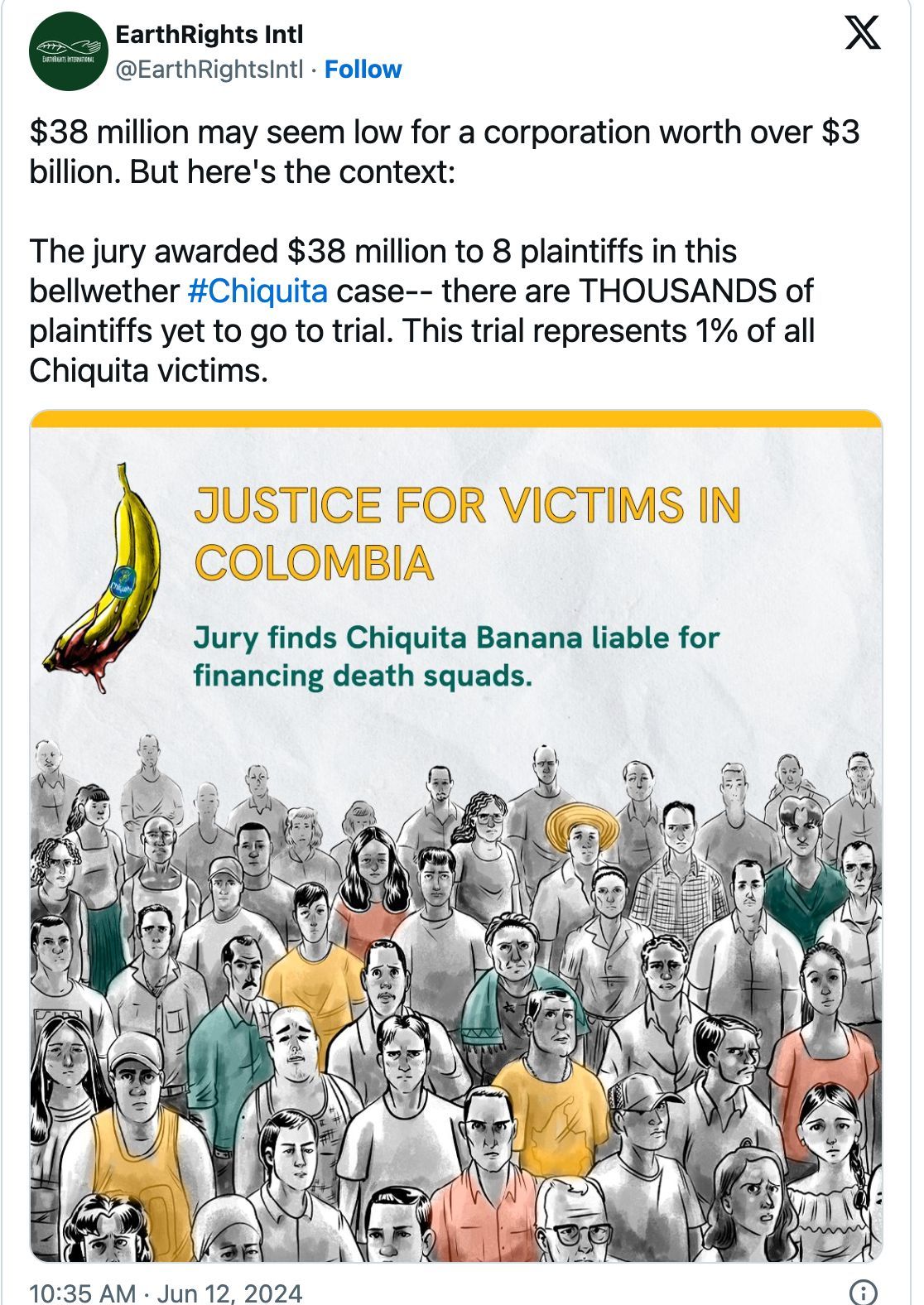
| |  | | In a landmark ruling, a jury in Miami has found the banana giant Chiquita Brands International responsible for the killings of eight Colombian civilians as a result of its funding of a paramilitary death squad. It is the first time a major U.S. company has been held liable for human rights abuses committed abroad. After 17 years of legal proceedings, the jury ruled that Chiquita must pay $38.3 million to the families of the murdered men. Between 1997 and 2004, during the height of Colombia’s armed conflict, the banana company made over 100 payments to the United Self-Defense Forces of Colombia (AUC), a brutal paramilitary organization, totaling more than $1.7 million. The AUC was responsible for thousands of civilian deaths and other major human rights violations between the late 1990s and mid-2000s. “Jurors in Miami sided with plaintiff’s claims that Chiquita Brands chose to profit from the bloodiest period of Colombia’s more than half-century conflict rather than abandon its operations in the country,” write Daniela Díaz Rangel and Joshua Collins for NACLA. As part of evidence presented in the case, jurors viewed an internal email sent in 2003 by a Chiquita brands director stating: “We appear to be committing a felony.” Nevertheless, the company continued to issue payments to the AUC for months. The trial centered on nine bellwether cases among hundreds of claims that have been brought against Chiquita by victims of AUC violence. It drew from thousands of internal records on “sensitive payments” Chiquita made in Colombia that were obtained by the National Security Archive through Freedom of Information Act Requests (FOIA) and through FOIA litigation. Chiquita attempted to block the release of the records by the U.S. Securities and Exchange Commission. According to EarthRights International, which represented the plaintiffs, the new ruling represents just 1 percent of all Chiquita victims. The trial is one part of a larger process of seeking justice. A second case representing other victims with claims against the company will begin preliminary hearings in July. In 2018, Chiquita settled separate suits brought by the families of six victims of the FARC insurgent group, to which Chiquita also issued payments over many years. It is not the first time that the company has been involved in human rights abuses in Latin America. In the early 20th century—when it went by the now infamous name United Fruit Company—the brand controlled vast tracts of territory and transportation networks across Central America, the West Indies, and the Caribbean coast of Colombia. In 1928, federal troops in Colombia slaughtered hundreds of striking banana plantation workers who had been demanding wage increases and more humane working conditions from the company. For more on Chiquita’s sordid history in Latin America, listen to NACLA’s Under the Shadow podcast episode on United Fruit in Guatemala, hosted by Michael Fox. |
| |
|
|
|
| | | NACLA'S 2023 ANNUAL REPORT Did you miss NACLA’s 2023 Annual Report? This report highlights the important work of our staff and contributors and emphasizes transparency with our readers, funders, and partners. Read the report for reflections on 2023 from NACLA's co-Executive Editors, as well as information about NACLA's partnerships, financials, and editorial independence, a selection of notable coverage, and more! Spoiler alert: NACLA does a lot with very little. If you support NACLA's mission, and want to help us work toward our strategic goals and ensure NACLA's long-term sustainability, please consider donating to support NACLA in 2024. |
|
|
| | | | |
|
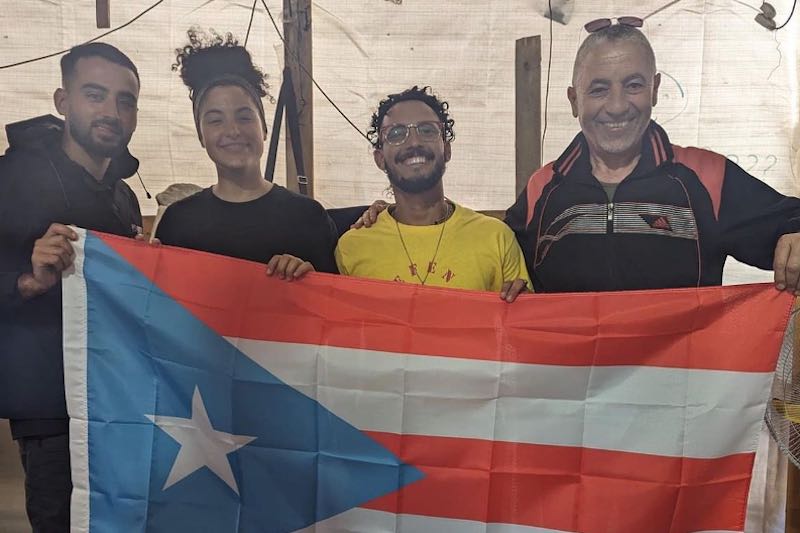
| | | 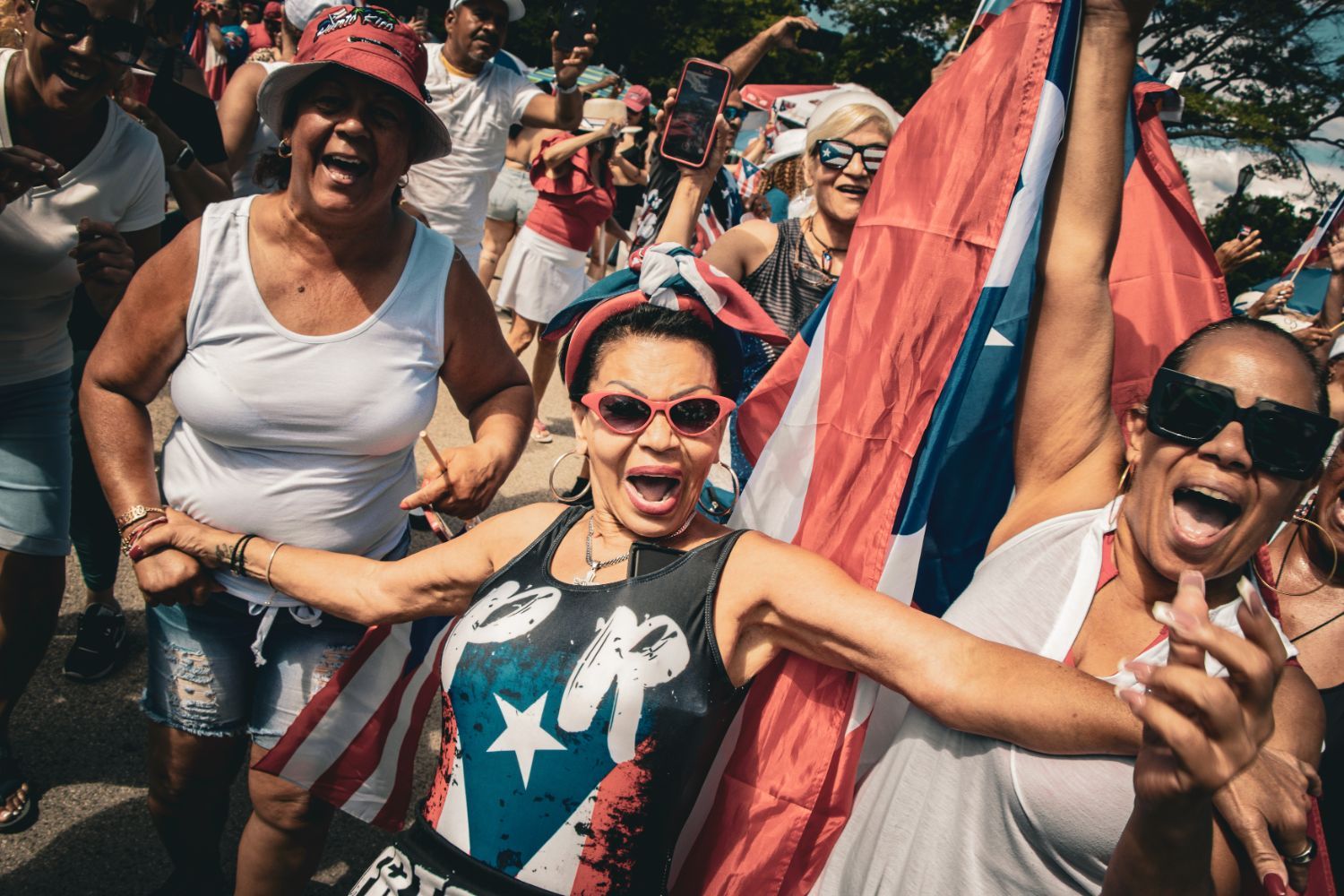 | Puerto Rican Day celebrations at Orchard Beach in the Bronx last Sunday, June 9. Photographer Marcos Echeverría Ortiz, creator of the interactive oral history project "Where We Were Safe" documenting the history of salsa music in NYC, highlights the Afro-Caribbean identity of Orchard Beach: "In the late 1950s, when the beach was mostly used by Irish and Italian white families, Earnie Ensley started to play Latin music on the beach. Afro-Caribbean sounds were a vehicle for opening the space for racial diversity and integration. In the early 1960s, Ernie settled the iconic 'Salsa Sundays' at Orchard Beach, and by the 1970s, it was the place to be." Image: Marcos Echeverria Ortiz, @marquee_o |
| | | -
SENATE PASSES MILEI’S REFORM BILL — Argentina’s Senate narrowly approved a significantly reduced austerity reform bill pushed forward by the far-right administration of Javier Milei. Meanwhile, in the streets, police used water cannons, rubber bullets, and tear gas to repress protesters. After more than 13 hours of debate, lawmakers voted 37 to 36 in favor of the bill late on Wednesday, with Vice President Victoria Villarruel casting the tie-breaking vote. In a subsequent vote on each individual chapter of the bill, two provisions on tax legislation were stuck down. The bill will now return to the lower house, which will vote on whether to approve the modifications. Originally including more than 600 articles, the revised version of the bill still gives broad legislative powers to the president on issues of energy, security, pensions, and others. A nationwide cacerolazo erupted on Wednesday evening to protest the bill and the increasingly repressive security crackdown. The government called the protesters “terrorists” leading an attempted coup d'état that was repelled by security forces “deployed in defense of democracy.” -
BLACKOUTS IN PUERTO RICO — A massive power outage hit Puerto Rico on Wednesday, leaving more than 340,000 people without electricity after two major plants shut down. While power was restored to most of the affected areas by Thursday, residents and union groups have denounced persistent outages that have not been resolved since Hurricane Maria razed the island in 2017. In 2020, Puerto Rico handed over the operation and maintenance of its power distribution and transmission system to LUMA Energy, a privately-owned U.S. and Canada-based venture, that has consistently failed to meet the energy needs of the island territory. As of Thursday, several municipalities on the eastern side of Puerto Rico lacked water due to electrical failures. Ruth Santiago, Catalina de Onís, and Hilda Lloréns have written for NACLA about the urgent need for rooftop solar in Puerto Rico, and the colonial and racist undertones of energy distribution and management. |
|
|
| - ADVOCACY GROUPS SUE OVER ASYLUM RESTRICTIONS — A coalition of advocacy groups has sued the Biden administration over its controversial crackdown on asylum claims at the U.S.-Mexico border. Filed by the ACLU, the lawsuit states that suspending asylum for migrants who do not arrive at a designated port of entry violates federal immigration law, and that exemptions on humanitarian grounds are far too limited. Meanwhile, the head of the UN refugee agency said Thursday that aspects of Biden’s executive order, issued last week, may violate refugee protections under international law. The U.S. Refugee Act of 1980 stipulates that anyone who sets foot on U.S. soil has the right to request asylum if they fear persecution in their home country based on their race, religion, nationality, political views, or other protected grounds. Immigration advocates say Biden’s decree is “legally indistinguishable” from a similar ban issued by Trump that was successfully blocked by the courts.
- ECUADOR FUEL SUBSIDY PROTESTS IN ECUADOR — Union and student groups mobilized in Quito on Wednesday to oppose plans by the government of Daniel Noboa to cut fuel subsidies. Organized by the Popular Front, a collection of a dozen union organizations, the demonstration denounced austerity measures that disproportionately impact poor and working class sectors already facing violence, extortion, and elevated costs of living. “The measures adopted by the government have not been to guarantee security, but rather [are] a blow to the popular sectors, [and] the end of subsidies will be an added attack on the economy and well-being,” announced Nery Padilla, president of Ecuador’s Federation of University Students. In October of 2019, 12 days of nationwide protests against a similar plan to eliminate decades-old fuel subsidies forced the government of then-President Lenin Moreno to abandon the decree. As in 2019, the current plan to cut subsidies falls within the context of Noboa’s efforts to seek a $4 billion loan from the IMF, for which he committed to reviewing fuel subsidies in an agreement signed with the lending institution on May 31.
-
COLOMBIA WILL SUSPEND COAL EXPORTS TO ISRAEL — Colombian President Gustavo Petro announced Saturday that he is suspending coal exports to Israel over the ongoing bombardment of Gaza. In a draft decree posted on X, Petro stated that coal exports to Israel will only resume “when the genocide stops” and Israel complies with an International Court of Justice order to withdraw its troops from Gaza. According to the American Journal of Transportation, Israel imports 50 percent of its fuel from Colombia. Coal exports to Israel constitute only a fraction of Colombia’s overall coal exports. |
|
|
|
|
|
|
| | | North American Congress on Latin America
53 Washington Sq South, Fl. 4W | New York, New York 10012
(212) 992-6965 | [email protected] |
| |
|
| |
|
|