| |  | | The South American nation of Suriname elected Jennifer Geerlings-Simons as its first female president on Sunday. The historic victory, which brought the center-left National Democratic Party (NDP) back to power, came after weeks of gridlock following the country’s May parliamentary elections. The 71-year old physician and lawmaker now faces the challenge of leading one the region’s poorest, youngest, most ethnically diverse, and least discussed nations. Yet with the discovery of massive offshore oil reserves set to be tapped in the coming years, the Dutch-speaking country that gained independence in 1975 is poised to play a bigger role in regional affairs. Geerlings-Simons came to power on extremely tight margins. In May’s elections, her party secured one more congressional seat than outgoing President Chan Santokhi’s Progressive Reform Party, which led to weeks of dealmaking until she finally managed to form a coalition with lawmakers from smaller parties. Though recently in opposition, the NDP is no stranger to political power in Suriname. It was founded in 1987 by Dési Bouterse, the country’s military ruler in the 1980s, president in the 2010s, and a convicted murderer and drug trafficker who nonetheless retained the support of large swaths of the country’s working class sectors due to his charisma and generous social programs. The cutting back of these social programs by Santokhi sparked social discontent that paved the way for the NDP’s return. In early 2023, inflation, corruption, and a brutal IMF structural adjustment program that mandated an end to state subsidies for electricity and fuel led to mass protests that rocked the capital of Paramaribo. Though the cuts generated outrage they remained in place, and the NDP, while nominally a left-wing party, ran a campaign focused less on restoring the welfare state than promising stability as the country prepares for an oil-fueled transformation. Suriname’s offshore gas reserves are expected to bring in billions of dollars of revenue in the coming decade. With its largest oil field expected to begin production by 2028 at upwards of 200,000 barrels per day, the country could follow the explosive path of neighboring oil-rich Guyana, whose economy grew more than 43 percent last year. More than half of Suriname’s oil blocks remain uncontracted, meaning its future production could reach astronomical levels. While officials eagerly anticipate the boom, environmental concerns loom large. More than 90 percent of Suriname is tropical rainforest and the country absorbs more carbon than it emits—a point of pride for politicians like Santohki who have promised that the oil boom will not affect Suriname’s carbon-negative status. But the country is already grappling with a surge in legal and illegal gold mining and timber operations that have severely damaged the country’s forests, and oil spills in neighboring Guyana paint a bleak picture of what may be around the corner. As former head of the National Assembly, Geerlings-Simmons was a vocal proponent of stronger environmental regulations, which may position her well to navigate these tensions. Suriname’s oil reserves, as well as its ties to international drug trafficking networks and reliance on Chinese loans have drawn attention from the United States. In March, Senator Marco Rubio visited Paramaribo as part of a larger Caribbean tour, meeting with Santohki to discuss energy, drugs, China, and regional security. The recent election of former Foreign Minister Alberto Ramadin as Secretary General of the OAS has also raised Suriname’s diplomatic profile. Given the U.S. State Department’s warm response to the news of Geerlings-Simmons’ victory, a major shift in relations between the two countries is not expected. |
| |
|
|
|
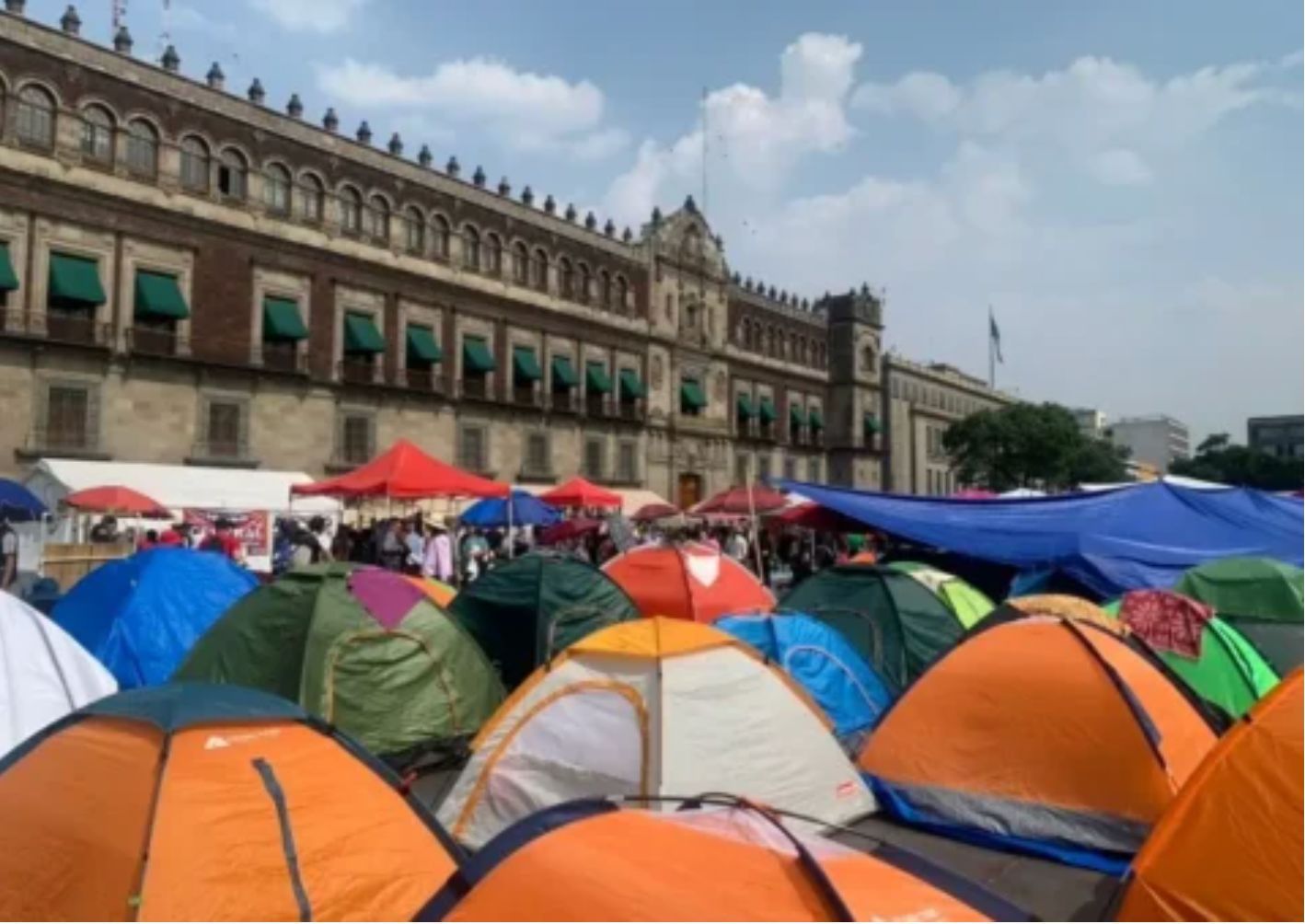
| | | | | | | | | | | | | | Mexico’s Teachers Demand Pensions Over Profit Isabel Villalón | July 7, 2025 Education workers in Mexico are leading a renewed struggle to reclaim public retirement systems from global finance. |
|
|
| | | | 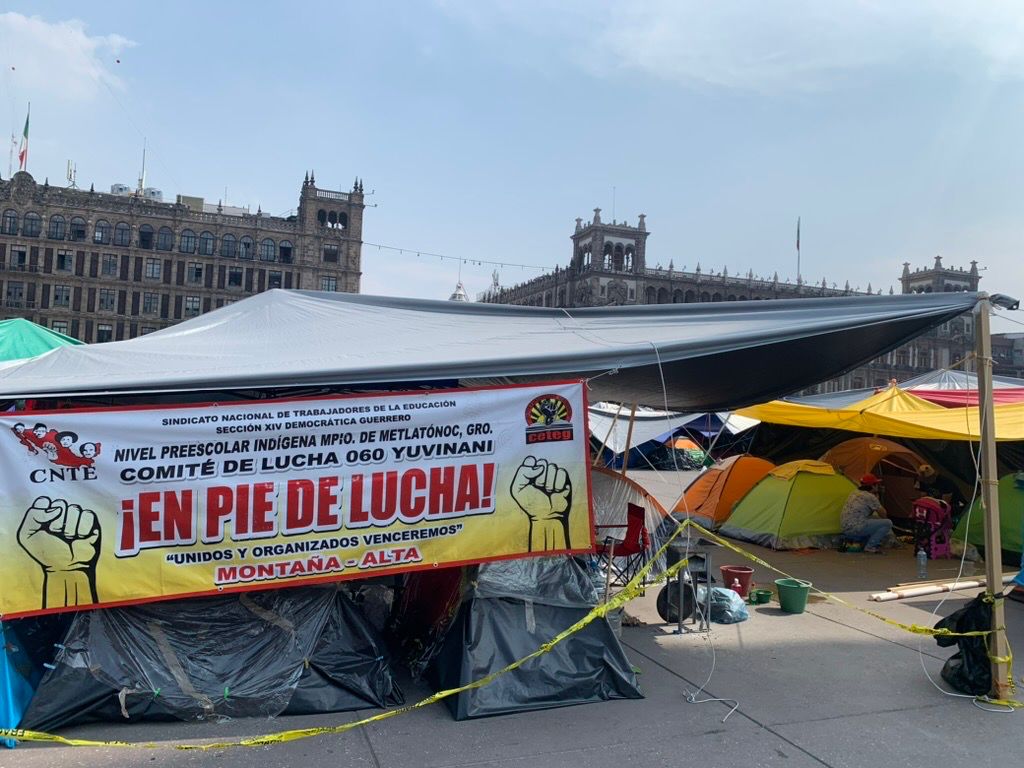 | Mexico's National Coordinator of Education Workers (CNTE) set up a protest encampment in Mexico City’s Zócalo plaza in May. Read more about the protest, the government's response, and the wider struggle for public goods in Isabel Villalón's article for NACLA. (Isabel Villalón) |
|
|
| | | -
U.S. CONTROL OF VENEZUELANS IN EL SALVADOR’S PRISONS—Court filings and a botched diplomatic deal revealed this week that the U.S. government has more control over Venezuelan migrants being held in Salvadoran prisons than it previously claimed. On Monday, it emerged that the Salvadoran government recently told UN investigators that the Trump administration maintains jurisdiction over Venezuelan held in CECOT, the country’s maximum security prison. The admission—cited in court filings for a separate case by lawyers representing more than 100 Venezuelans detainees—prompted a U.S. judge to press the Trump administration on its claim that it lacks the power to repatriate them. Reporting by The New York Times also exposed how the prisoners have been used as bargaining chips, casting doubt on U.S. claims of helplessness. Secretary of State Marco Rubio reportedly negotiated with the Venezuelan government to return the detainees in exchange for the release of political prisoners held in Venezuela, but the deal collapsed amid internal confusion. Richard Grenell, Trump’s envoy to Venezuela, made a more compelling offer: sanctions relief on Venezuelan oil in exchange for the return of political prisoners. -
TARIFFS ON BRAZIL—Donald Trump threatened Brazil with a 50 percent tariff if it did not end what he called a “witch hunt” against former President Jair Bolsonaro. In a letter sent to President Luiz Inácio “Lula” da Silva on Wednesday, Trump argued that Bolsonaro’s trial “should not be taking place” and accused Lula of attacking “free elections” and “free speech,” a veiled reference to attempts by Supreme Court Justice Alexandre de Moraes to combat disinformation online, which has angered conservatives in the United States. Trump warned that tariffs on Brazilian goods—already at 10 percent—would increase further if Lula retaliated. Brazil’s president immediately threatened to do so, asserting on X that his country is a “sovereign nation” that would respond to “any unilateral tariff increases.” He also pushed back against Trump’s free speech claims, writing that “freedom of expression must not be confused with aggression or violent practices.” Brazil also faced a separate 10 percent tariff threat this week for its association with BRICS, a Global South alliance that met this week, drawing Trump’s ire. |
|
|
| -
PETRO’S FLAWED COAL BAN—In an op-ed in The Guardian, Colombian President Gustavo Petro made an urgent plea for countries to do more to hold Israel accountable for its genocide in Gaza. The piece, which came out a week before the country is set to host an “emergency conference” on Gaza, argued that if Israel is not stopped, the world risks “stripping the remaining protections for less privileged nations.” Petro hammered home the need to introduce “concrete, legal, diplomatic, and economic measures that can halt Israel’s destruction,” and pointed to his government’s banning of coal exports to Israel as a model. Nevertheless, reporting from the Colombian outlet Vorágine revealed this week that Petro, too, has struggled to move from words to concrete actions. Since August 2024, when the government issued Decree 1047 that bans coal exports to Israel, at least 30 boats carrying more than 1 million tons of Colombian coal have arrived to Israeli ports. A pre-existing free trade agreement between the two countries, resistance to the ban, and massive carve-outs in the decree have left the country’s biggest coal producers virtually untouched by Petro’s signature policy. The amount of coal Israel has received from Colombia since the ban could reportedly fuel the production of upwards of 800 attack drones. -
HYPERINFLATION IN VENEZUELA?—New economic data shows that U.S. sanctions on Venezuela are having their intended effect: sending the country back into a hyperinflationary spiral and radicalizing domestic politics. According to a recent Bank of America Global Research report, fears of hyperinflation have returned, largely due to the crippling of the country’s oil sector. While the economy had seen relative calm in recent years, April and May brought sharp increases in inflation. In April, oil production dropped precipitously due to the Trump administration's imposition of secondary sanctions on countries buying oil from Venezuela; in May, production plunged after the U.S. declined to renew Chevron’s waiver to export the country’s oil, a loss of nearly five million barrels of crucial revenue. The human consequences of this economic warfare cannot be understated: food prices are skyrocketing and workers’ real wages are declining. Analysts are comparing this moment to the country’s economic spiral from 2017-2019, which scholars have linked to the deaths of more than 40,000 people and the mass displacement of millions who fled the country. With few options left, President Nicolas Maduro has reportedly begun detaining analysts who publish independent financial data, including a former Finance Minister. |
|
|
|
|
|
|
| | | North American Congress on Latin America
53 Washington Sq South, Fl. 4W | New York, New York 10012
(212) 992-6965 | [email protected] |
| |
|
| |
|
|