On Sunday, 3.7 million Costa Ricans will vote in crucial elections that could reshape the country’s political landscape and consolidate a regional right-wing turn. If current polling holds, voters will choose a new president, two vice presidents, and an entirely new 57-member legislative assembly. While a second round is mandated if no presidential candidate secures more than 40 percent of the vote, Laura Fernandez—the right-wing front-runner and chosen successor of outgoing President Rodrigo Chaves—is currently poised to clear the threshold and become Costa Rica’s second female president.
Fernandez’s popularity, fueled in part by her admiration for Salvadoran President Nayib Bukele’s draconian “war on gangs,” attests to voters concerns about issues related to crime, corruption, and insecurity. Though all the leading candidates have leaned into hardline security rhetoric— includingcenter-right Álvaro Ramos and center-left Claudia Dobles—Fernandez has gone farther, calling for a “state of exception” to combat narcotrafficking, a move straight out of Bukele’s playbook. In a country long defined by its economic, social, and political stability—a story linked to its lack of an army—the open embrace of extrajudicial security measures reflects a broader regional shift in public consciousness.
The emphasis on security is a new phenomenon that mirrors regional trends. In 2022, less than 5 percent of voters cited crime as their primary concern. While the homicide rate has declined since peaking in 2023, anxieties persist, driven in part by localized upticks in violence in areas such as the capital province and the port region of Limón. High profile incidents have reinforced the narrative, promoted by conservative media outlets, of a country under siege. In June, a retired Nicaraguan Army major and critic of President Daniel Ortega was killed in San José. Days later, former Security Minister Celso Gamboa was arrested on drug trafficking charges and slated for extradition to the United States, following the passage of a constitutional referendum enabling extradition. The recent announcement of an alleged plot to assassinate President Chaves has contributed to this narrative, as has Bukele’s recent visit, in which he presided over a ceremony launching the construction of a massive new prison.
Though the divided state of the opposition has cleared a path for Fernández, Costa Rica is no stranger to poll-defying elections, and more than a third of voters remain undecided. The field is crowded and ideologically diverse, including Ramos, a senior official in Chaves’s administration who heads the social security and pension system; Ariel Robles, a left-wing congressman representing the Frente Amplio; former first lady and architect Dobles; and far-right evangelical singer Fabricio Alvarado, a third-time candidate who made it to the second round in 2018.
Since its founding in 1967, NACLA has worked to expose and oppose U.S. intervention in Latin America. In the face of lies and propaganda generated by the U.S. government, and a mainstream media often complicit in legitimizing U.S. actions, NACLA has sought to be a source of reliable information about the facts on the ground.
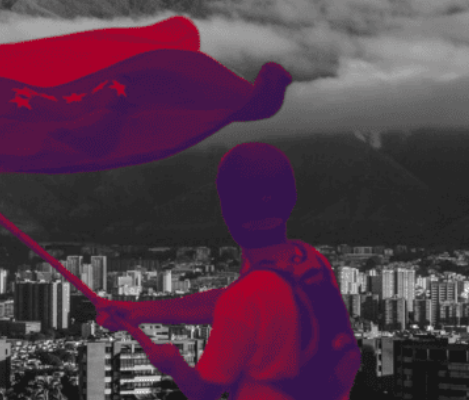
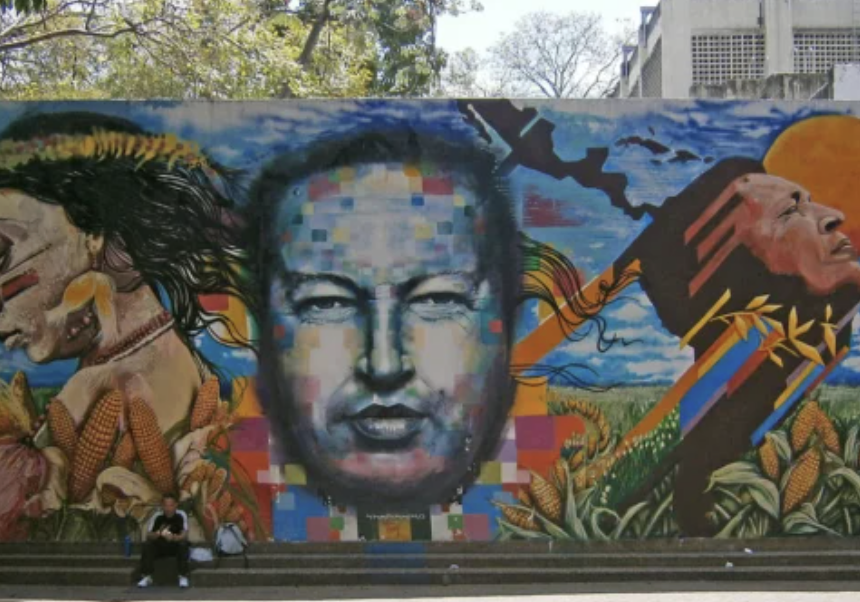
In this dossierof articles and podcast episodes, NACLA offers several pieces that aim to help readers understand the facts about Venezuela’s recent history, the rise and significance of the Chavista movement, the role of oil in shaping the country’s political economy, and evolving relations between the Maduro government and the United States.
WINTER ISSUE AVAILABLE OPEN-ACCESS
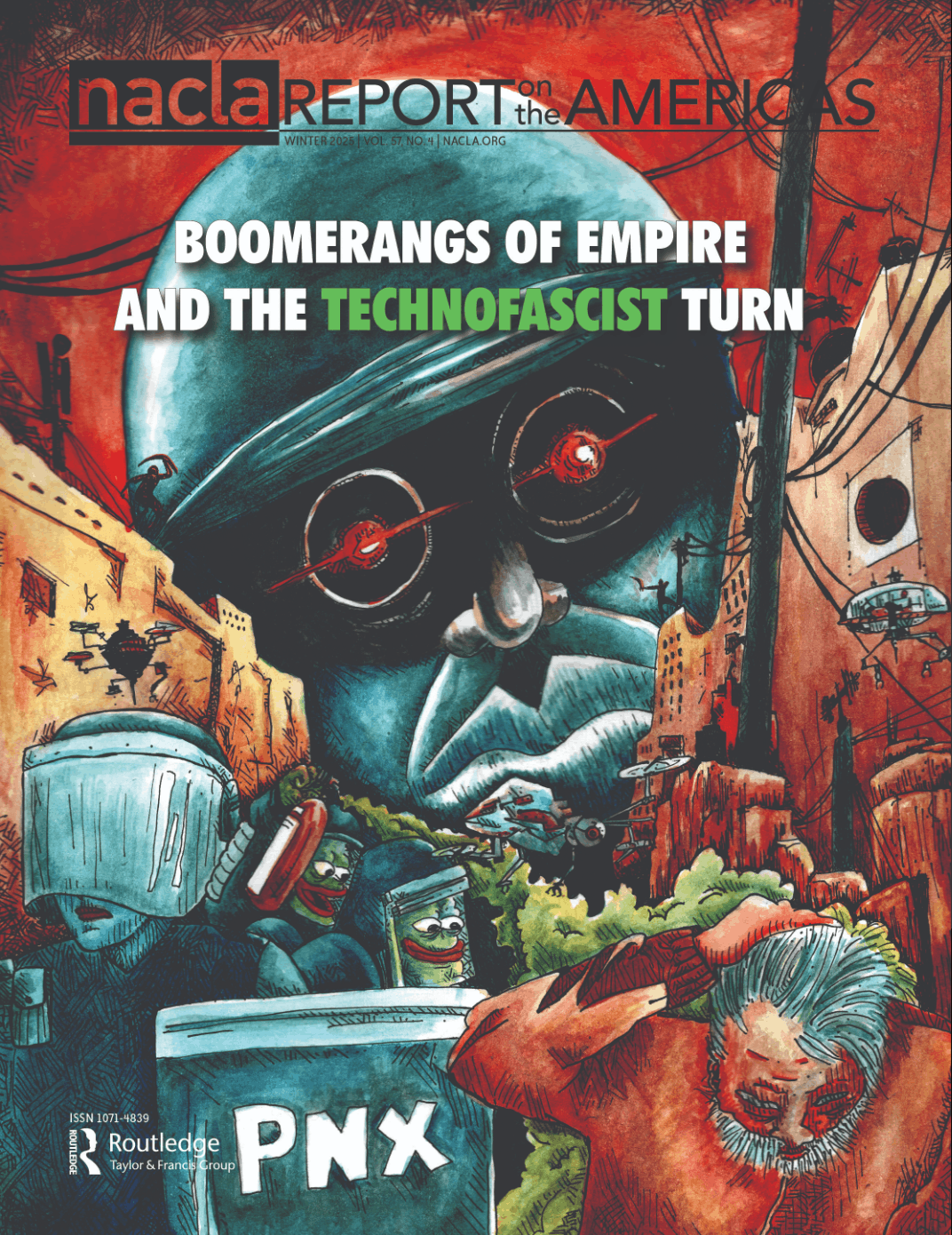
After long delays on the part of our publisher, our winter issue is out and available free to access in its entirety for a limited time! Read it here! If you are a subscriber, print copies will arrive in the mail soon.
In 1950, Martinican author Aimé Césaire used the term "imperial boomerang" to describe a historical circuit, in which the tactics of imperial domination tested abroad return home, reshaping the very societies that invented them. Our winter issue, “Boomerangs of Empire and the Technofascist Turn,” takes Césaire’s insight not as metaphor but as method, tracing how this returning and disseminating violence is shaping the Americas today.
Please consider making a donation to support more work of this kind at a time of increased hardship and pressures for independent media.
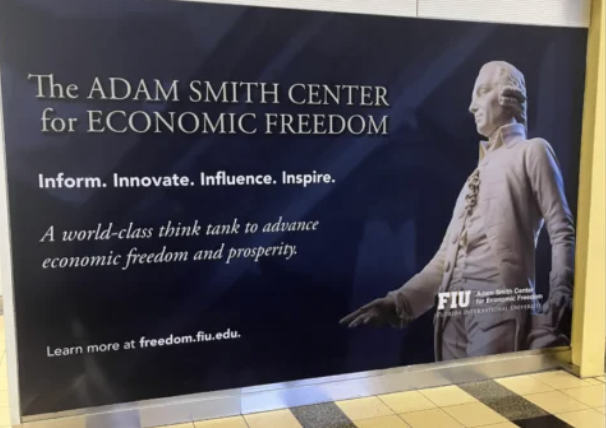
As a right-wing center harnesses public funds to bolster U.S. imperial power at Florida International University (FIU), a faculty member issues an urgent call to resist.
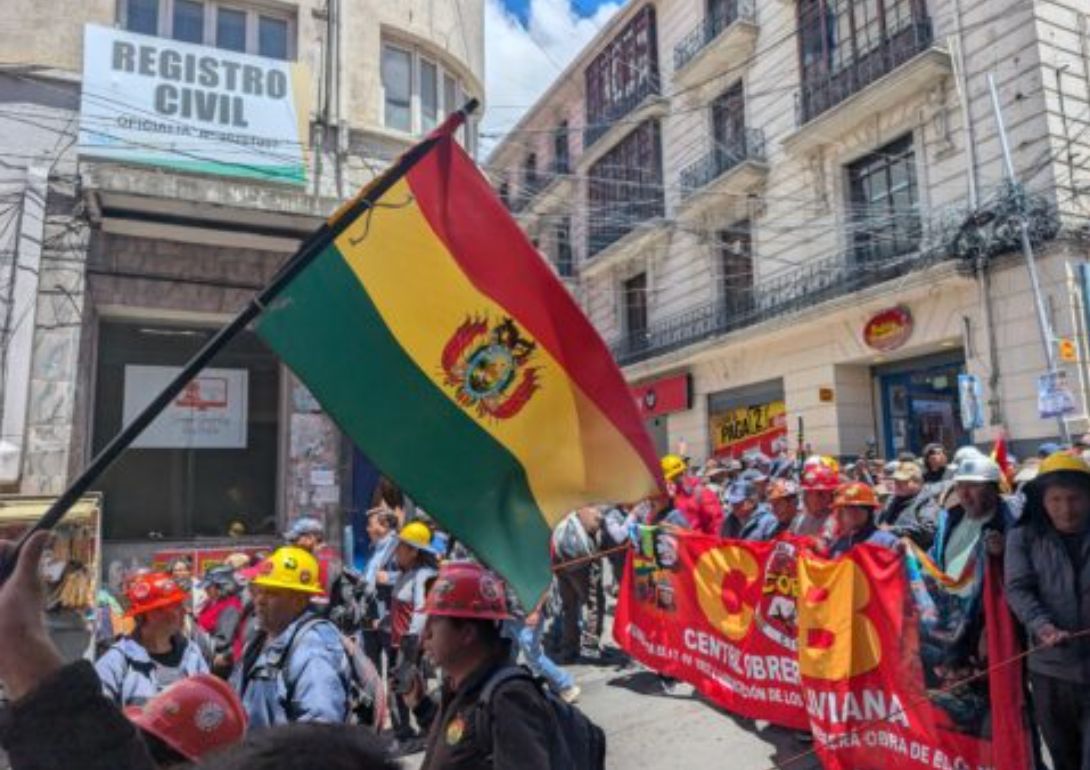
After a series of protests over cuts to fuel subsidies brought the country to a halt, Bolivia’s powerful social movements embark on a new chapter and face new forms of repression.
Host Michael Fox looks at the misconceptions, myths, and misinformation that have been spread about Venezuela in the wake of the US invasion.
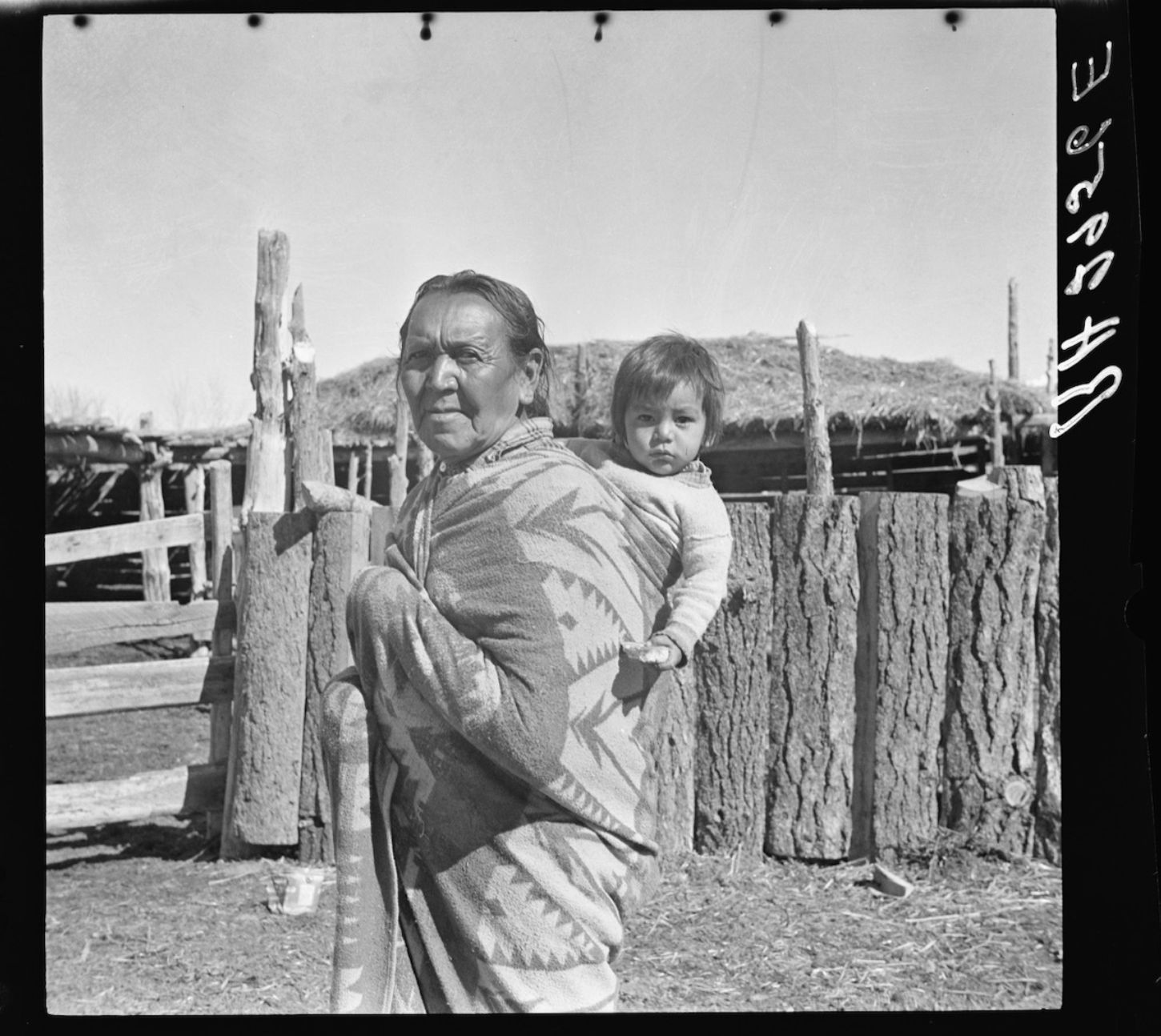
IMAGE OF THE WEEK
“Governor Sandoval of the Taos Pueblo,” New Mexico, April 1936. This archival photo comes from "Submerged Pluralist Possibilities in the Pueblo Indian Homelands," an article by Sam Markwell in our winter issue of the NACLA Report, “Boomerangs of Empire and the Technofascist Turn." Check out the entire issue for free, for a limited time. (ARTHUR ROTHSTEIN / OFFICE OF WAR INFORMATION PHOTOGRAPH COLLECTION, LIBRARY OF CONGRESS, WASHINGTON D.C.)
AROUND THE REGION
RUBIO ON VENEZUELA—Less than one month after the Trump administration's kidnapping of Venezuelan President Nicolás Maduro, Secretary of State Marco Rubio testified before lawmakers to outline the administration’s plans. After repeating a familiar litany of falsehoods about the global threat posed by Maduro, Rubio—widely seen as the brainchild of the operation—unveiled a brazenly imperial scheme: the Venezuelan government would be required to submit a monthly budget to the Trump administration in order to access funds generated from the sale of its own oil, currently held in a U.S.-controlled account based in Qatar. While Rubio acknowledged that Qatar’s role was unusual, he said it was a temporary workaround necessitated by U.S. sanctions on Venezuela. Rubio spoke positively of interim President Delcy Rodríguez, with whose government he claimed to maintain a “very respectful and productive line of communication.” Key questions, however, remained unanswered, particularly regarding the possibility of further U.S. military action. Although Rubio said he did not “intend or expect” to use force, he declined to rule it out and made clear in a belligerent statement submitted to the committee before the hearing that the United States was “prepared to use force to ensure maximum cooperation.”
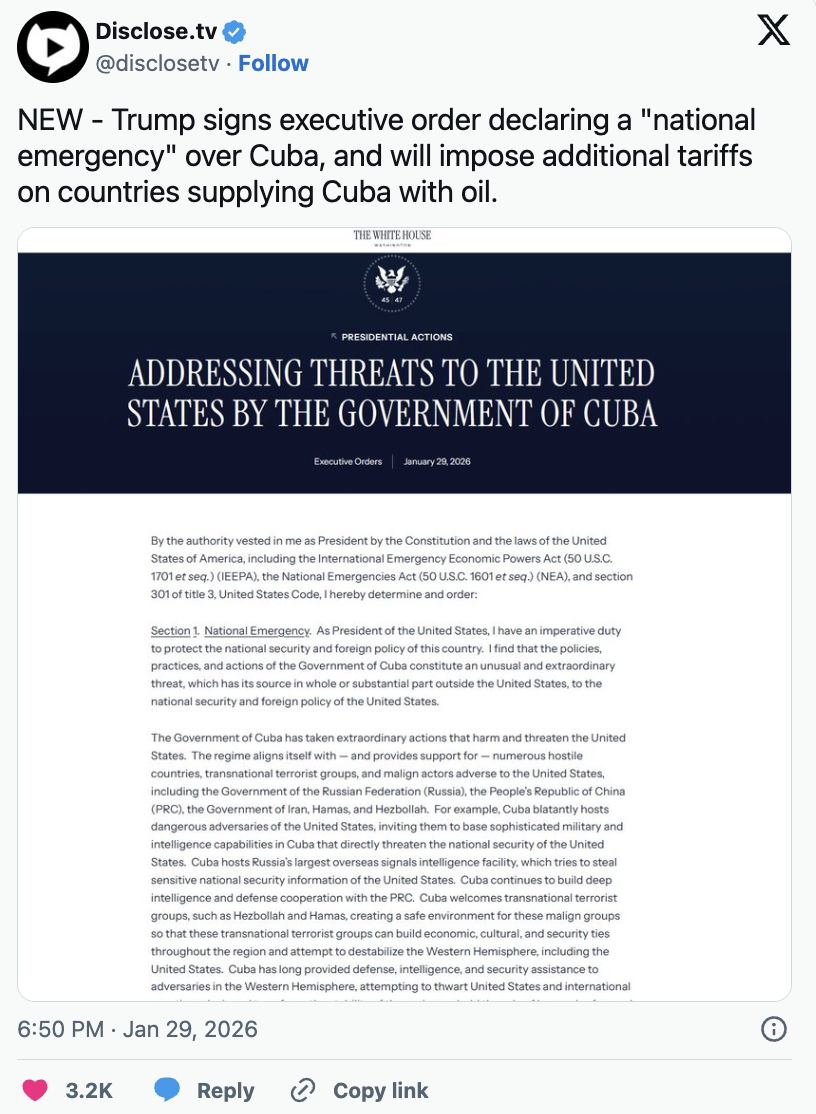
MEXICAN AID TO CUBA—The Mexican government has cancelled a shipment of oil to Cuba at a time of economic crisis and increasingly severe blackouts driven by chronic fuel shortages. The decision, which appeared to be confirmed by Mexican President Claudia Sheinbaum on Tuesday, followed reports that Mexico was considering suspending fuel aid out of fear of retaliation by the Trump administration. While Sheinbaum described the pause as a “sovereign decision” stemming from standard fluctuations in oil supply, she used identical language last week to justify the extradition of cartel members to the United States—a move widely understood as a response to U.S. pressure. Since Maduro’s kidnapping, Trump and his allies have ramped up their efforts to destabilize Cuba’s government, urging Havana to “make a deal,” calling for “no more oil or money going to Cuba,” and debating a naval blockade on oil imports. The threat has placed Mexico—Cuba’s largest supplier of oil since the fall of the Maduro government—in a bind, fearful of angering Trump while also continuing to call for "solidarity" with the Cuban people. On Wednesday, Sheinbaum pushed back against media characterization of her remarks, insisting that “humanitarian” shipments would continue and that commercial contracts with Cuba continue to be evaluated, though she remained purposely vague.
LAWFARE IN ECUADOR?—Early Wednesday morning, Ecuadorian police raided the homes of leading opposition figures, including former presidential candidate Luisa Gonzalez and her running mate, Andrés Arauz. The operation are part of an investigation into allegations that the progressive movement illegally financed its 2023 presidential campaign with funds from Venezuela, a case that has come to be known as “Caja Chica.” The targeting of these Correístas, who are aligned with the political movement founded by former President Rafael Correa, drew accusations of “lawfare,” a favored tactic of the Latin American right to wage war against its political opponents. Police seized phones, passports, flashdrives, and documents, materials the right-wing government of President Daniel Noboa says will provide evidence of organized crime, illicit financing, and money laundering. Noboa, who has openly championed the Trump administration’s kidnapping of Venezuelan President Nicolás Maduro, has repeatedly accused Maduro of illegally financing leftist campaigns across the region, including in Colombia, a country with which he is currently feuding.
KAST’S TRIP—Jose Antonio Kast, Chile’s far-right president-elect, spent the week meeting with foreign leaders in search of “models” for his incoming administration. Unsurprisingly, given his fixation on migration and insecurity, he started his tour last weekend in the Dominican Republic and is set to conclude it in El Salvador on Friday. In the Dominican Republic, Kast appeared alongside President Luis Abinader, a far-right businessman and close ally of the Trump administration who has overseen one of the world’s most brutal immigration crackdowns on Haitian migrants. Touring the border region, Kast praised the country’s system of walls and surveillance technology as a “comprehensive border solution”—one he may try to replicate on Chile’s northern border. He then traveled to Panama to participate in a regional economic forum, where he called for greater cooperation and met briefly with Brazilian President Luiz Inácio “Lula” da Silva—a gesture Kast cited as evidence of his openness to dialogue. Nevertheless, the ideological nature of his project is clear: on Friday, he is set to meet with Salvadoran President Nayib Bukele and potentially visit CECOT, the country’s maximum security prison that has served as a model for the region’s right-wing leaders.