The United States’ war on the Venezuelan people reached its grim culmination on Saturday in “Operation Absolute Resolve,” a shocking display of imperial force. Months of racist and illegal policies targeting Venezuelan migrants in the United States, extrajudicial strikes on small boats in the Caribbean, sanctions on oil companies and tankers, and the steady buildup of U.S. military forces in the region culminated in an early-morning assault on Caracas and the kidnapping of President Nicolás Maduro and his wife, Cilia Flores. They both now sit in a Brooklyn detention center as Venezuela—and its new leadership—confronts the herculean task of governing amid the wreckage of foreign aggression.
The Trump administration’s attack on Caracas and the states of Miranda, Aragua, and La Guaira was deadly, illegal, and unprecedented—the first direct U.S. military invasion of a South American country. 150 aircraft bombed Venezuelan air defenses and plunged Caracas into darkness as military helicopters swept into the capital to seize the president and his wife and transport them to the United States. The death toll stands at around 100 people, including 32 Cuban soldiers, 24 Venezuelan security officials, and dozens of civilians.
Maduro and Flores were swiftly transferred to New York, where they now face charges including narco-terrorism, possession of weapons, and—against Flores—conspiracy to import cocaine. The trial is widely seen as a farce. As Maduro declared during his court appearance, where both pleaded “not guilty,” he is a “prisoner of war. The proceedings provide a window into the shifting arguments of an administration that has gone out its way to ally itself with, pardon, and employ powerful figures with deep ties to drug trafficking. Confronted with the need to substantiate its claims in court, federal prosecutors have already walked back a central justification for regime change: that Maduro leads a narco-terrorist organization known as the Cartel de los Soles. The latest Justice Department’s indictment effectively admits that the organization does not exist, a point analysts have made for months.
In recent days, Trump and his advisors have also dispensed with the usual pretense of “democracy promotion.” Indeed, Trump and his team have quickly discarded the typical bipartisan playbook for regime change: they cast aside the Venezuelan opposition by arguing that Nobel Prize winner Maria Corina Machado lacked the “respect” to govern, openly claimed they are going to “run the country” instead of hiding behind local elites, and acknowledged that the operation was—and has always been—about oil. Trump even briefed oil executives about the raid in advance, while keeping lawmakers in the dark.
Despite the candor, the mainstream media has continued to play its dutiful role as a champion of empire. As media critic Adam Johnson notes, the press has fallen into line every step of the way—speculating about Trump’s “motives for regime change” despite his own statements that it was about oil downplaying, Venezuelan fears of a U.S. attack, legitimizing strikes on oil tankers, and framing drone killings as part of a credible “war on drugs.” After the attack, many outletsdescribed Maduro’s kidnapping as a “capture” or “arrest,” language that implicitly endorses the legality of an illegal act.
On the ground in Venezuela, the situation is volatile. Vice President Delcy Rodríguez has assumed power, though her position is precarious. While she was sworn in as interim leader, she has also insisted that Maduro remains Venezuela’s “only president.” In a similar vein, Rodríguez has signaled a willingness to “collaborate” with the Trump administration while condemning U.S. aggression and calling for Maduro’s release. Analysts continue to debate whether her work as former oil minister makes her a pliable technocrat who was targeted to make a deal, or whether her revolutionary credentials expose those claims as part of a “psychological operation” to destabilize the regime. Regardless, her position remains tenuous: Trump has said that failure to cooperate could invite another military strike.
Time will tell how the new government will deal with the immense pressures placed upon it. While massive rallies point to a popular rejection of the U.S. attack, the government has also moved to consolidate power—cracking down on opposition figures and journalists even as it released scores of political prisoners on Thursday. Reports of negotiations with Washington over oil sales and imports continue, though officials deny claims that Venezuela will hand over resources without compensation.
We need your support more than ever to fund the perspectives on Venezuela and U.S. imperial attacks on the region that you can't find anywhere else. We have yet to reach our year-end fundraising goal of $30,000.
Help NACLA fund the journalists, photographers, and team of editors who provide the analysis and context you depend on in times like these.
Donate today and help carry NACLA's work into it's seventh decade!
Since its founding in 1967, NACLA has worked to expose and oppose U.S. intervention in Latin America. In the face of lies and propaganda generated by the U.S. government, and a mainstream media often complicit in legitimizing U.S. actions, NACLA has sought to be a source of reliable information about the facts on the ground.
In this dossier of articles and podcast episodes, NACLA offers several pieces that aim to help readers understand the facts about Venezuela’s recent history, the rise and significance of the Chavista movement, the role of oil in shaping the country’s political economy, and evolving relations between the Maduro government and the United States.
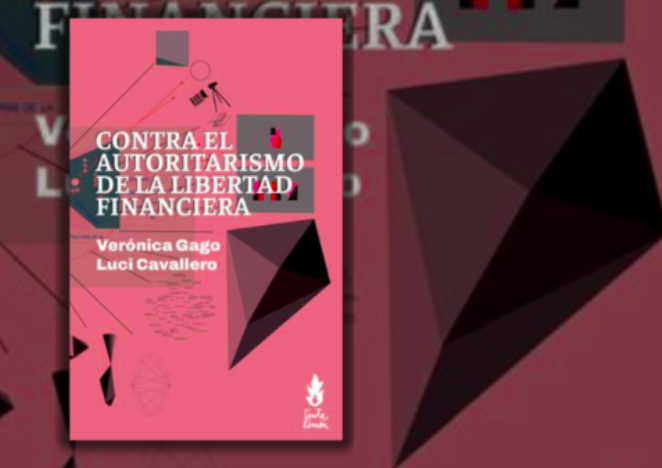
Verónica Gago and Lucí Cavallero’s book completes a trilogy that takes debt seriously as a feminist problem—one that operates not as a momentary burden but as a lasting mechanism of dispossesion.
Echoing a global trend, the country's ruling Colorado Party has relied on vague accusations of corruption to attack critical NGOs and further their far-right agenda.
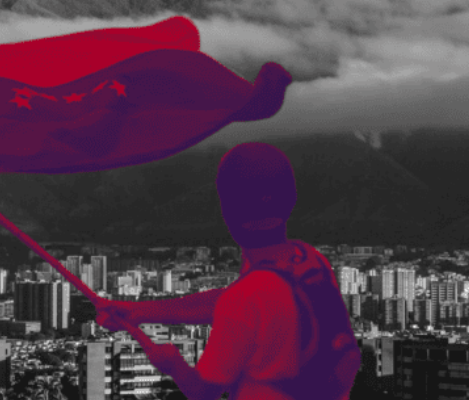
Early on January 3, the U.S. government invaded Venezuela and took President Maduro into custody. It marked the first time the United States used its own military to invade a South American country.
How Trump is redefining U.S. foreign policy in Latin America with Monroe 2.0. This is Season 2, Episode 1 of Under the Shadow.
IMAGE OF THE WEEK
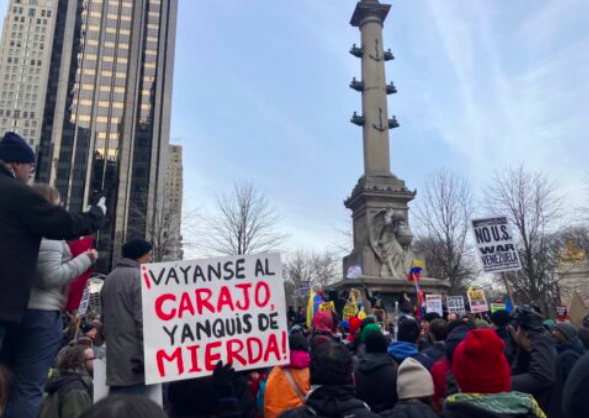
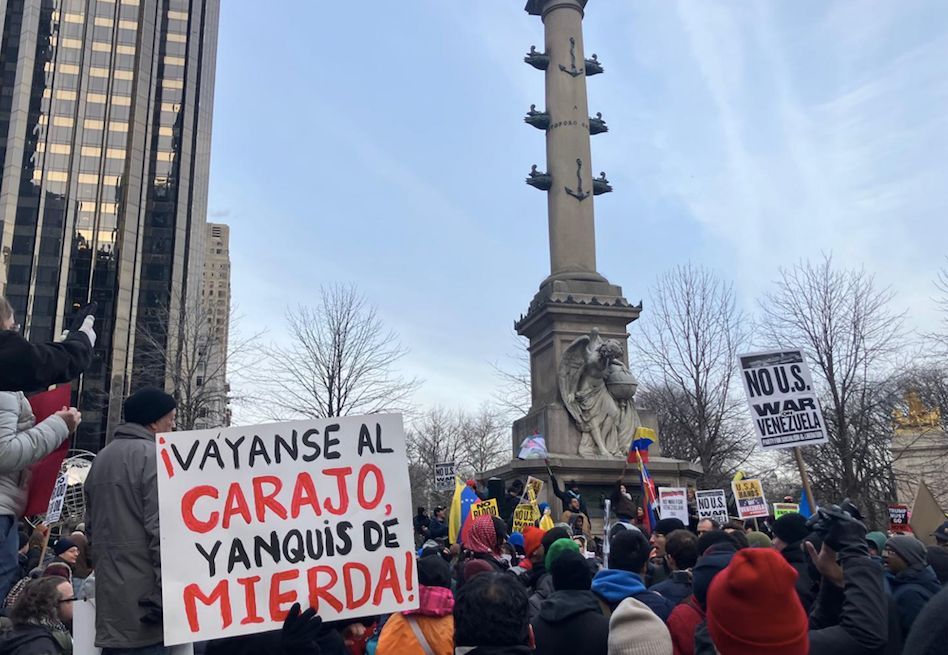
Protesters gathered at Columbus Circle in Manhattan on Saturday to oppose the U.S. attack on Venezuela. (Gabe Levine-Drizin).
AROUND THE REGION
WEAK U.S. OPPOSITION—The vast majority of the Democratic Party, the nominal opposition, has played along with Trump’s invasion of Venezuela, limiting its criticism to procedural concerns while echoing the claim that Maduro was a “brutal, illegitimate ruler” and therefore a legitimate target of intervention. Impeachment calls from a growing yet small cohort of lawmakers have not been taken seriously by party leadership, while anonymous Democrats have briefed the press to chastise their colleagues for failing to celebrate Maduro’s removal. Confronted with a profound constitutional—and moral—crisis, party leaders have reverted to a tactic that failed just weeks ago: a War Powers Resolution in Congress. On Thursday, Democrats celebrated what they deemed a major victory when the Senate successfully advanced legislation that would require the president to consult Congress before further military action against Venezuela. Yet the legislation is unlikely to become law—it must pass the House and survive a Trump veto. In any case, it is a strikingly insufficient response to an operation that involved the kidnapping of a foreign leader and the killing of soldiers and civilians, all in the pursuit of cheaper access to resources.
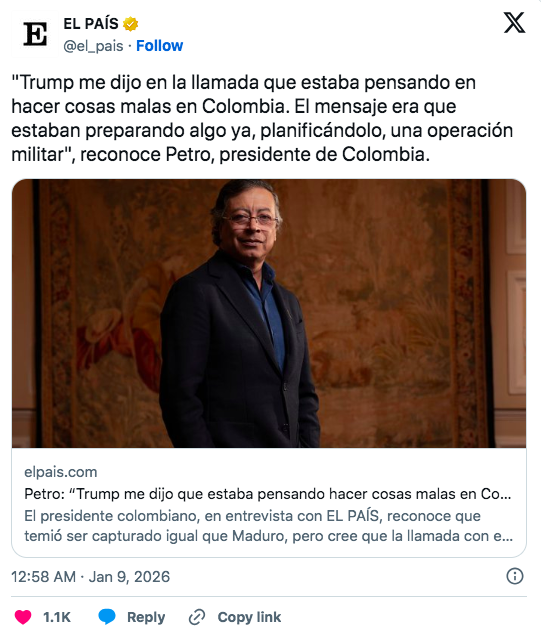
U.S.-COLOMBIA TENSIONS—On Sunday, Trump told reporters on Air Force One that Colombian President Gustavo Petro was “a sick man who likes making cocaine and selling it to the United States,” adding that a military operation against Colombia “[sounded] good” to him. Petro, who has repeatedly clashed with the Trump administration over Gaza, migration, drug interdiction, and U.S. strikes on boats in the region, responded defiantly. A former guerrilla fighter, he declared that he would “take up arms again to defend the country,” convened massive rallies in defense of Colombian sovereignty, and had his foreign minister warn that any U.S. attack would trigger a military response. Petro’s bombastic rhetoric has angered Colombian liberals and conservatives alike, many of whom blame him for provoking U.S. aggression. Yet Trump’s threats against more cooperative allies, including Mexico, suggest that tone is not the determining factor. Petro’s broader warning—that international law has been replaced by the rule of the mighty, a shift he links to the genocide in Gaza—has also largely been proven right. Petro’s fiery response appeared to yield results: on Wednesday, amid massive anti-U.S. protests across Colombia, Trump said he had spoken with Petro, described the call positively, and invited him to the White House.
ATTENTION ON CUBA—The Cuban government announced two days of national mourning on Tuesday to honor the 32 military personnel killed in the U.S. attack on Venezuela. The announcement coincided with the release of details about the fallen soldiers, underscoring the enduring—if diminished—ties between Cuba and Venezuela. Those ties have long revolved around the exchange of Cuban doctors, nurses, and security personnel for discounted Venezuelan oil. The relationship has fueled speculation about the longevity of the Cuban government, a theme Trump echoed on Sunday when he claimed the country looked “ready to fall” because it “got all their income” from Venezuela’s oil. While the assertion overstated Cuban dependence, it adequately captured the severity of the island’s current economic crisis, a situation exacerbated by U.S. sanctions. Targeting Venezuela to get to Cuba has long been an explicit goal of Secretary of State Marco Rubio, who told the press on Saturday that Cuba is “in a lot of trouble.” Though he downplayed the need for direct military intervention, Trump echoed the sentiment, saying, “Cuba is going to be something we’ll end up talking about” because it is “a failing nation right now.”
MEXICO IN THE CROSSHAIRS?—The Trump administration’s attack on Venezuela reverberated with a particular intensity in Mexico, a country that Trump has long accused of being run by cartels. Following Maduro’s kidnapping, Trump threatened Mexico, saying he would “have to do something” because drugs are “pouring through” the country. While President Claudia Sheinbaum denounced the attack on Venezuela, she also called for further security collaboration with the United States, an impossibly thin line she has continually tried to walk. This course of action was struck a heavy blow on Thursday, when Trump announced that his administration would carry out land operations against drug trafficking groups, a threat made more meaningful by recent events. Sheinbaum nonetheless stayed the course, calling on Friday to “strengthen coordination” with the Trump administration. Her government has also lashed out at the opposition, accusing them of calling for direct U.S. intervention, a claim bolstered by the open celebration of Maduro’s kidnapping by many prominent right-wing figures.