Last Sunday, a brutal gang massacre in the Haitian town of Kenscoff killed at least 47 people and led to the kidnapping of dozens more who are currently being held hostage. The attack punctured any notion that the country’s security situation was improving and cast doubt over the viability of elections, currently scheduled to take place in December.
The attack occurred in a strategically-located town above the hills of the capital, Port-au-Prince, leading to fears that the next target would be the upper-class suburb of Petion-Ville, an area that has been largely spared the violence of the rest of the city. Gang members reportedly rampaged through the village in the evening, burning buildings, taking hostages and committing acts of sexual violence; 22 people were reportedly killed while hiding in a church. Gang leaders then threatened to kill the more than 50 hostages if any of their members were killed in security operations to retake the community. The attack is one of the largest mass kidnappings in the country in recent years.
Haiti has long been one of the region’s poorest countries due to its forced payment of billions of dollars to compensate the French upon independence, nearly a century of U.S. intervention, and a slew of brutal natural disasters. The country’s social and political crisis intensified in the wake of the assassination of President Juvenel Moise in July of 2021. Presidential elections have not been held since 2016, and a powerful coalition of gangs have taken increasing control of the capital city and surrounding areas—leaving a record 1.5 million people displaced—and a rotating cast of political leaders have ruled with very little legitimacy. In the face of these deep crises, the international community has largely trotted out the same solution, vowing to send more soldiers, regardless of the inefficacy of the approach.
The strain on Haitian society caused by rampant insecurity has been exacerbated by the ongoing deportation of Haitians around the region. Leading the way has been the Dominican Republic, whose barbaric immigration crackdown under President Luis Abinader saw more than 379,000 Haitians deported in 2025 alone, often by the most reprehensible means, including the targeting of pregnant women and the use of cage-like trucks. Recently, the Trump administration has also ramped up its attacks on Haitians in the United States. In June, the Supreme Court allowed the government to strip 350,000 Haitians of their Temporary Protected Status. Last week, the U.S. government carried out its first deportation flight to Haiti since the ruling, uprooting the lives of more than 160 people and bragging about the “criminals” it had sent to a country in a profound crisis. The Trump administration is reportedly set to drastically expand deportation flights to Haiti to one flight per week.
Thank you to all who took the time to share your feedback in our Audience Survey! The NACLA team has already been brainstorming ways to apply what we’ve learned:
You trust us, for deep, critical investigation into the issues you care about in the region that is nearest and dearest to you.
Most respondents have been reading NACLA for over 15 years, and many since the start, nearly 60 years.
Our readers want more content en español, more explainers and issue overviews, and video.
Many readers are willing to make small monthly contributions to keep NACLA alive.
Working with journalists, activists, and experts to provide you with the coverage you depend on is made possible by a tiny dedicated team of editors. NACLA is operating on a budget that’s tighter than ever after cuts to funding this year. Will you support NACLA with a monthly donation today?
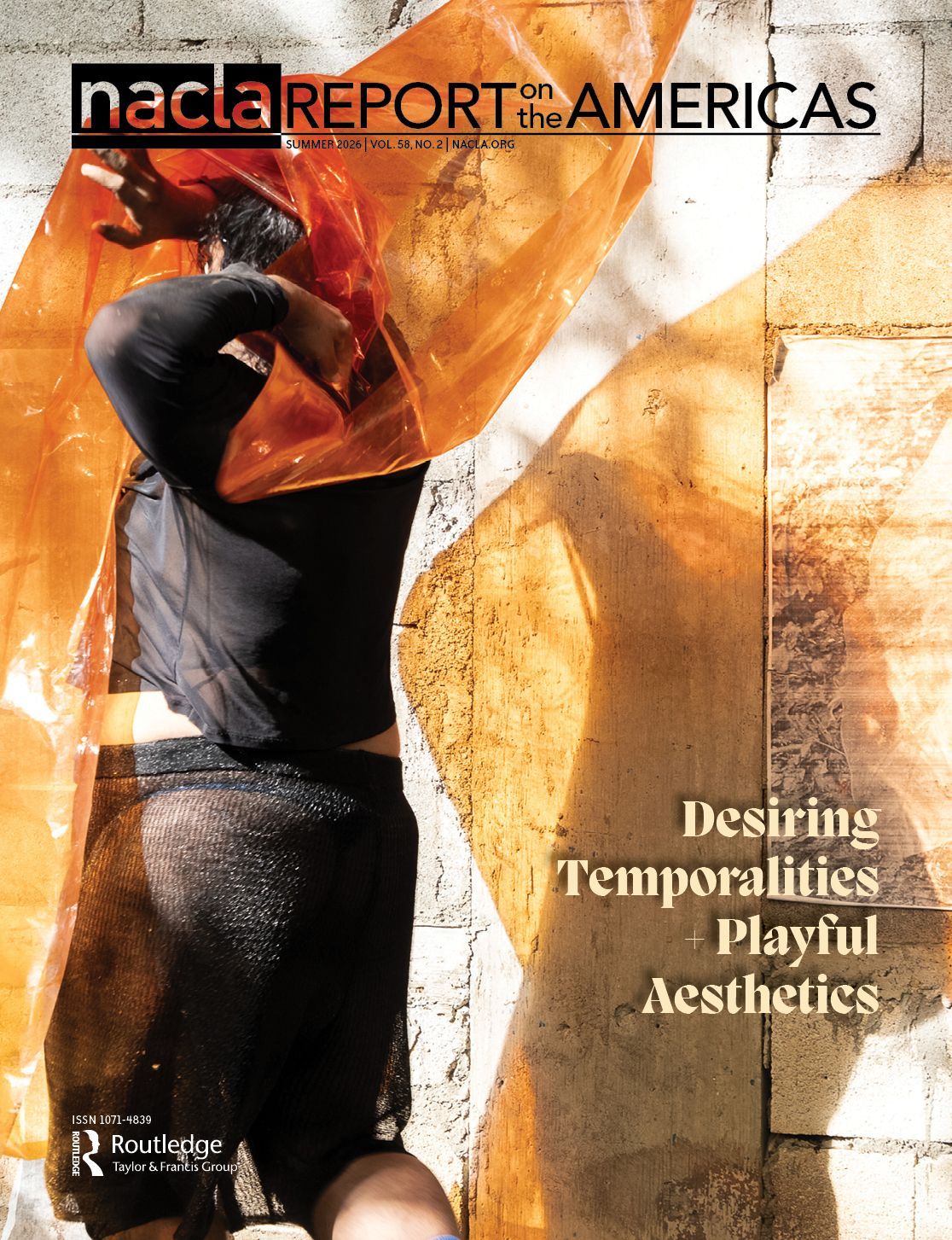
The Summer 2026 issue of the NACLA Report explores artistic and research practices that activate memory, engage the archive, and expand the possibilities of collective life amid ongoing forms of dispossession, militarization, and war. From Puerto Rico and Palestine to Colombia, Ecuador, Mexico, and the diaspora, contributors examine how artists, writers, performers, and organizers are creating new ways of inhabiting history, preserving memory, and imagining futures that exceed the limits imposed by colonialism, racial capitalism, and state violence.
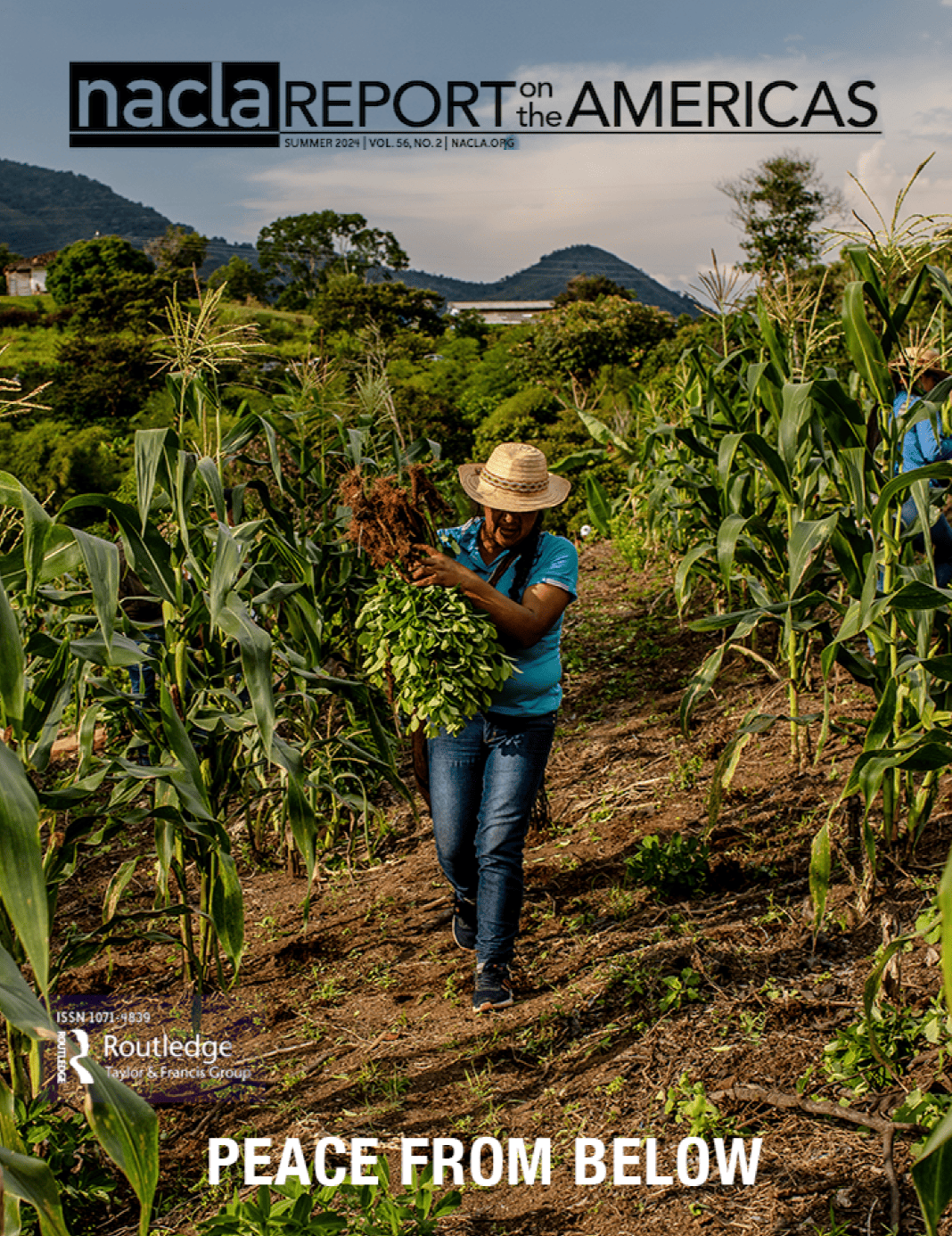
Subscribe now to receive NACLA’s fall 2026 issue, “Peace from Below,” examining the promises, achievements, and shortfalls of Colombia’s historic Peace Agreement signed a decade ago.
Guest edited by Anthony Dest and Diana Gómez Correal, the issue foregrounds the voices, analysis, and testimony of grassroots movements at the forefront of building peace, including former insurgents, buscadoras leading the search for the disappeared, victims of state violence, exiles displaced by the armed conflict, and campesino, Indigenous, and Afro-descendant communities that continue to confront multiple forms of violence at the hands of armed groups. At a critical moment, when an incoming far-right administration threatens to undo the hard-fought gains of the peace process, this collection centers the proposals, struggles, and demands of Colombians deeply committed to building peace from below.
If you haven’t done so already, subscribe byAugust 31to receive your issue in the mail. And, as always, please consider supporting this work.
Over the past year, the U.S. Army Corps of Engineers has received $170 million from the Guatemalan government for road and port infrastructure projects that are deepening its dependence on the U.S.
The massacre of 20 campesinos in the Bajo Aguán Valley demonstrates the deadly consequences of their struggle against powerful landowners with ties to the recently elected far-right government
IMAGE OF THE WEEK
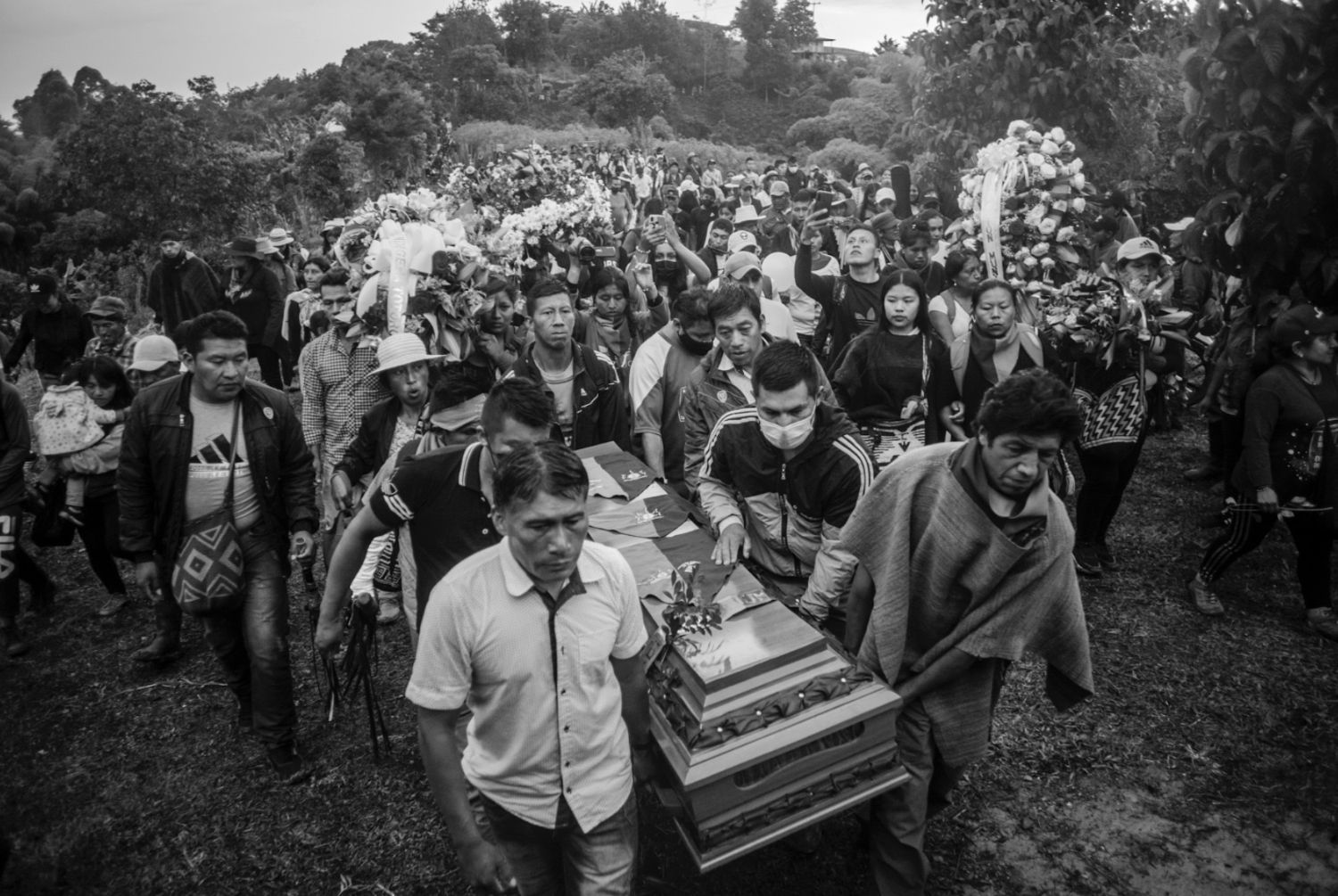
The funeral of Indigenous leader Sandra Liliana Peña Chocué, assassinated by FARC dissidents after leading efforts to eradicate illicit coca crops in Caldono, Cauca, April 2021. For more, stay tuned for the Fall 2026 edition of the NACLA Report, "Peace from Below." (ARIEL ARANGO PRADA / ENTRELAZANDO)
U.S. MIGRATION CRACKDOWN—According to newly released government data, the Trump administration arrested and deported a record number of migrants in July. The numbers are staggering: nearly 50,000 people were arrested—almost 1,600 per day—and nearly 34,000 people were deported—around 1,100 per day. The majority of deportees had no criminal convictions or charges. The deepening immigration crackdown is part of a change in tactics. The government has been relying upon quieter enforcement operations instead of the blitzkrieg style attacks that produced major backlash in cities like Minneapolis and Chicago. The Trump administration has also increasingly focused on cutting down the number of migrants who visit the country; this week it announced a pause on U.S. visa applications across the world, a move the Trump administration argues is necessary to retrain consular officers. The administration also announced this week that it would soon carry out the largest mass visa revocation in U.S. history, targeting the business and tourism visas of 200,000 foreigners who applied for or are currently seeking asylum. While those who lose their visas would not automatically be targeted for deportation—their asylum cases would likely continue—the policy has served as another front in the attack on legal forms of migration.
DEPORATIONS AND PRISONS IN COLOMBIA—Colombia’s far-right President Abelardo de la Espriella announced an immigration crackdown on Sunday. He vowed to begin deporting “irregular migrants” within the week. His speech immediately drew comparisons to Donald Trump's rhetoric. De la Espriella linked irregular migration to criminality, a relationship widely rejected by experts.” While he did not mention Venezuelans directly, they account for roughly 90 percent of the country’s migrant population and nearly 850,000 are currently in an irregular situation. The announcement came as the death toll from the recent massive earthquake continues to climb and the government’s lackluster response has continued. The government also sought to bolster its image as “tough on crime” this week, announcing a plan to build new prison ships and publishing propaganda videos of prisoners being transferred in a manner similar to the videos of Salvadoran strongman Nayib Bukele, who has deeply inspired Colombia’s new leader.
PANAMERICAN CONGRESS—Last weekend, more than 150 representatives from 15 countries gathered in Montevideo, Uruguay for the “Panamerican Congress,” a regional conference promoting dialogue between the hemisphere’s progressive forces. This is the third such conference after similar events in Bogotá in 2024 and Mexico in 2025. Participants pushed for more equal dialogue between the Global North and Global South and the construction of wide coalitions and alternative mechanisms through which to defend a crumbling international order. The event took place at an extremely difficult moment for the regional left; in the year that has passed since the last conference, the left has lost power in Bolivia, Honduras, Chile, and Colombia. Nevertheless, as reported by the New York Times, hope came from an unlikely place: the recent wave of progressive victories from democratic socialists in the United States. Indeed, soon-to-be congressional representatives Darializa Avila Chevalier (D-NY), Claire Valdez (D-NY), Chris Rabb (D-PA), and Adam Hamawy (D-NJ) were all in attendance; their Latin American counterparts repeatedly cited their victories as demonstrative of the type of politics the left needs to reclaim, namely a deep attachment to working-class politics.