Monday morning, a magnitude 7.4 earthquake struck western Colombia, killing nearly 300 people, and injuring over 4,000. Potentially thousands remain missing, according to the latest figures. The massive quake came merely three days after the inauguration of the country’s new far-right President Abelardo de la Espriella (ADLE), who came to power promising a return to stability after what he alleged was four years of chaos under his leftist predecessor Gustavo Petro. The earthquake represented a quick test for the novice government; while the original damage was beyond his control and the situation remains in flux, de la Espriella’s response to the crisis has been incredibly lackluster.
De la Espriella, who was inaugurated on Friday, August 7, inherited a country that was woefully underprepared for natural disasters of this scale. This unpreparedness, which largely falls along regional and class lines, was magnified by the fact that the epicenter was the town of San José del Palmar, in the eastern-part of the conflict-ridden Chocó department—the town itself remains largely unreachable. While the extent of the damage in the rest of the department remains unclear due to the isolated nature of many Chocó communities, the capital city, Quibdó, was heavily affected, as were the nearby cities of Manizales, Pereira, Armenia, and Cali; Colombians in Medellín and Bogotá, too, felt the effects.
Much of the rescue efforts have focused on Cali, the country’s third-largest city, which was hit especially hard. In the immediate aftermath, residents largely took on the work of saving their neighbors themselves; on Tuesday, when mayor Alejandro Eder visited an affected neighborhood, he was chased out by angry residents. While there were scenes of miraculous rescues, by Thursday, the crucial 72-hour window to find survivors alive had come to an end; in Cali, crews have begun to shift their attention away from rescue operations to the removal of debris.
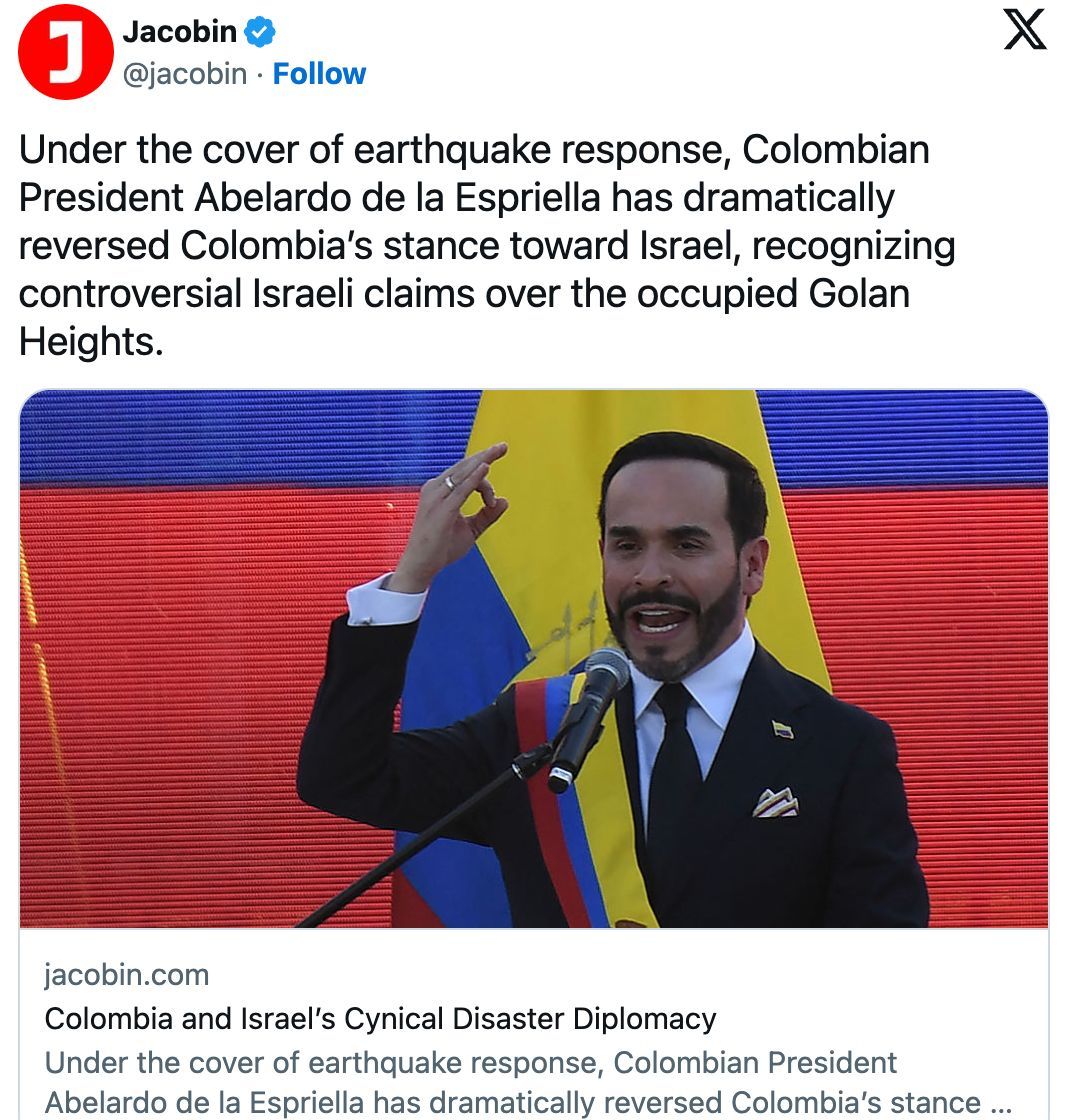
While the magnitude and location of the earthquake was set to make any relief effort incredibly difficult, de la Espriella’s initial response has been resoundingly criticized. Detractors have zeroed in on de la Espriella’s handling of international affairs. After initially claiming that Colombians had enough resources to handle their own rescue operations—leading him to accept only international offers of humanitarian assistance and reject formal offers of rescue teams—the government finally approvedthe entry of rescue teams from Ecuador, El Salvador, the United States, and Israel, all allied right-wing nations. In the immediate aftermath of the quake, his Foreign Ministry also posted a statement formally recognizing Israeli sovereignty over the Golan Heights, a Syrian territory it has illegally occupied for decades.
The rescue efforts have also been complicated by ADLE’s combativeness—the fact that he refused to take part in the formal handover process through which the state seeks to ensure continuity in its governance has made the task more difficult. The entity in charge of coordinating the relief effort, the National Unit for Disaster Risk Management (UNGRD), was headed by a Petro ally at the time of the earthquakes. David Tamayo, de la Espriella’s pick, had not been formally nominated, though he is now serving in the role. De la Espriella was also in Barranquilla when the earthquake struck, forcing him to fly to Bogotá to coordinate the response, wasting valuable time.
The task ahead remains difficult and the challenges of delivering aid to Chocó are complicated by the country’s armed conflict, as NACLA co-web editor Lara Loaiza argued this week in a piece for The New Humanitarian. It is quite possible that the humanitarian crisis will deepen as the state returns to the iron-fist approach to criminal organizations of the past.
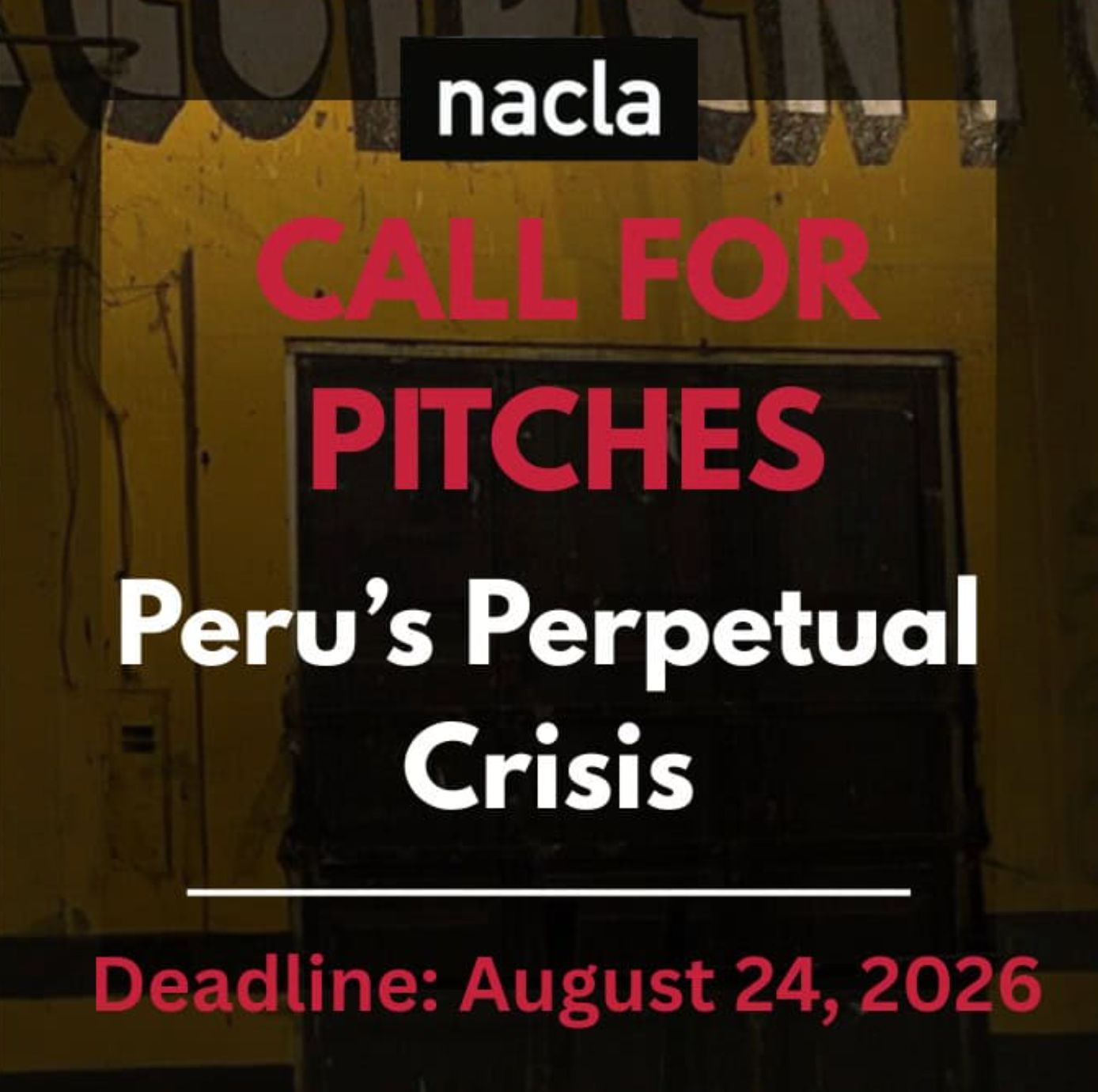
NACLA invites original contributions centered on Peru’s enduring institutional and political crisis (2018 – present), the legacy and resurgence of historical Fujimorismo, and the challenges ahead following Keiko Fujimori’s election as president for our Spring 2027 issue. Guest edited by Javier Puente and Gonzalo Romero, this issue will bring together detailed perspectives that collectively dissect Peru’s seemingly perpetual crisis and the emergence of a “hybrid regime” combining authoritarianism, corruption, and social repression, with troubling consequences for popular democratic legitimacy.
Please send a brief pitch (250 words) outlining the central argument, approach, and tone of your proposed contribution and why you are well positioned to write it by Monday, August 24 to managing editor Julianne Chandler at [email protected]. We will respond to pitches by early September. Drafts of accepted articles (2,500-3,500 words) will be due on December 1, 2026.
NEW ISSUE COMING SOON!
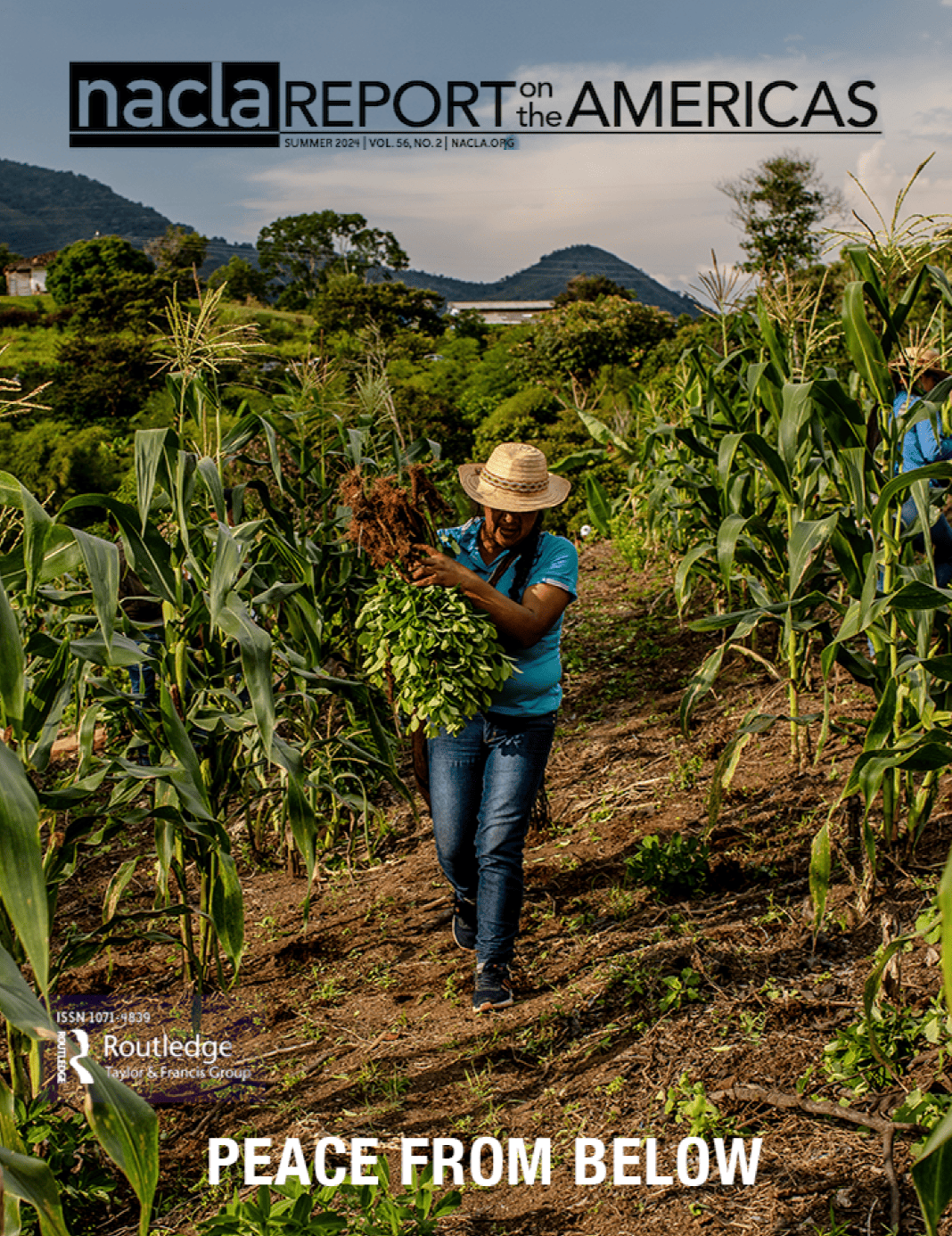
Subscribe now to receive NACLA’s fall 2026 issue, “Peace from Below,” examining the promises, achievements, and shortfalls of Colombia’s historic Peace Agreement signed a decade ago.
Guest edited by Anthony Dest and Diana Gómez Correal, the issue foregrounds the voices, analysis, and testimony of grassroots movements at the forefront of building peace, including former insurgents, buscadoras leading the search for the disappeared, victims of state violence, exiles displaced by the armed conflict, and campesino, Indigenous, and Afro-descendant communities that continue to confront multiple forms of violence at the hands of armed groups. At a critical moment, when an incoming far-right administration threatens to undo the hard-fought gains of the peace process, this collection centers the proposals, struggles, and demands of Colombians deeply committed to building peace from below.
If you haven’t done so already, SUBSCRIBE NOWto receive your issue in the mail. And, as always, please consider SUPPORTING THIS WORK.
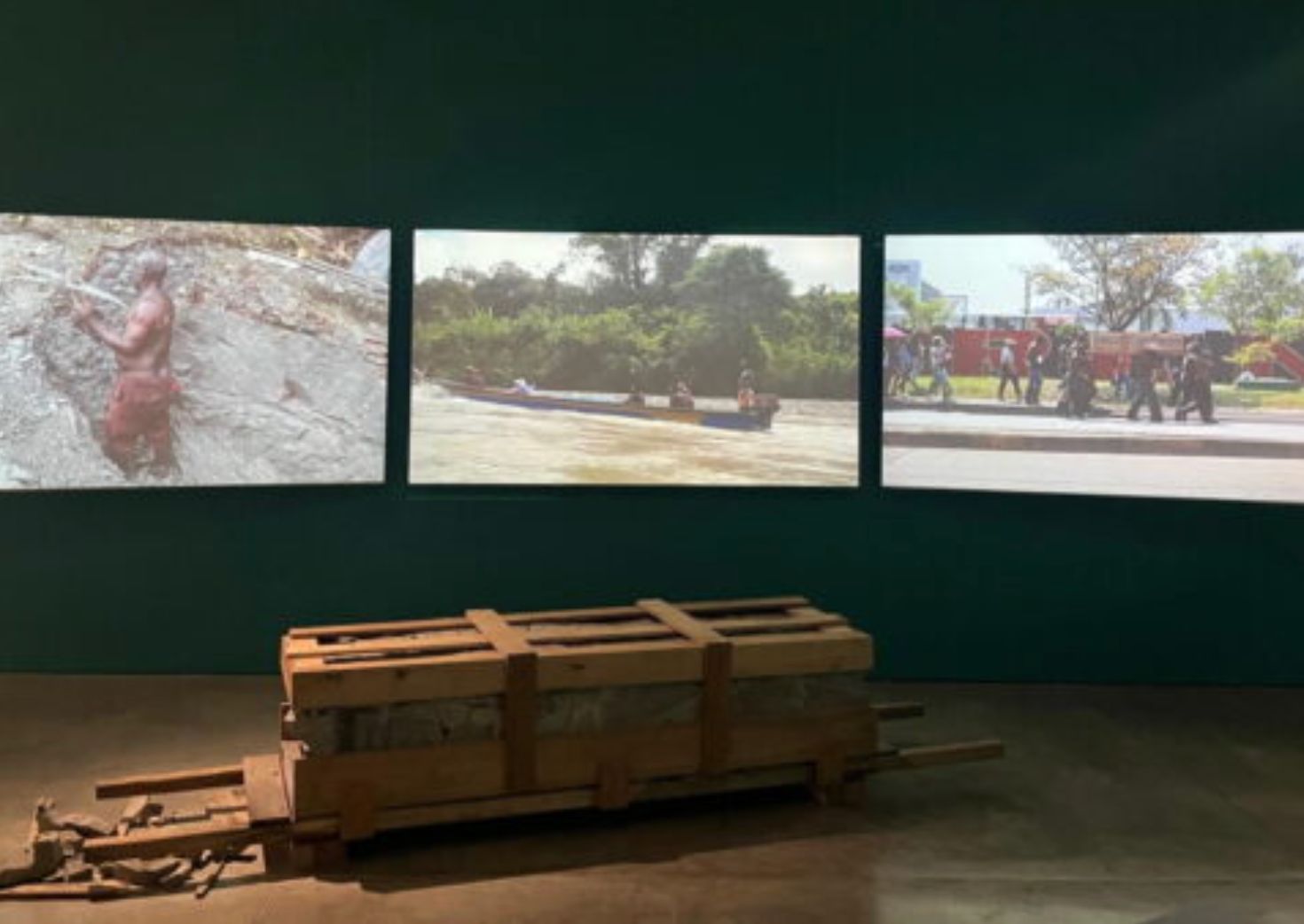
Tracing a journey from the gold mines of Timbiquí to the Pacific and on to Cali, Eblin Grueso’s Viaje en el Tiempo activates memory as a detonating force that affirms Black life.
Tras cuatro años de una campaña de represión contra presuntos pandilleros que ha acabado con los derechos civiles, las recientes reformas constitucionales abren la puerta a nuevos abusos.
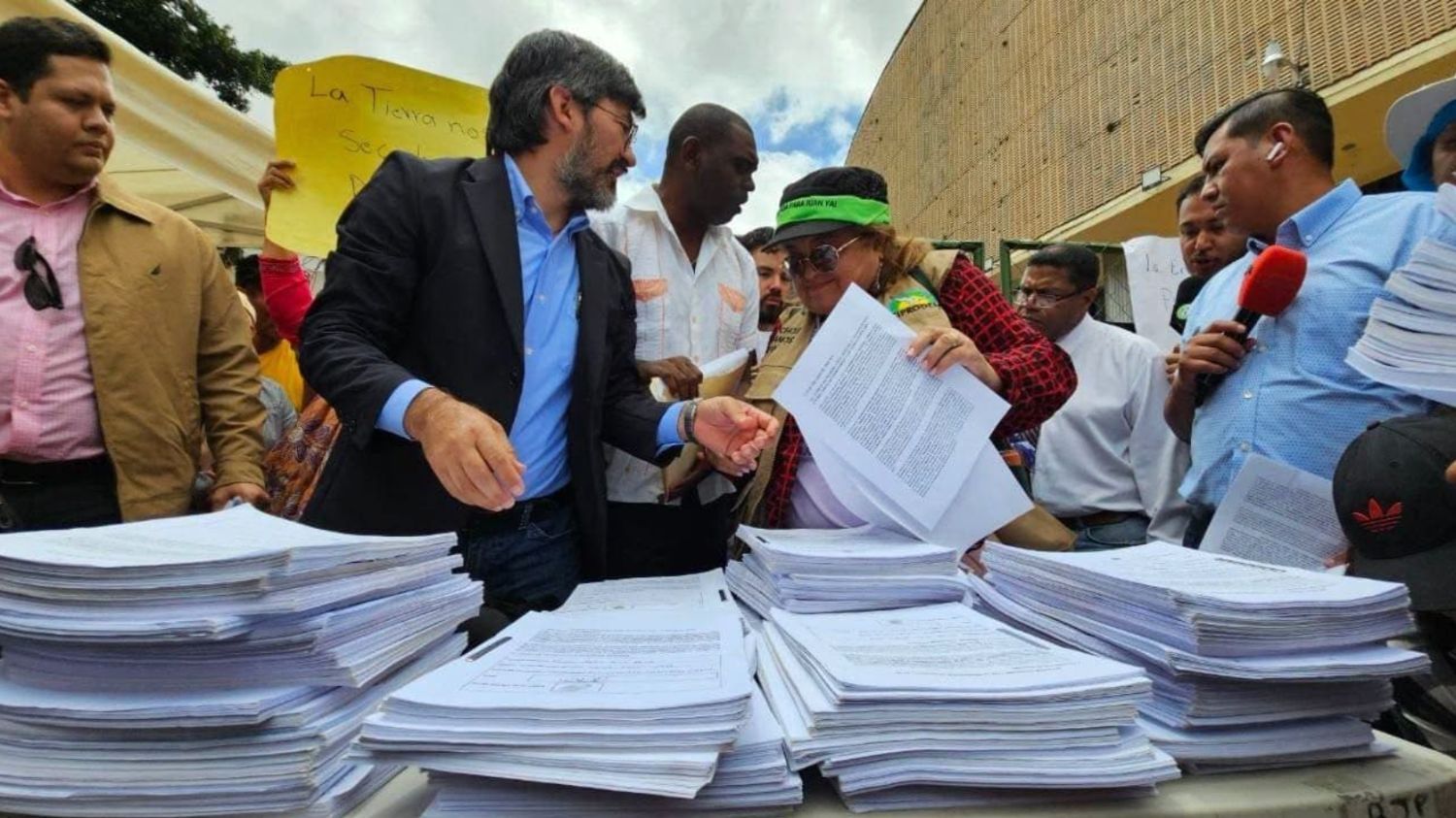
Honduran social movements gather signatures outside the National Congress on July 29. Read more about how a business-friendly agro-industry law, implemented by the country’s new right-wing government, is intensifying pressure on Garífuna land in Theodora Bradford's article. (Photo: OFRANEH)
AROUND THE REGION
COLOMBIA AUTHORIZES JOINT U.S. STRIKES—Colombia formally joined the Americas Counter Cartel Coalition (A3C) on Wednesday, a U.S.-led regional initiative that serves as one of the main tools of the so-called “Shield of the Americas.” Additionally, U.S. Secretary of Defense Pete Hegseth announced that new far-right President Abelardo de la Espriella had authorized joint counter-terrorism operations, a move that opens the door to U.S.-led strikes on Colombian territory, which Hegseth said has already been discussed. De la Espriella’s granting of permission to U.S. troops to operate on Colombian soil is likely unconstitutional—the transit and operation of foreign troops on Colombian soil requires Congressional approval. The agreement was formalized in Panama, where Hegseth spent two days meeting with the A3C’s 19 partner members, deepening ties, and rallying support against the International Criminal Court, which he accused of launching a “lawless power grab” for potentially investigating U.S. strikes in the region, a step it has not yet taken.
VENEZUELA-ISRAEL TIES—Venezuela became the latest country in the region to warm up to Israel, announcing the re-establishment of diplomatic relations after 17 years. The move, which will re-establish consular services but falls short of full diplomatic ties, was linked to Israel’s provision of humanitarian aid in the wake of the twin earthquakes that devastated Venezuela in June. This step was predicted last week by Simón Rodriguez, who wrote for NACLA about how Israel's “disaster diplomacy” worked as a vehicle to establish deeper ties. The decision is a massive political development in a region that just years earlier was at the forefront of the Palestinian solidarity movement; similar moves have recently been made in Bolivia, Honduras, and Chile. Beyond the diplomatic language, however, energy concerns appear to be a central component of the decision: behind the scenes, Israel’s Energy and Security Minister has recently held talks with his Venezuelan counterparts on possible cooperation in the energy and technology sectors, and the country’s vast oil reserves are being cited as a vehicle to deepen collaboration.
100 DAYS FOR COSTA RICA’S PRESIDENT—Laura Fernández, Costa Rica’s right-wing president, marks her first 100 days in office on Sunday. Fernández is a protegée of former President Rodrigo Chaves, who continues to play a major role in her administration as both Minister of the Presidency and Minister of Finance, earning him the nickname “superminister.” Chaves, a populist who left office with high approval ratings, has been taking on duties far beyond his mandate. Fernández has largely followed in his footsteps, adopting his weekly public addresses, mimicking his manner of speaking, and replicating his attacks on the opposition. Fernández has also carried on with his attacks against Costa Rica’s independent institutions: her administration and allies in Congress are currently locked in a bitter dispute with the country’s courts that has led to fears of creeping authoritarianism and spurred protests in defense of democracy. Fernández has accused the Constitutional Court of trying to carry out a “coup d’etat” for operating without the requisite number of magistrates, a reality imposed by her and her congressional allies who have cut its budget and refused to appoint substitutes. The courts had previously investigated Chaves for corruption, an accusation made against the courts by Fernández and Chaves themselves, a common move in the authoritarian playbook.
SHOCK GLOVES FOR ICE AGENTS—The Department of Homeland Security is reportedly set to spend upwards of $20 million to equip ICE agents with gloves that can deliver painful electric shocks, according to plans that it posted on Monday. Billed as a “de-escalation” device, the use of the technology—known as CTG-5 G.L.O.V.E., or Generated Low Output Voltage Emitter—has raised fears that agents will use them to escalate their use of force. Demonstrations of their use, made by the provider Compliant Technologies, show that they are incredibly painful. ICE has been criticized for its use of disproportionate force; on Monday, another video of a near-death encounter emerged in which an ICE agent pointed a gun at Carolina Molina, a Virginia woman who was falsely accused of trying to run over agents. The electric gloves are largely untested; many policing experts had reportedly never heard of the technology prior to the news of its impending use.