The revelation that two U.S. officials killed in a car crash on Sunday in northern Mexico were members of the CIA has spurred a week of intense debate over the scope of U.S. involvement in the fight against organized crime and the role of local governments in coordinating directly with U.S. forces. The crash, in the northern border state of Chihuahua, also killed two Mexican officials and occurred as the investigative team was returning from an operation targeting clandestine methamphetamine labs led by Mexico’s Armed Forces.
The deaths of two U.S. intelligence officers, originally identified as embassy officials, put President Claudia Sheinbaum in a difficult position. Sheinbaum, who has faced threats from a belligerent U.S. administration of drone strikes against alleged cartels that Trump claims run the country, has long responded to U.S. pressure by emphasizing “collaboration,” though only when authorized by the federal government and with U.S. forces limited to a supervisory role. As she made clear, however, the federal government was not aware of the agents’ presence—an apparent violation of a previous agreement with the Trump administration that was compounded by the agents’ apparent operational role on the ground. Her administration announced Monday that it was launching an investigation into the crash, focused specifically on whether the involvement of U.S. forces violated national security laws.
Sheinbaum and her allies quickly blamed officials in Chihuahua, one of the few states governed by the political opposition. On Monday, she suggested that the presence of the U.S. agents may have resulted from direct collaboration between the U.S. embassy and the state government without federal authorization—an arrangement she argued violated the Mexican constitution. Days later, she announced she was considering sanctions against state officials, stressing that “there cannot be any agents from any U.S. government institution operating in the Mexican field.”
Following her lead, on Wednesday, Mexico’s Senate voted overwhelmingly to summon Governor María Eugenia Campos and Attorney General César Jáuregui to testify before Congress about the incident. During the debate, lawmakers from Sheinbaum’s MORENA party accused Campos and her right-wing National Action Party of “betraying the homeland and the Mexican people” by concealing the CIA’s presence—an agency that senators emphasized has long worked to overthrow democratically elected governments in the region. The former governor of Chihuahua and current senator Javier Corral likewise, accused Campos of “facilitating foreign interference” and called for her removal from office.
Officials in Chihuahua, meanwhile, have repeatedly changed their story. After originally stating that the crashed as officials were “returning from an operation to destroy clandestine drug labs,” Jáuregui later claimed the U.S. agents had been working on a separate operation six hours away and only ended up traveling with officials involved in the drug raid after they were given a ride—a claim directly contradicted by Sheinbaum.
Aside from anonymously confirming that the deceased agents were CIA personnel, the response from U.S. authorities has been relatively muted. White House Press Secretary Karoline Leavitt said Sheinbaum should show “some sympathy” for the “two American lives lost” while helping to “stop the scourge of drug trafficking," which she argued benefits both countries. For her part, Sheinbaum appeared to lower the temperature Thursday, saying she “did not want conflict” with the Trump administration and directing her criticism instead at local officials she accused of violating protocol.
Join us for a virtual discussion on the production of this important issue.
The latest issue of the NACLA Report, "Borders Can't Contain Us," examines the consolidation of a hemispheric bordering regime whose reach now extends far beyond any single boundary line, tracing how border violence has moved from the margins to the center of political life across the Americas.
Though the First Conference on Transitioning away from Fossil Fuels is a historic achievement, movement organizers question if it will create needed pathways toward a just transition
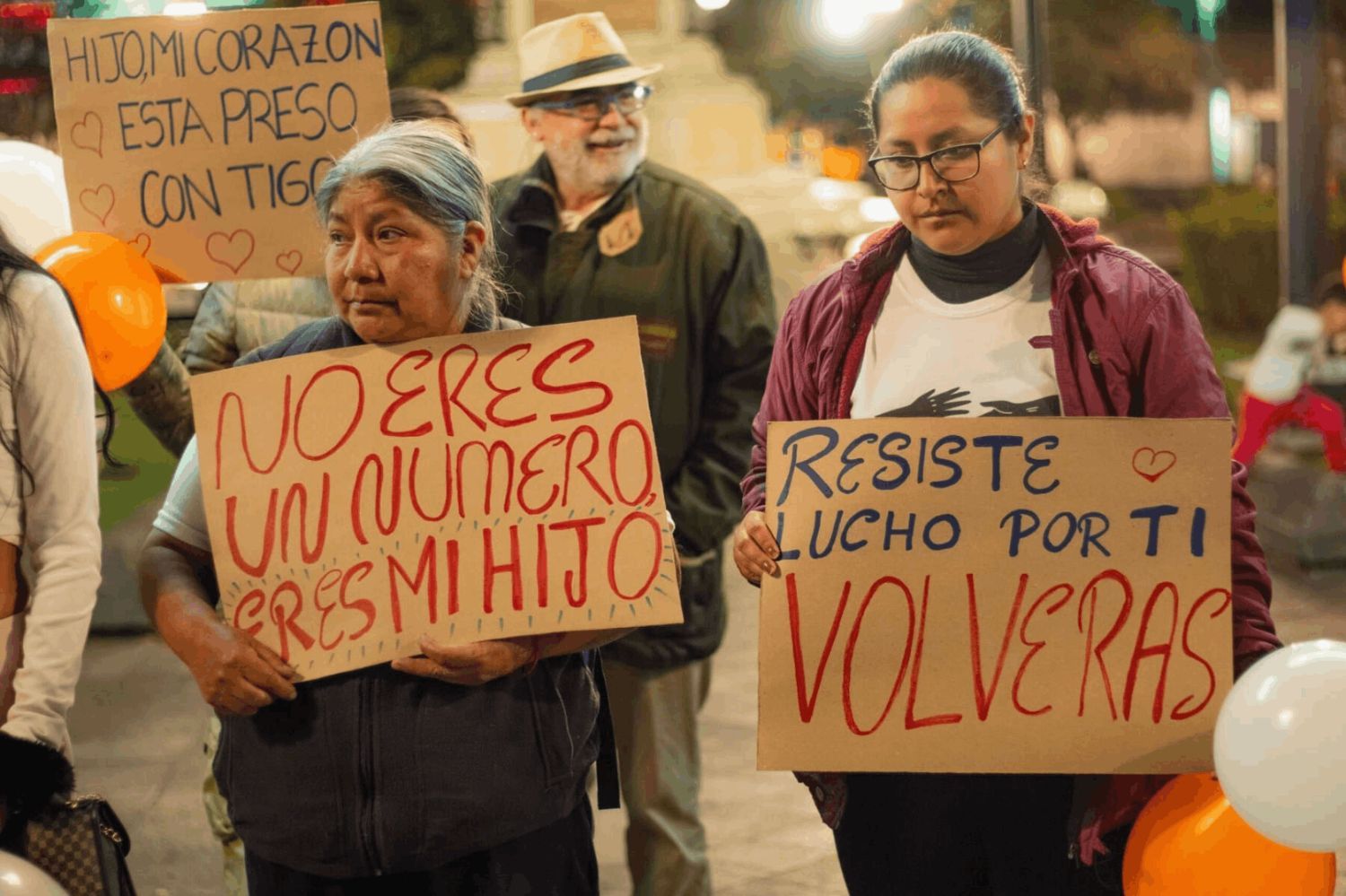
Two years on, far-right President Daniel Noboa’s prison crackdown—characterized by militarization, corruption, and deadly violence—has yielded no results.
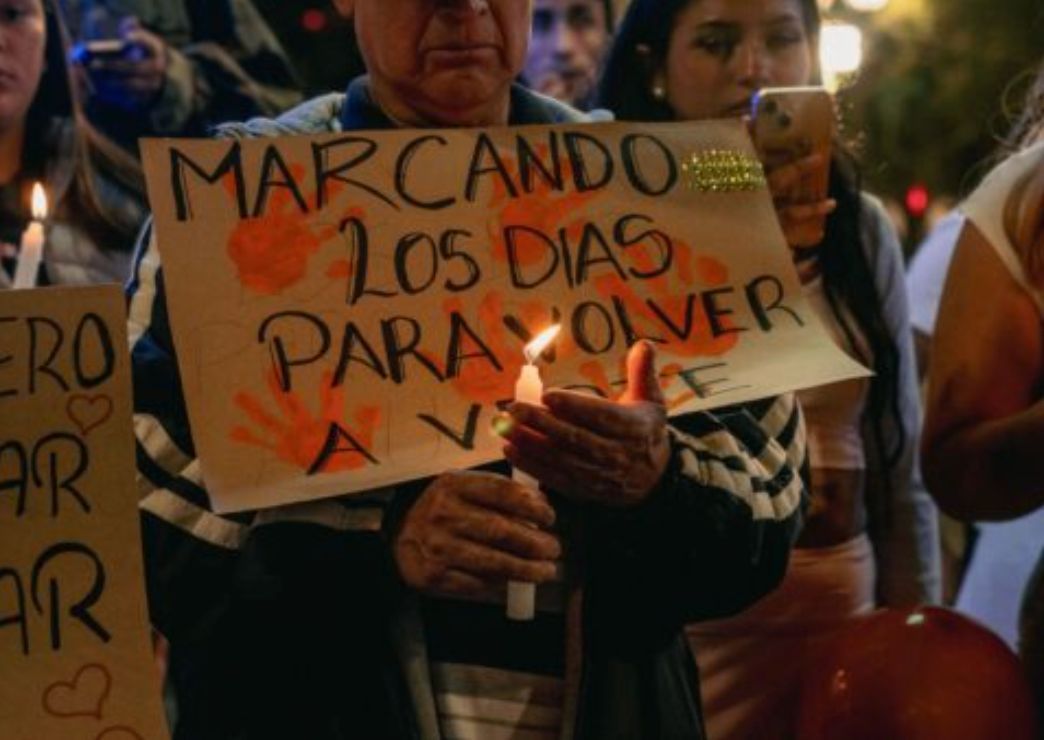
Families of detainees protest human rights abuses against their loved ones in Quito, Ecuador, on December 22, 2025. Read more in "Militarizing Ecuador's Prisons Has Failed," an article by John Henry Murdy published this week. Lee este artículo en español. (Gabriela Giacometti Burbano)
AROUND THE REGION
U.S. DEPORTATIONS—Late last week, 15 South American migrants were deported from the United States to the Democratic Republic of the Congo (DRC), a war-torn nation that recently signed an agreement with the Trump administration to accept “third-country nationals.” Their deportations—which reportedly should not have occurred, as all of the migrants had court-ordered protections—included a grueling 27-hour journey during which they remained shackled. Though the DRC framed the accord as a reflection of its “commitment to human dignity and international solidarity,” deportees interviewed in the capital city of Kinshasa described horrible conditions upon their arrival. One Colombian national said, “we want to leave but they don’t let us,” adding that they were being held as “prisoners” at a property run by a UN-affiliated organization. Another deportee, a 29-year old Colombian woman who fled to the United States after being kidnapped by an armed group and abused by her police officer ex-husband, said she felt pressured by Congolese authorities to return to her Colombia. The Trump administration has pressured dozens of countries to participate in “third-country” deportations, often offering financial incentives. Paraguay announced Tuesday that it will soon receive25 Spanish-speaking deportees, while Costa Rica accepted its second group of “third-country” deportees late last week.
PERU ELECTION—Nearly two weeks after Peru’s April 12 first-round presidential election, the country appeared no closer to determining who will face leading candidate Keiko Fujimori in the run-off. Though electoral authorities began reviewing thousands of contested ballots on Monday, the official vote count has hardly moved since Friday, when leftist Roberto Sánchez held a narrow lead of just 13,000 votes over far-right former Lima mayor Rafael López Aliaga—currently in third-place with roughly 94 percent of ballots tallied. On Tuesday, Piero Corvetto, the head of Peru’s embattled election authority, announced that he was stepping down from his role. Though he acknowledged serious logistical issues during the vote, Corvetto rejected allegations of fraud, a conclusion echoed by several independent observers. López Aliaga has nevertheless claimed the election was manipulated, accusing Corvetto of allying with the “radical Left,” calling for new elections, and urging his supporters to take to the streets to “defend” democracy, as at least 3,000 demonstrators did in Lima on Sunday. After stoking what prosecutors described as an“insurgency,” López Aliaga has faced at least one criminal complaint. Final results are not expected to be released until mid-May.
MASS TRIAL IN EL SALVADOR—A Salvadoran court opened proceedings Monday against 486 alleged MS-13 gang members who are being collectively charged with more than 47,000 crimes between 2012 and 2022. If convicted on charges that include homicide, femicide, arms trafficking, and extortion, the defendants could face sentences of up to 245 years. Since a 2023 reform to the country’s penal code authorized mass trials, human rights experts have warned that detainees’ due process rights are being violated—a concern echoed at the time even by the U.S. State Department. In previous mass trials, anonymous judges handed down identical sentences to all defendants, an outcome that observers expect will be repeated in this case. The majority of the defendants are currently being held at the notorious Terrorism Confinement Center (CECOT), a maximum-security prison plagued by allegations of torture and abusive conditions, from which they watched the hearing by video link. Even as criticism of El Salvador’s prison system has mounted, right-wing President Nayib Bukele has moved to intensify his crackdown, signing into law last week a constitutional reform enabling life sentences for children as young as 12.
GUATEMALA’S ATTORNEY GENERAL—Consuelo Porras, Guatemala’s attorney general and a leading adversary of President Bernardo Arévalo, will likely step down from her role next month after losing her re-election bid. Since taking office in 2018, Porras has been an extremely controversial figure, working to roll back anti-corruption efforts, prosecuting political opponents, and attempting to prevent Arévalo’s ascent to power in 2023—actions that led to sanctions against her by the U.S. State Department. Her widely criticized sham investigations into Arévalo and his party have hindered the country’s center-left government in its efforts to advance crucial political reforms, curb the concentration of power among entrenched elites, and address rising insecurity. Arévalo lobbied hard last week against Porras’ candidacy, arguing that she had proven herself a “danger to the nation.” In her testimony before the commission responsible for finalizing the shortlist of candidates, Porras defended her record, insisting she had consistently met the requirments of the office. ” Although she can still file a legal appeal to be included on the final list of candidates, it appears her time in power is finally coming to an end.