Days after Sunday’s vote, Peruvians remained in the dark as to which candidate will face frontrunner Keiko Fujimori in June’s run-off. While it initially appeared that far-right former Lima mayor Rafael López Aliaga would coast to the second round, left-wing congressman Roberto Sánchez has since surpassed him as the week progressed, positioning himself for the run-off—though his lead remains narrow.
Election day was plagued by logistical problems, including significant delays in the delivery of ballots that caused thousands of polling stations to open hours late and hundreds in Lima to remain closed altogether. In response, electoral authorities allowed more than 52,000 voters to cast their ballots on Monday, prompting anger among voters who were forced to miss work to comply with Peru’s mandatory voting law to avoid fines. The disruptions and extension of the vote have sown distrust in the process, leading to unsubstantiated accusations of fraud, most notably by López Aliaga, who called for the election to be declared “null and void.” Electoral observers, including from CEPR and the European Union, have cautioned that these allegations are unfounded.
What is clear is that Keiko Fujimori, the daughter of disgraced former President Alberto Fujimori (1990-2000), who was laterimprisoned for human rights abuses, will advance to the second round after securing 17 percent of the vote. Fujimori, who previously reached run-offs only to lose by a narrow margin in 2011,2016, and2021, campaigned on cracking down on crime, a key concern for voters. While she has so far distanced herself from López Aliaga’s claims of fraud, she would likely prefer to face him in the second round—a result she prematurely suggested was certain after the initial vote count was released. Speaking early Monday morning, when results still pointed to López Aliaga finishing second, she declared that “the enemy is the Left, which will not be in the second round.”
In a surprise turn of events, Roberto Sánchez surged to second place on Wednesday. An ally and former cabinet member of ex-president Pedro Castillo, Sánchez campaigned on promises to draft a new Constitution, nationalize key resources, boost public spending, and pardon Castillo, who was imprisoned in 2022 following a failed attempt to dissolve Congress. His support comes overwhelmingly from the country’s most marginalized regions, including the rural south and east, where votes continue to trickle in. Though he currently holds a narrow lead over López Aliaga, his rise to second place has sent Peruvian markets tumbling, as they are wont to do in the face of a potential leftward shift.
López Aliaga, a self-proclaimed MAGA ally known for denouncing what he calls a “lying, thieving, murderous” left, was seen as a frontrunner going into the vote. His allegations of fraud have further escalated tensions. His formal appeal, submitted Wednesday, urging electoral authorities to suspend certification of the second- and third-place finishers, is expected to be reviewed soon, though many officials—including the country’s prosecutor general—have rejected his claims. López Aliaga was also targeted with a criminal complaint after calling on supporters to engage in “civil insurgency” if the “fraud is consummated." His supporters have since rallied outside the offices of electoral authorities, prompting the deployment of additional security and further raising tensions.
Experts suggest it may take several weeks for the final results to be confirmed. The vote count for the newly reestablished Senate and Chamber of Deputies is ongoing, though initial estimates suggest that right-wing parties will secure a majority in the Senate but not in the lower house, where center and left-wing parties performed more strongly.
Join us for a virtual discussion on the production of this important issue.
The latest issue of the NACLA Report, "Borders Can't Contain Us," examines the consolidation of a hemispheric bordering regime whose reach now extends far beyond any single boundary line, tracing how border violence has moved from the margins to the center of political life across the Americas.
Óscar Martínez’s profile of Salvadoran President Nayib Bukele unmasks an authoritarian leader who hangs on to power through propaganda, gang pacts, and repression.
The 2026 “Save the World Cup Act” Stirs Up Hidden Histories of Latino Immigration Activism during USA ‘94.
IMAGE OF THE WEEK
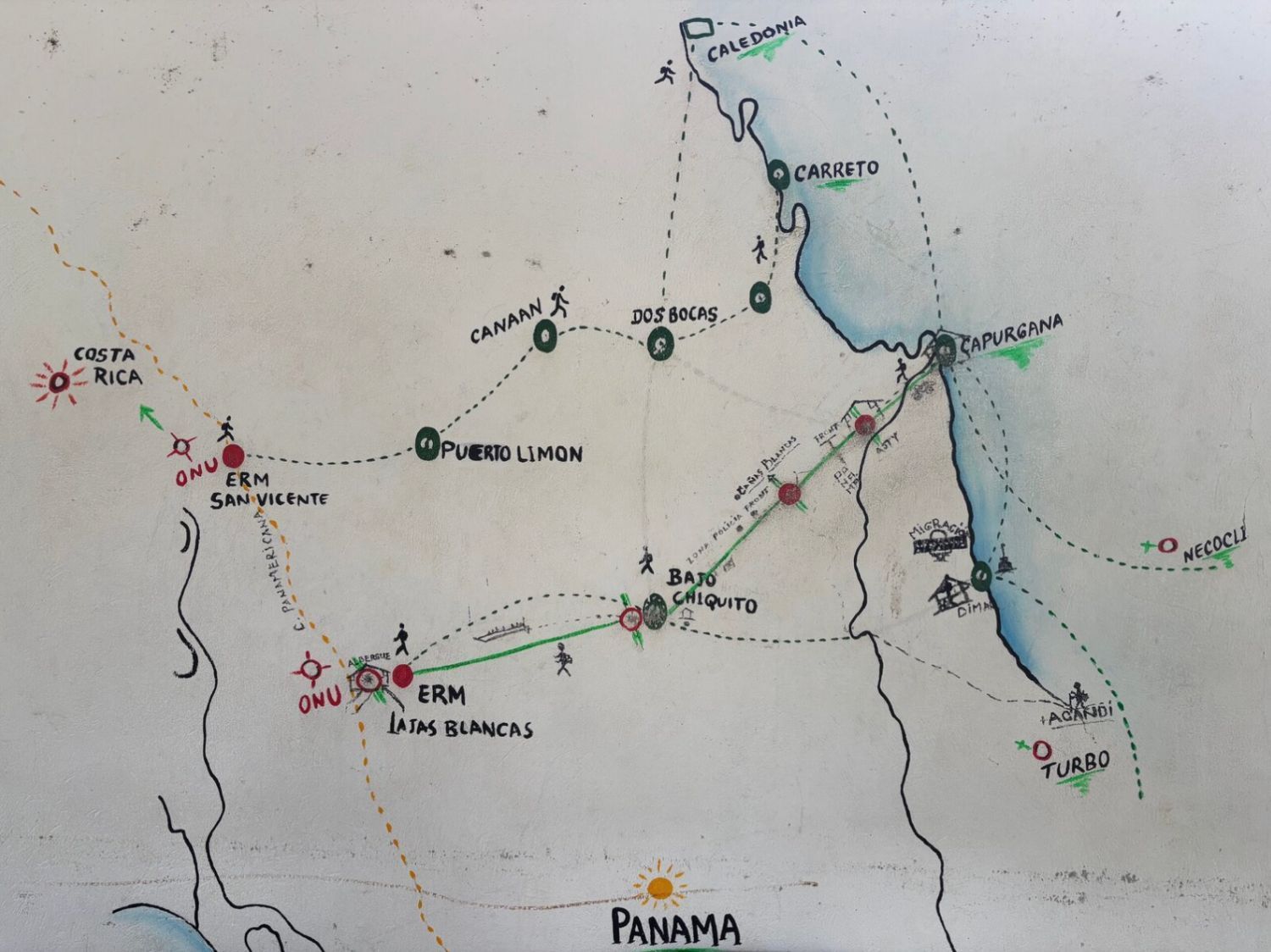
A map of migrant routes and services painted on the wall at a migrant hostel in Capurganá, on the Colombian side of the Darién jungle, July 19, 2025. The photo comes from "Echoes of Trump Across the Darién: Return Transits and Local Repercussions," a recent piece from our Spring 2026 Issue, now available open-access. Access the entire "Borders Can't Contain Us" web collection here. (Soledad Álvarez Velasco)
AROUND THE REGION
U.S. STRIKES—The U.S. military accelerated its campaign of strikes on alleged “drug boats” this week, conducting four attacks in the region over five days. On Wednesday, U.S. Southern Command announced it had carried out a "lethal kinetic strike” in the Eastern Pacific the day before, reportedly killing “four male narco-terrorists,” though it provided no evidence to substantiate the claim. The strike, the 51st in the administration’s illegal bombing campaign, brought the death toll to at least 174 people. It followed a Monday strike in the same area that killed two men, as well as two strikes on Saturday that killed five more. There have now been more strikes in the first half of April than during the entire month of March, all of them in the Eastern Pacific. Despite reports that the campaign has included “double-tap” strikes targeting survivors and the repatriation of victims who were later released due to lack of evidence, the operations have continued. So too has the land-based campaign in places like Ecuador, which have also been found to have targeted innocent civilians.
MEXICAN MIGRANT DEATHS—Alejandro Cabrera Clemente, a 49 year-old Mexican man, died Saturday while in ICE custody, marking the 47th such death of the second Trump administration and the 16th this year. While ICE released little information about Clemente, who was detained in Tennessee, medical care in ICE facilities has been consistently delayed or denied to detainees in need. Fifteen Mexican citizens are among those who have died in this recent surge, prompting a sharp rebuke from President Claudia Sheinbaum. While she had previously condemned the inhuman treatment of Mexican nationals in ICE detention—most notably at the facility known as “Alligator Alcatraz”—her remarks on Tuesday signaled an escalation. Sheinbaum vowed to “defend Mexicans at every level,” including by raising their treatment before the Inter-American Commission on Human Rights and potentially even the United Nations. She also instructed her consular representatives to visit U.S. detention centers daily and reiterated that her government would support lawsuits filed in U.S. courts by detainees protesting their conditions.
KAST’s REFORMS—During his first nationally televised address on Wednesday, Chile’s new far-right President José Antonio Kast outlined more than 40 reforms he argued would spur economic growth. The package is largely centered around a series of tax cuts—notably to the corporate tax rate, but also to property taxes, large investments, and donations—and also includes measures to accelerate environmental permitting for extractive projects as well as additional funding for fire-affected regions. While Kast has argued that making the country more tax-competitive will attract investment, economists have warned that the cuts could deepen Chile’s fiscal crisis and disproportionately benefit higher-income groups. Though members of the Kast administration have insisted that the package is essential to the government’s agenda, its passage may prove difficult: their right-wing allies hold fewer than half of the 155 seats in the lower house and only half of the Senate. For other parts of his agenda, Kast can act unilaterally, as he did on Thursday when his administration carried out its first deportation flight.
COLOMBIA’S DEFICIT—Colombia’s fiscal crisis is set to worsen after the Constitutional Court ordered President Gustavo Petro to return funds his administration had collected during an economic emergency that the court later ruled unconstitutional. In October of last year, Congress approved a 2026 spending budget whose funding was contingent on a package of tax reforms that were rejected in December, prompting the government to issue an emergency decree imposing a series of new taxes to raise revenue. On Tuesday, the court ruled that the nearly $7 million collected through those measures must be returned; Petro responded by saying there was “nothing to return.” The government’s precarious fiscal position has been further strained by tensions with far-right Ecuadorean President Daniel Noboa, who recently announced tariffs of up to 100 percent on Colombian goods. Ostensibly imposed to punish Petro for not doing enough to combat drug trafficking—despite record cocaine seizures—the tariffs have hit Colombia’s Petro-supporting south particularly hard. Petro, in turn, accused the Colombian right of conspiring to destabilize his government, noting that former conservative president Álvaro Uribe visited Ecuador days before the new tariffs.